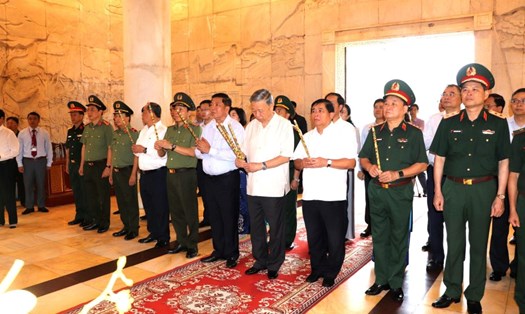
Historical milestone
84 years ago, on January 28, 2021, President Ho Chi Minh - then named Nguyen Ai Quoc - after 30 years of searching for a way to save the country chose Cao Bang as the first place to set foot when returning to the Fatherland.
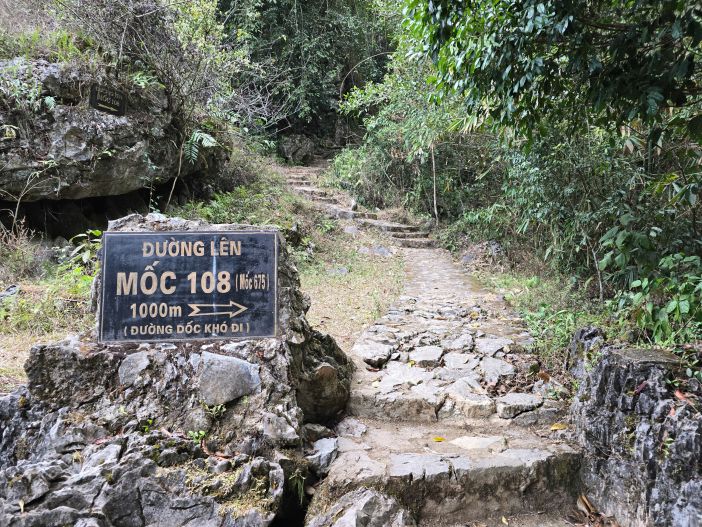
On the occasion of the 135th anniversary of President Ho Chi Minh's birth, the reporter had the opportunity to return to this sacred land. To reach the 108 milestone, must follow the stone mountain road, even though it has been paved to create a path. More than one kilometer of the forest road, it took more than 30 minutes to climb the mountain to reach the place where Uncle Ho returned to his motherland. The quiet space among the thousands of borders makes each step slow down, giving way to the tacitance and pondering about a sacred moment of the nation.
According to historical documents, the 108 milestone was erected from the end of the 19th century under the border dispensing treaty between France and the Qing Dynasty. This was one of 314 milestones built to determine the mainland border between Vietnam and China at that time. The original 108 milestone is a rectangular stone, about 1m high, about 80cm wide. Over time and rain and sunshine, the lines engraved on the rock were eroded, making the stone surface become smooth and ancient as its historical value.
Today, next to the old 108-mental mark is the national border mark No. 675 - which was solidly built in 2001 under the Vietnam - Central Vietnam Border Agreement in 1999. According to the agreement of the two countries, Landmark 108 is kept as a sacred historical relic, while Landmark 675 is placed about 5m away, marking the modern boundary between the two countries.
After returning home, Uncle Ho chose Pac Bo as his residence and activities for the Revolution. This place, with harsh terrain, steep mountains, deep grottos and cool streams, has become the base of the First Revolution of the Fatherland.
According to local people, the name "Coc Bo" in Nung language means "watershed". Coc Bo cave - where Uncle Ho chose to live and work as a cave deep in the mountain, discreet, difficult to be discovered. There are only a few temporary beds in the cave, a small heated fire, completely light thanks to the natural skylight. These extremely simple conditions did not falter his will, on the contrary, further enhancing the simplicity, determination and deep patriotism of the leader.
Historical people
Cao Bang is a mountainous province bordering the Northeast of the country, with a border with China of more than 333km, including both road and waterway. The terrain is rugged, the forests are mountainous, many remote areas are places that the French colonialists have difficulty controlling. From Cao Bang, it is easy to go to provinces such as Lang Son, Thai Nguyen, Ha Giang, Tuyen Quang, creating favorable conditions for the development of revolutionary forces.
Not only has favorable terrain, Cao Bang is also a gathering place for many ethnic groups that have lived together for a long time such as: Tay, Nung, Dao, Mong, Lo Lo, Hoa, Kinh... The ethnic groups here have a tradition of patriotism, solidarity, solidarity, following the Party, and steadfastly fighting against colonialism and feuding. The revolutionary movement in Cao Bang developed early and strongly, which was the basis for Uncle Ho to confidently choose to be the first place to set foot when returning.
In the first days after returning home, Uncle Ho stayed at Mr. Ly Quoc Sung's house - a small stilt house on the back of a mountain. This is a trusted revolutionary establishment in Pac Bo. However, to avoid causing trouble to the people and keep it a secret, Uncle Ho quickly left here to move to Coc Bo cave to live and work from February 8, 1941.
In the misty, narrow, and weak light in Coc Bo cave, during the day, Uncle Ho often goes to the upstream area - where there are a set of stone tables and chairs made from flat stone planks taken from high mountains. On that simple set of tables and chairs, next to the small banyan tree, great strategic plans for the Vietnamese revolution were pondered and drafted by Uncle Ho.
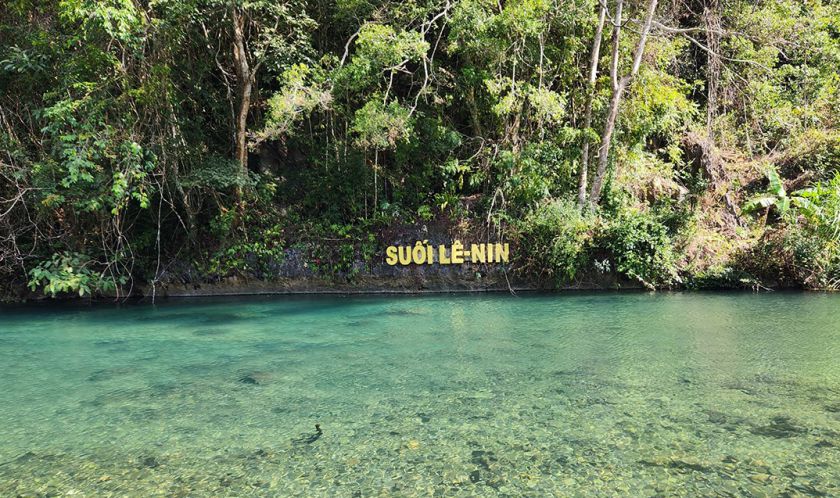
After working hours, Uncle Ho went fishing in the Le-nin stream - both to relax his mind and improve his silver-colored meals. Nearby is Cac-Mac Mountain, simple names given by Uncle Ho himself, expressing the spirit of the International Revolution and the respect for the great ideological teachers.
When life in Coc Bo cave was gradually stabilizing, there were signs of being exposed, so the comrades built a small hut for Uncle Ho on the stream, called Khuoi Nam hut - where he moved to live and work from the end of March 1941. This is also where he lived the longest of his time working at Pac Bo.
In Khuoi Nam shack, from 10 to 19.5.1941, Uncle presided over the Eighth Central Conference - an extremely important milestone in the history of the Party and the Vietnamese Revolution. The conference clearly defined the task of national liberation as the leading, establishing the Vietnam Independent Vietnam Front (Viet Minh Front), laying the foundation for the August 1945 uprising later.
During his time working in Pac Bo, Uncle Ho not only led the strategy but also regularly went to the village to meet, propagate, and educate the people. It was from those intimate and intimate conversations that the revolutionary flame was kindled and spread throughout the regions, fostering a national climate that boiled all over the country.
On May 4, 1945, Uncle Ho and his delegation left Pac Bo for Tan Trao (Tuyen Quang) to directly direct the National Revolutionary movement, preparing for the General Uprising to gain power, giving birth to the Democratic Republic of Vietnam - now the Socialist Republic of Vietnam.
A relic that lives forever
The special national relic site of Pac Bo currently still retains its simple, rustic appearance like when Uncle Ho lived and worked. The stone boards on the Le-nin stream, the stone table, the single bed, the small fire... are still carefully preserved, becoming a sacred testament to a difficult but glorious period of the Vietnamese Revolution.
Pac Bo is not only a place to mark the historical return of Uncle Ho, but also a place where events of great significance in the process of gaining national independence took place. This is the pride of the people of Cao Bang in particular and Vietnam in general. The complex of Pac Bo relics has become a "red address" in the journey to the source of many generations.
Today, visitors from all over the world when coming to Pac Bo are entire-heartedly admired and moved. Ms. Nguyen Thi Trang - a tourist from Hanoi, shared: Pac Bo is a place that preserves the sacred image of beloved Uncle Ho. When I came here, I could see with my own eyes the living and working conditions of Uncle Ho in the past, and I admired his spirit of sacrifice and greatness even more. This is where the younger generation needs to come to understand and continue the traditions of their ancestors.