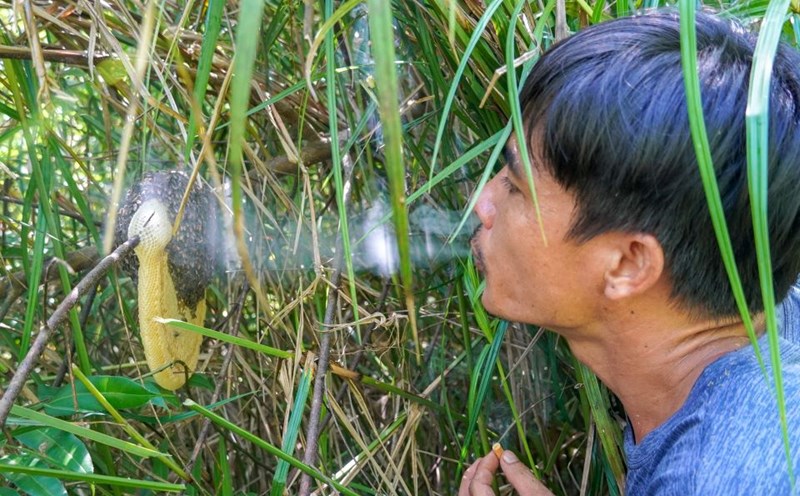
Following the trail of bees in the melaleuca forest
Early in the morning, the melaleuca forest next to Phu Loi sub-field (Ho Dac Kien commune, Can Tho city) was still filled with dew. The water surface of the canal was shimmering with silver. The motorboat slowly turned between dense melaleuca patches, leaving behind the sound of water gently hitting the side of the boat.
Standing at the bow of the boat, Mr. Huynh Thanh Phuong attentively watched the air above the melaleuca canopy, discovering a flock of bees flying low, circling around and then disappearing behind the dense foliage. Mr. Phuong signaled to turn off the engine. The boat slowed down, drifting along the water.
Bees flying like that, the nest is very close. If they fly straight, high, they go for food. If they fly up and down, around, the nest is somewhere else," Mr. Phuong affirmed.
No paper maps, no GPS devices. The guide for bee hunters like Mr. Phuong is the experience accumulated through many years of sticking to the forest: Flight direction, altitude, speed and even feeling. Each movement is carefully "read", because just guessing wrong, the whole group can spend hours crossing the forest.
The boat docks. The whole group wades into the forest. Under the feet is a layer of dry melaleuca leaves that have rotted, on the top is a tightly woven canopy, sunlight penetrates through each leaf crevice, spilling loosely onto the gray-silver melaleuca trunks. After clearing the bushes, determining that the nest is low, the whole group quickly put on rubber protective clothing to cover from head to toe. "Bees crawl very fiercely, being burned can cause shock, danger to life, so they have to wear protective clothing. But this item is very hot, like in a sauna," Mr. Phuong said.
The noise caused the bee colony to immediately rush out, flying straight towards the group. With quick and neat operations, in less than 5 minutes, the group had finished harvesting the beehive and retreated safely. When they were far from the dangerous area, they dared to take off their protective clothing, everyone's faces were covered in sweat.
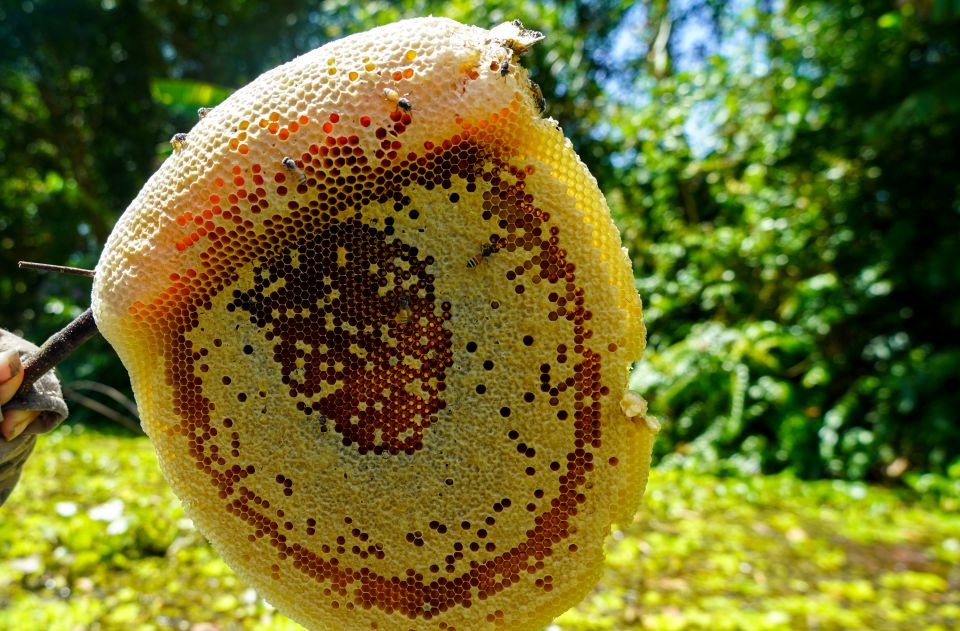
According to Mr. Phuong, the bee hunting season lasts from June to the end of December of the lunar calendar. On average, each day, the group harvests 4 - 7 nests, each nest weighing from 2 - 3kg, with large nests up to 5kg.
It's a bit of a bit of a bit of a bit of a bit of a bit.
Reading the forest for a living
For bee hunters, the forest is not only a place to make a living but also a space that must be "like the palm of a hand". They remember each shallow canal, deep according to the water season, each section of forest that poses a risk of fire when the sun is prolonged. "Do not use fire, do not use smoke with bees chiseling. This season, just a small spark is enough to burn the forest. Losing the forest is losing the profession," Mr. Phuong said.
Also thanks to "reading" the forest, they know that when cajeput flowers bloom and honey bees come, bee hunters become bee honey collectors. The "map" for the livelihoods of bee hunters is therefore not on paper. It is in each bee wing, each cajeput canopy, each flowering season.
Mr. Nguyen Chi Thanh, who has been attached to the forest honey harvesting profession for many years, said that from November to about the end of April, when the melaleuca forest enters the flowering season, this is the time when honey yields the best quality. "Bees usually nest on large trees, with horizontal branches, ventilated. Looking at the direction of bees flying, you can guess the nest location," Mr. Thanh shared.
According to Mr. Thanh, to get honey, workers use incense smoke to drive bees away. Beeflies are gentle, they fly when they encounter smoke, so they do not need much protection. For honey bees that are more aggressive, workers must wear gloves, long sleeves and cover their faces. The most important thing is to leave the nest part so that bees can continue to reproduce and maintain the honey source for a long time.
Bee colonies are built very quickly. After about 20 days, honey can be produced, but if you want high-quality honey, you have to wait more than 30 days. Understanding this rule will give you a stable honey season and sustainable exploitation," Mr. Phuong added.
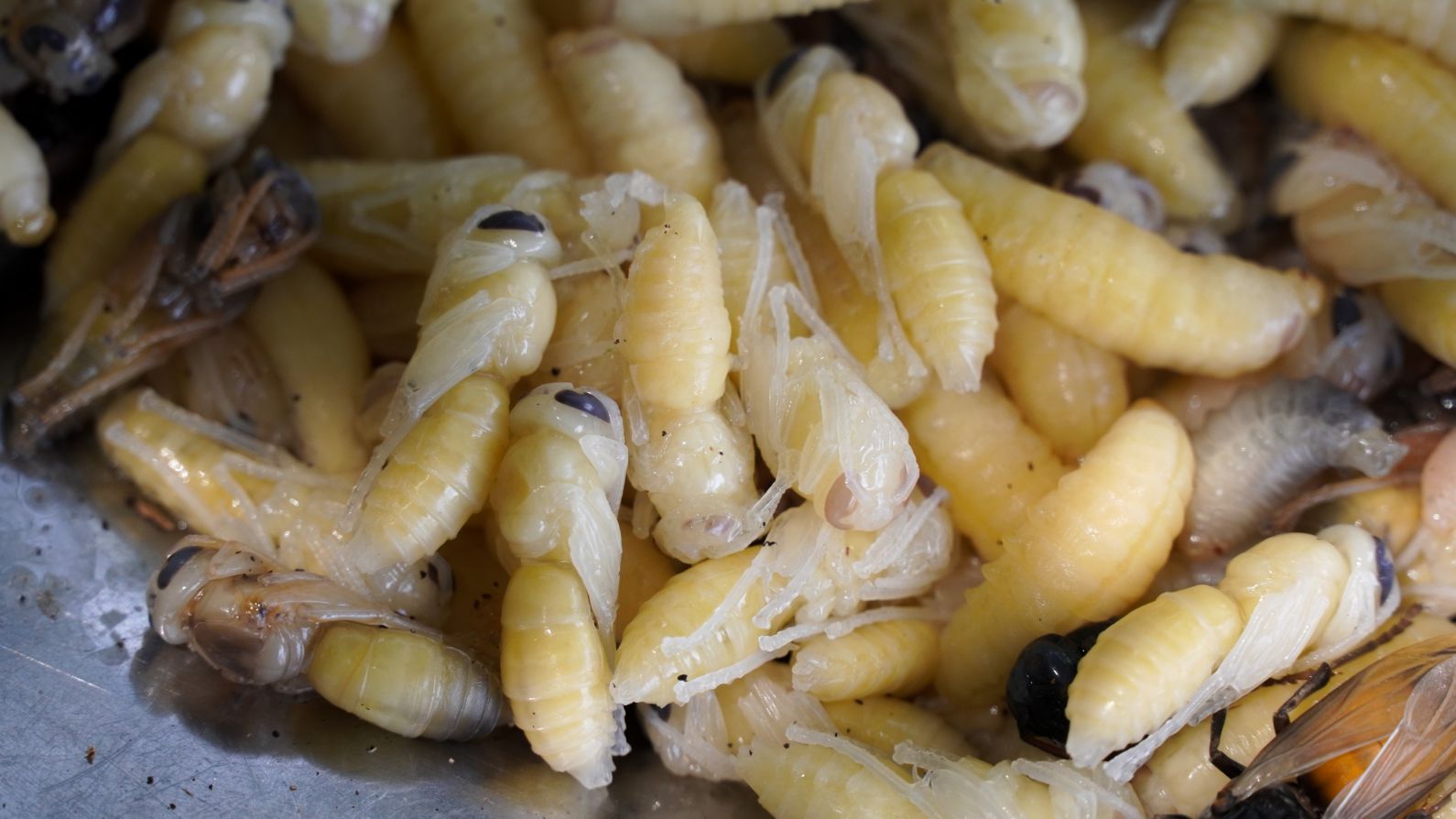
Honey after harvesting is hand-squeezed, filtered clean and then bottled. Wild cajeput honey is light yellow in color, lightly fragrant, and has a mild sweet taste. The selling price ranges from 500,000 - 650,000 VND/liter; especially more precious honey flies can be up to 1 million VND/liter. With bees, pupae splitters sell them as food, old bees used for wine soaking, priced at about 300,000 VND/kg, bringing a significant source of income for rural people.
Living by the forest must preserve the forest
According to Mr. Thanh, in the dry season, workers' groups always put fire prevention first. "Do not use fire in the forest. Living by the forest, you must preserve the forest. Forest fire means no bees, no profession," he said.
Not only is it a story of the forest worker's self-awareness, "taking bees but keeping the forest" is now also placed within the framework of official management. At Lung Ngoc Hoang Nature Reserve (Can Tho City), from 2023 to now, more than 50 households have been contracted for forest area to both carry bees and participate in forest protection.
Recently, Can Tho City People's Committee also allowed Lung Ngoc Hoang Nature Reserve to deploy contract exploitation of honey in the period 2026 - 2030, linked to exploitation with forest conservation. Accordingly, honey collection activities are only carried out in Administrative Service and Eco-Restoration sub-areas, strictly complying with regulations on forest fire prevention and fighting, absolutely not using fire, and at the same time issuing cards to households receiving contracts for strict management. This approach both creates legal livelihoods for people living along the forest and supports functional sectors in protecting forests, in accordance with the philosophy that long-time bee hunters still preserve: "As long as there is forest, there are bees, as long as there are bees, there will be livelihoods".
It's a bit of a bit of a bit of a bit of a bit of a bit.
It's a bit of a bit of a bit of a bit of a bit of a bit.
It's a bit of a bit of a bit of a bit of a bit of a bit.