
According to the Monitoring System of the Department of Environment (Ministry of Agriculture and Environment), at 7:00 a.m., at the Nhan Chinh - Khuat Duy Tien Park measuring station, the AQI was 131 (poor level). With this index, sensitive people may experience health problems, while normal people are less affected.
At the same time, the AQI index at the measuring station at the gate of Hanoi University of Science and Technology on Giai Phong Street was 216 ( purple threshold, very poor). This index warns that people are affected by more serious health problems. Yesterday morning (December 10), the AQI index at this measuring station was 211.
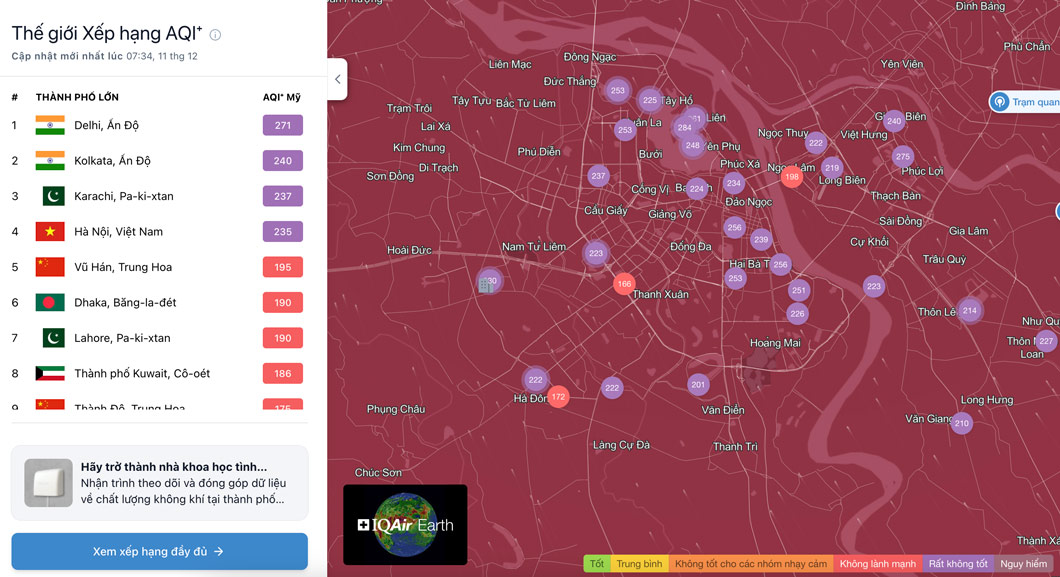
According to the IQAir Air Pollution Index Application, at 7:30 am this morning, Hanoi was the 4th most polluted city in the world with an AQI of 235. At the same time yesterday, IQAir ranked Hanoi as the 5th most polluted city in the world with an AQI of 225. The increase in the index shows that the level of air pollution continues to remain at a very high level.
Measurement points in Hanoi's inner city continue to have a high AQI air pollution index. In particular, at the Quang Khanh measuring point, the air quality at 7am was at a dangerous level with an AQI of 30,4 (dense). At 3-4am today, the AQI index at this point was 376.
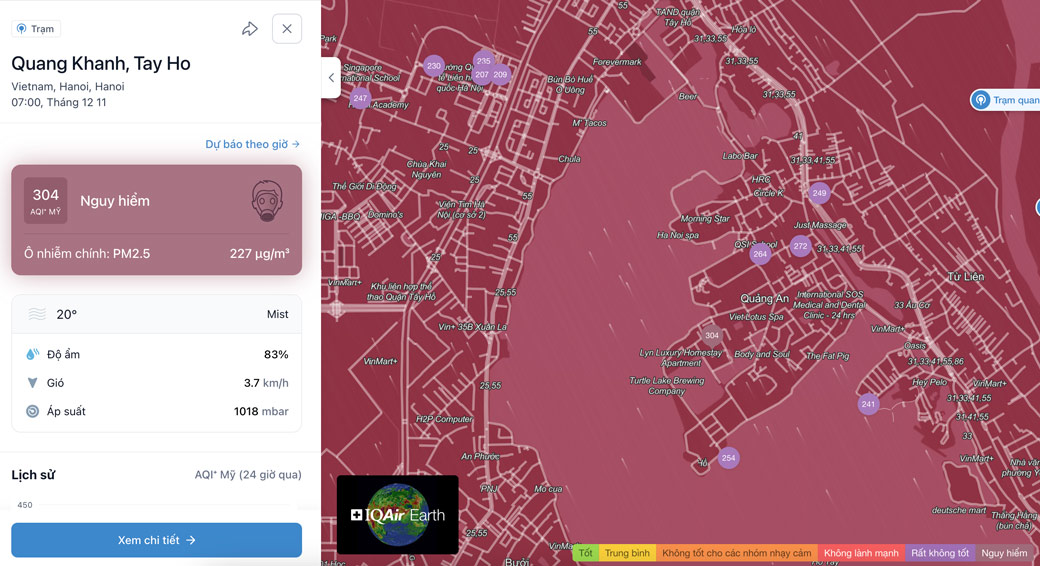
Other areas also have very high pollution index. At 7:00 a.m., IQAir Hanoi AQI Office is 249; Ciputra AQI 256; Foreign Trade Union AQI 253; Lo Duc AQI 256; Le Duan AQI 256...
To overcome the pollution situation, the Chairman of the Hanoi People's Committee requested the Department of Agriculture and Environment: Deploy emergency measures under the coordination of the Ministry of Agriculture and Environment for cases of seriously polluted air environment on inter-regional, inter-provincial, and cross-border levels.
The head of the City People's Committee advised on a mechanism for coordinating with provinces and cities in the region in controlling inter-regional and inter-provincial air pollution.
Immediately deploy inspections of all solid waste treatment areas; Request units to ensure continuous transportation, not allowing dust and odor to be released. Report weekly results in December 2025.
Monitor environmental sanitation packages according to decentralization to ensure quality of sanitation at key routes; require communes and wards to report monthly results. Direct environmental health units to increase fog spraying, dust, and water for road washing.


