
On the morning of December 11, with 431/433 National Assembly deputies present voting in favor (accounting for 91.12%), the National Assembly passed the Resolution on a number of special mechanisms and policies that create a breakthrough for the work of protecting, caring for and improving people's health.
Before the National Assembly deputies voted, Minister of Health Dao Hong Lan presented the Report on receiving and revising the draft resolution.
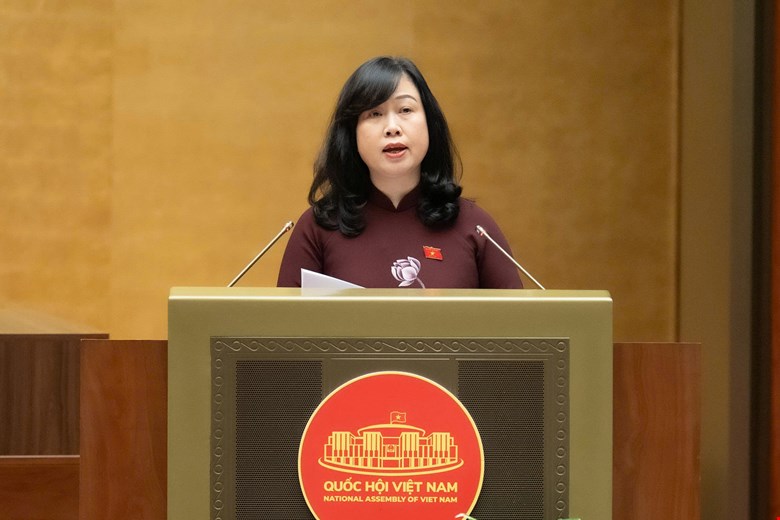
According to Minister Dao Hong Lan, based on the conclusion of the National Assembly Standing Committee, the review of the Committee for Culture and Society, and the opinions of National Assembly deputies, the draft resolution includes 3 policies: Group of policies on reducing health costs for people; Group of policies on salary and allowance regimes and policies for health sector employees; Group of policies on solutions for land, tax, and finance.
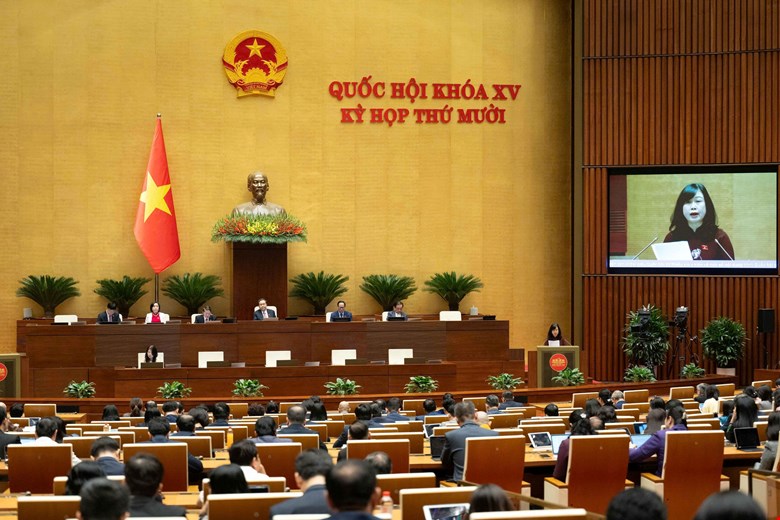
The draft has been studied, supplemented, absorbed and revised to the maximum the opinions of National Assembly deputies and has further specified a number of contents of Resolution 72.
Regarding the group of policies to reduce health costs for people, Minister Dao Hong Lan said that in addition to adjusting to ensure the consistency and synchronization of the legal system for regulations related to periodic health check-ups or free screening examinations, the draft Resolution has added regulations: Increase the rate of payment for health insurance examination and treatment costs for screening, diagnosis, and early treatment of a number of diseases and priority subjects such as the elderly aged 75 and over, receiving social pension benefits, social policy beneficiaries, vulnerable people, from the health insurance fund according to the roadmap in accordance with the socio-economic development conditions of the country and the balancing capacity of the state budget.
For the group of policies on salaries and allowances for health workers, Article 3 of the resolution stipulates that doctors, traditional medicine doctors, dental and maxillofacial doctors, preventive medicine doctors, and pharmacists are paid from level 2 when recruited into the corresponding professional title until there are new regulations on salaries.
People who regularly and directly practice medical expertise in the fields of psychiatry, forensic medicine, forensic psychiatry, emergency resuscitation, and pathology are entitled to preferential allowances at a rate of 100%.
People who regularly and directly work as health workers at commune-level health stations and preventive health facilities are entitled to 100% occupational allowances for ethnic minority and mountainous areas, areas with difficult socio-economic conditions, areas with especially difficult socio-economic conditions, border areas, and islands;
Minimum 70% for cases not covered by Point a of this Clause.
For the group of policies on land, tax, and finance, the draft Resolution has been supplemented with regulations on the form of attracting social resources in the health sector; regulations on allowing health facilities to decide on the level of allocation to establish additional income funds.
At the same time, the draft Resolution also mentioned adding 3 groups of policies, namely: Policy on safety for health workers at health facilities; Group of policies on recruitment in the health sector when recruiting people to work as civil servants at commune-level health stations to increase the attraction of human resources working in grassroots health; Group of policies on digital transformation, international cooperation in the health sector.
The Resolution takes effect from January 1, 2026, and the regulations on exemption from hospital fees at the basic level take effect from January 1, 2030.
Increase occupational allowances by at least 70%
Previously, the Politburo issued Resolution No. 72-NQ/TW with many breakthrough solutions in human resource development, ethics and especially treatment policies for medical staff.
Creating an attraction policy for health workers to feel secure in their long-term commitment and wholeheartedly occupying their work is extremely important, so it is necessary to have a treatment policy that is strong enough and practical for the team working in prevention and grassroots health care.
The new Resolution has identified preferential policies commensurate with the view that the medical profession is a special profession, which must be trained, used and given special treatment.
Doctors, preventive medicine doctors, and pharmacists are paid from level 2 of the recruited professional title.
Increase the vocational preferential allowance to a minimum of 70% for people who regularly and directly work in health at commune-level health stations and preventive health facilities.
Increase the vocational preferential allowance to 100% for people who regularly and directly work in health care at commune-level health stations, preventive medical facilities in ethnic minority and mountainous areas, areas with difficult socio-economic conditions, especially difficulties, border areas, islands, areas of psychology, forensic medicine, forensic psychiatry, emergency resuscitation, pathology and some other specific subjects suitable for socio-economic development conditions.


