
After about 4 months of experiencing dizziness, crooked mouth and weak limbs, a 7-year-old girl in Hai Phong was taken by her family for examination. The results of magnetic resonance imaging (MRI) at the Center for Diagnostic Imaging and International Interventional Optics, Phuong Dong General Hospital showed a tumor in the brainstem, consistent with a glioblastoma of the brainstem.
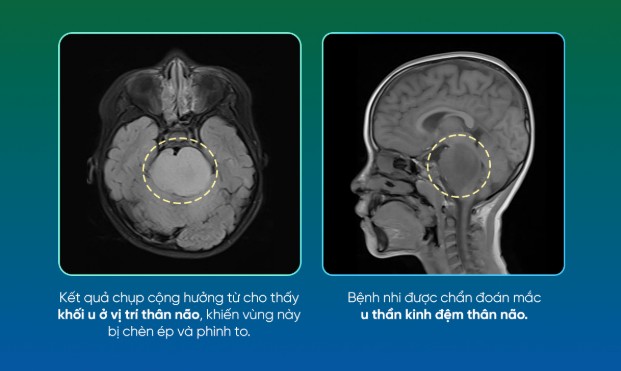
According to MSc.BSNT Tran Van Giang - Deputy Director of the Center for Diagnostic Imaging & International Interventional Electrosurgery, Phuong Dong General Hospital: The brainstem is the area located between the brain and the spinal cord, concentrating many important nerve structures. Here, there are cranial nerve nuclei governing optic motorization, facial muscle movement, swallowing and speaking; and there are motor pathways from the brain down to the spinal cord.

Therefore, when there is damage to the brainstem, children may simultaneously experience many neurological manifestations such as blurred vision or double vision, distorted mouth, weak limbs, unstable walking, difficulty speaking or difficulty swallowing. Symptoms depend on the location and extent of the damage.
Dr. Giang explained that tumors can still appear in children's brains due to abnormal gene changes, causing some glial cells or precursor neurons to proliferate uncontrollably. Therefore, it should not be assumed that young children are difficult to get brain tumors just because mature nerve cells are almost non-divided.
Some diffuse glioblastoma tumors are common in children around 5-10 years old. However, these are only characteristics of a certain group of tumors, not applicable to all glioblastoma tumors of the brainstem.
Doctors recommend that parents take their children to the doctor when neurological symptoms are prolonged, progressing, or appearing simultaneously. Signs to note include strabismus or prolonged double vision, distortion or weakness of one side of the face, weakness of limbs, loss of balance in walking, difficulty speaking, difficulty swallowing, prolonged headache or vomiting.
These manifestations can occur in many different diseases and are not synonymous with brain tumors. However, when symptoms persist or tend to gradually increase, children need to be examined to determine the cause and have appropriate treatment.


