
A form of exercise that is being concerned about is "exercise snacks", which can be understood as "exercise snacks". Exercising people take advantage of short periods of time in the day to perform simple, repetitive movements. This method is suitable for busy people who have little time to exercise.
Take advantage of lobbying between meetings
For people who regularly have to sit in meetings, a few minutes of exercise during breaks can help the body reduce fatigue and reduce muscle stiffness.
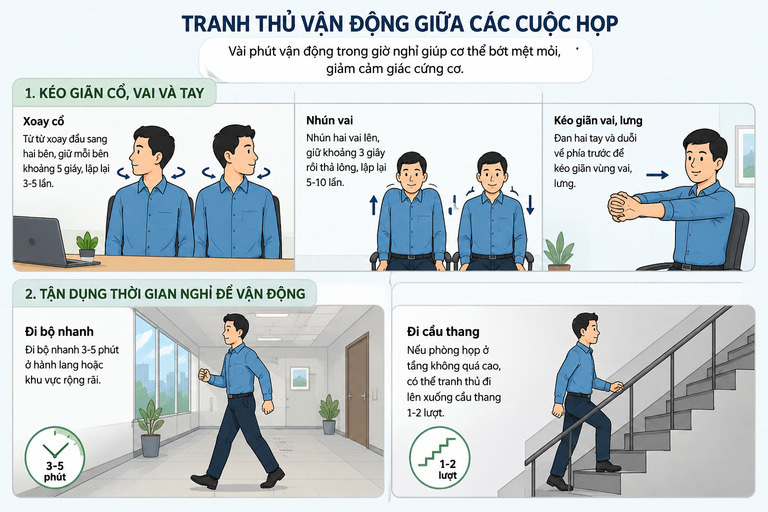
You can start with stretches of neck, shoulders and arms. Slowly rotate your head to both sides, holding each side for about 5 seconds, repeat 3-5 times.
To relax your shoulders, you can push your shoulders up, hold for about 3 seconds and then relax, repeat 5-10 times. In addition, weave your arms and stretch forward to stretch your shoulders and back.
During breaks, instead of staying seated, you can take a quick 3-5 minute walk in the hallway or a spacious area. If the meeting room is not too high, you can take advantage of going up and down the stairs 1-2 times.
Exercise for 5 minutes after each working hour
Office workers can perform some movements right at work.
With the tiptoe movement, stand with both feet shoulder-width apart, slowly lift your heels high, hold for 1 second and then lower. Perform 15-20 repetitions per set.
With the leg lift movement when sitting, sit at the edge of the chair, holding the chair with both hands to keep balance. Close both legs, lift up to parallel to the ground, hold for 3-5 seconds and then lower. Perform 10-12 times per set.
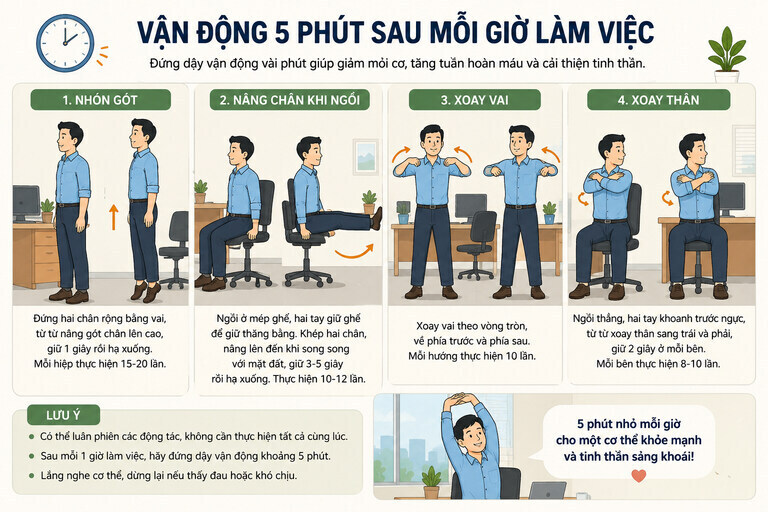
In addition, you can rotate your shoulders in circles or sit straight, slowly rotating your body to both sides. These movements help move the shoulder and back after a long time of sitting at work.
No need to perform all the movements at the same time, they can be rotated throughout the day. After each 1 hour of work, you should stand up and exercise for about 5 minutes.
Exercise snacks" do not replace regular exercise
People who are inactive should start with low-intensity, short-term exercises, then gradually increase the frequency and duration. When exercising in the office, pay attention to tables, chairs, equipment and obstacles around to avoid collisions and injuries.
After meals, you can walk lightly, but you should not immediately do strenuous exercises like dancing or squatting.
If symptoms such as dizziness, chest tightness, and palpitations appear during exercise, stop and rest. People with cardiovascular disease, osteoarthritis, or other chronic diseases should consult a specialist before choosing exercises.


