
Ho Chi Minh City proposes to soon issue a circular on emergency care outside hospitals
At the working session, BS.CKII Nguyen Duy Long, Director of Ho Chi Minh City 115 Emergency Center, said that after more than a decade of construction and development, the out-of-hospital emergency network of Ho Chi Minh City has expanded from the model of a hospital in charge of the whole city to 73 satellite emergency stations, covering the entire area after the merger.
According to Dr. Long, from 2015 to now, the number of calls to switchboard 115 has continuously increased. If in 2015 only about 87,000 calls were recorded, by 2025 this number has exceeded 400,000 calls, reflecting the increasing demand for out-of-hospital emergency care.
After the COVID-19 pandemic, the Ho Chi Minh City People's Committee issued a Project to develop an out-of-hospital emergency system in a professional direction. The 115 switchboard is the heart of the out-of-hospital emergency system. Not only receiving calls, the switchboard also provides first aid guidance via telephone, coordinates appropriate ambulances and connects with hospitals with specialized treatment expertise so that patients can access the right place and at the right time.
Dr. Long also proposed to soon complete the financial mechanism for out-of-hospital emergency activities, including health insurance policies to pay for pre-hospital emergency services; promulgate regulations on classifying emergency levels, standards for ambulances and equipment by type; and at the same time build a legal mechanism to protect people participating in first aid and allow the community to be trained and use automatic defibrillator (AED) machines in public places to improve the ability to save lives of patients with sudden cardiac arrest.
Agreeing with this view, Prof. Dr. Tang Chi Thuong - Director of Ho Chi Minh City Department of Health said that for the project to be effective, it is necessary to soon issue a complete legal corridor, especially a specialized circular on emergency care outside hospitals. Currently, many contents have been implemented by localities but still face difficulties due to the lack of specific legal regulations.
The Director of the Ho Chi Minh City Department of Health proposed that the Ministry of Health soon complete the regulations related to the ambulance system, in which it is necessary to clearly classify each type of vehicle such as specialized ambulances. Clear classification will create a basis for management, operation as well as building a suitable payment mechanism.
In addition, he proposed to clearly stipulate the role of emergency departments in the emergency network outside hospitals, instead of just being encouraged as before. According to him, this needs to be a mandatory requirement to ensure synchronous coordination between medical facilities in emergency work.
He also said that it is necessary to clearly distinguish between ambulances performing emergency rescue tasks and vehicles only performing the task of transporting patients, avoiding the situation of using horns and priority lights that are not in accordance with regulations. In many countries, ambulance drivers are also professionally trained rescue workers to effectively assist in the process of performing tasks.
The Ministry of Health will standardize ambulances and the price framework for out-of-hospital emergency services
Commenting on the above recommendations, Dr. Ha Anh Duc - Director of the Department of Medical Examination and Treatment Management (Ministry of Health) assessed that Ho Chi Minh City is a locality with a well-organized out-of-hospital emergency system. The models Ho Chi Minh City is implementing such as a multi-layered emergency network, in line with the orientation of the Out-of-Hospital Emergency System Development Project.
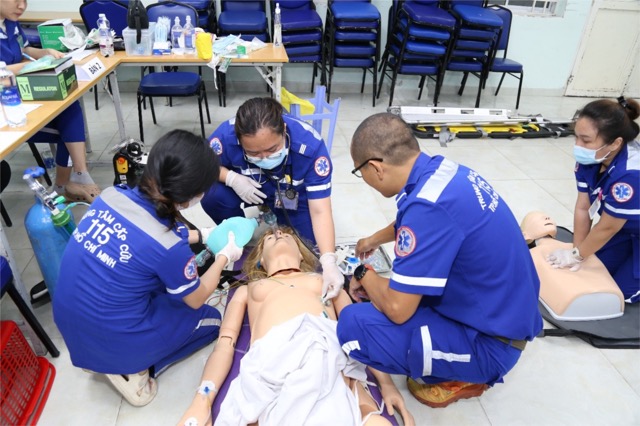
According to the Director of the Department of Medical Examination and Treatment Management, if the Project is approved by the Prime Minister in August, the whole country will form a unified emergency hotline system operated by the Ministry of Public Security. In 34 provinces and cities, emergency call receiving centers will be established, in which the health sector assigns personnel to be on duty at the hotline and be responsible for coordinating professional emergency activities.
Mr. Ha Anh Duc said that the Ministry of Health is developing a national standard for the out-of-hospital emergency system, which will clearly stipulate each type of ambulance, patient transport vehicle, specialized ambulance, including the two-wheeled ambulance model to suit the actual conditions in densely populated urban areas or difficult-to-reach areas.
Regarding the financial mechanism, the Ministry of Health will coordinate with Vietnam Social Security and related units to develop a price framework for out-of-hospital emergency services, separating patient transportation costs from professional emergency costs to ensure suitability for each type of service.


