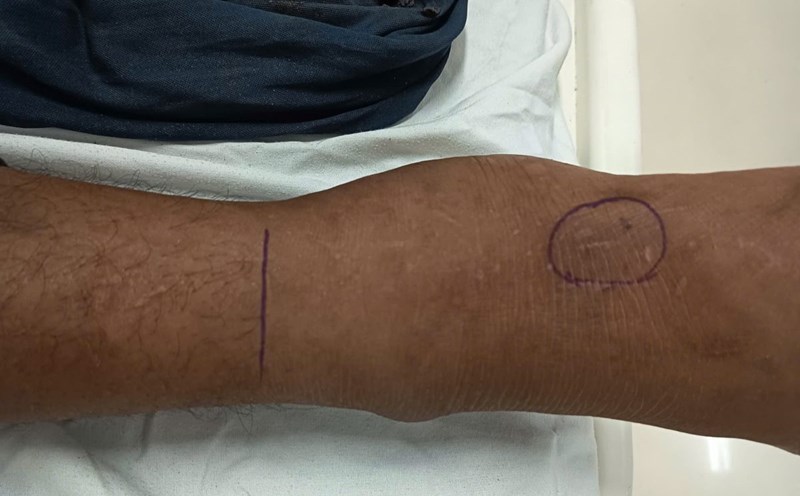
On December 16, information from Ninh Thuan General Hospital said that the unit had just successfully rescued a male patient who was bitten by a snake while cutting the grass.
The victim did not go to the medical facility immediately but arbitrarily applied leaves to the bite, making the poisoning serious and life-threatening.
Previously, patient N.Q.B.A (27 years old, residing in Phuoc Hau commune) was admitted to the hospital in a state of fatigue, scattered necrosis and severe blood clotting disorder.
Relatives said that Mr. A. was bitten by a snake on his finger while cutting the grass. After the accident, instead of going to the hospital, the victim applied leaves to the bite in the hope of reducing the poisoning. However, the bleeding wound could not be stopped, swelling spread quickly to the arms, appeared many blisters, necrosis and fever.
Only when the condition became critical did the family take Mr. A. to the hospital for emergency care.
Through examination, doctors from the Department of Nephrology and Urinology determined that the patient was poisoned by the Agency snake (also known as the amber snake), one of the most venomous snake species in Vietnam, distributed widely in the Ninh Thuan area.
The patient was given 4 bottles of special anti-zingorn snakelide serum. After 24 hours of active treatment, the bleeding was controlled, the necrotizing area did not continue to spread and the blood clotting index gradually recovered to normal.
A representative of Ninh Thuan General Hospital said that the hospital is currently capable of receiving and treating cases of venomous snake bites with specialized anti-parasite serum for each species. This is the only method that helps neutralize toxins, reduce the risk of death and limit severe sequelae.
Doctors also especially recommend that when bitten by a snake, people need to stay calm, limit movement, apply the Immunity Ban correctly and quickly take the victim to a medical facility.
Absolutely do not arbitrarily treat according to folk tips such as leaf covering, incising or suctioning, because these methods are not only ineffective but also cause infection wounds and necrosis to spread, making treatment difficult.