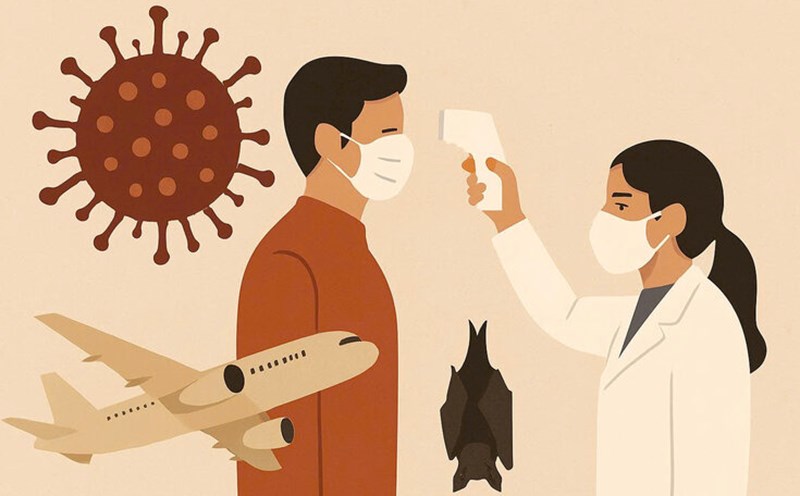
High mortality rate but difficult to spread widely
Before the information that the Nipah virus reappeared in India - a dangerous infectious disease with a high mortality rate - many people cannot help but worry about the possibility of intrusion and spread in Vietnam.
Assoc. Prof. Dr. Tran Dac Phu - former Director of the Department of Preventive Medicine (now the Department of Disease Prevention, Ministry of Health) - said that the risk of a major outbreak is low if preventive measures are strictly implemented.
According to Assoc. Prof. Dr. Tran Dac Phu, the Nipah virus is a dangerous infectious agent, first recorded in 1998 in Malaysia and then scattered in some South Asian and Southeast Asian countries, including India.
Epidemics caused by the Nipah virus usually do not record a large number of cases, but the condition is severe, the mortality rate is high, ranging from 40–75% in hospitalized cases" - Mr. Phu said.
People with the disease often start with symptoms such as fever, headache, muscle pain, then the disease can progress rapidly to respiratory failure, acute encephalitis and lead to death.
The Nipah virus is a disease transmitted from animals to humans. Fruit bats are identified as a natural reservoir of the virus. The virus can also be transmitted from person to person, especially during care and treatment if infection control is not ensured.
Some outbreaks in India have recorded medical staff being infected. This shows that the risk of transmission in hospitals is entirely possible if subjective" - Assoc. Prof. Dr. Tran Dac Phu emphasized.
Regarding the risk of transmission from pigs to humans, Assoc. Prof. Dr. Tran Dac Phu said that the Nipah virus once broke out in 1998 at pig farms in Malaysia and spread to Singapore, mainly due to direct contact with sick pigs. However, since then, Malaysia has not recorded a new outbreak, and later cases are mainly related to bats. People should not be panicked, especially during Tet, but need to ensure animal hygiene, slaughter and eat cooked food and drink boiled water to prevent the disease.
Risk of intrusion into Vietnam
Assessing the risk to Vietnam, Assoc. Prof. Dr. Tran Dac Phu said that it is necessary to look at it from two perspectives.
The first is the risk of external intrusion through people coming and going from countries with epidemics or countries that have recorded the Nipah virus circulating, not just India.
Second, Vietnam is located in South Asia - Southeast Asia, where there is a distribution of fruit bats - a natural reservoir of the virus. Although Vietnam has not yet recorded any cases, epidemiologically, it is still necessary to monitor the risk of viral circulation in animal populations, especially bats and possibly pigs - intermediate hosts that have been recorded in epidemiological history.
This is a disease transmitted from animals to humans, so monitoring work needs to be carried out simultaneously on both humans and animals. We are not subjective, but we should not be too worried," Mr. Phu affirmed.
Assoc. Prof. Dr. Tran Dac Phu said that if preventive measures are well implemented, the Nipah virus does not have the risk of a major outbreak in Vietnam.
To prevent the disease caused by the Nipah virus, Assoc. Prof. Dr. Tran Dac Phu recommends that people should limit going to epidemic areas if not really necessary. In case of going back and forth from epidemic areas, they should self-monitor their health within 14 days.
When symptoms such as fever, headache, muscle pain, vomiting, sore throat, dizziness, drowsiness or consciousness disorders appear, people need to go to a medical facility immediately for examination and testing, and at the same time limit contact with others and clearly notify their epidemiological history.
Even domestic patients, who do not have elements returning from the epidemic area but show suspicious signs, also need to be put under supervision," Mr. Phu noted.
In addition, people need to maintain common disease prevention measures such as eating cooked food, drinking boiled water; washing hands with soap; washing and peeling fruits before eating; not using food showing signs of being bitten by bats, birds or rodents; limiting contact with high-risk animals; ensuring hygiene in animal husbandry and slaughtering.