
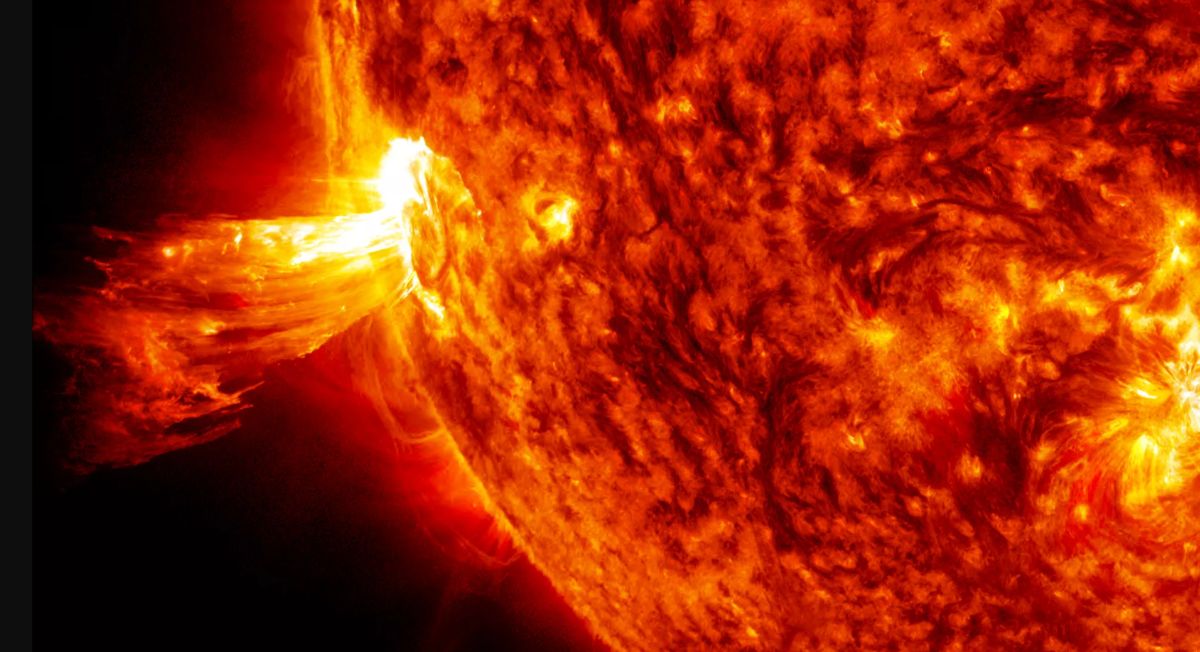
The National Oceanic and Atmospheric Administration (NOAA) space weather forecast center (SWPC) issued a strong, effective geophysical monitoring issued on December 9, after a climate change (CME) was observed and forecast to collide with the Earth.
CME is an explosion of matter and magnetism from the Sun; when it reaches Earth, it can cause ge terms. Images and simulations show the material mass moving straight towards Earth and is likely to arrive between morning and noon on December 9.
At level G3, geothermaples can impact some technological infrastructure and human health.
The dangers of magnetic storms are no longer a theory. The UK government has published The National Risk Register - a list of serious hazards that could affect the country at some point in the future.
In addition to risks such as nuclear incidents, terrorist attacks and epidemics, there is also a threat from cyclones.
Most of the response plan for geothermapic storms is based on the Carrington 1859 event - the most intense geothermapic storm on record.
As a result, the newspaper's employees were electrocuted, the high-voltage power poles issued electrical fires... These things have happened for a long time, but with today's advanced technology, the impact of a similar event will cause much greater disruption.
The satellite could be severely affected. Strong solar storms can cause the Earth's atmosphere to expand out into space, creating greater resistance for satellites. This could slow them down enough for some satellites to leave orbit and return to Earth.
Radio communication can be seriously affected when the GPS system is lost or interrupted for many days. Without GPS, the plane's safe operation would be affected - meaning air travel would also be severely affected.
Recently, on October 30, 2025, a Airbus A320 of Jet Blue Airlines flying between Cancun (Mexico) and Newark (USA) suddenly lost altitude, injuring a number of passengers.
Airbus' investigation found data in the steering wheel control computer was faulty due to solar radiation, causing incorrect commands for the steering wheel.
As a result, an Emergency Safety Directive (EAD) was issued, requiring more than 6,000 Airbus aircraft to update software or upgrade their computers before continuing operations. The EAD warned that in the worst case scenario, unexpected wing movements could exceed the aircraft's carrying capacity - a situation that could lead to disaster.
The power grid is another risk area. In March 1989, Canada's province of Quebec lost power due to a magnetic storm that left millions without power and heat for 9 hours.
For human health, storms can cause headaches; dizziness; fatigue and sleepiness; mood swings; reduced concentration; weakness and irritability; worsen chronic diseases.


