
Although assessed as weak La Nina, this climate pattern still left remarkable imprints in the early days of the new year.
According to the US National Oceanic and Atmospheric Administration (NOAA), January 2026 - the time immediately after the New Year - is the peak of the meteorological winter in the Northern Hemisphere.
NOAA's 2025-2026 winter forecast continues to emphasize the dominant role of La Nina, but notes that weak intensity makes extreme weather phenomena less likely to occur on a large scale.
NOAA forecasts that only a narrow strip in the northernmost part of the United States is likely to be colder than the average in January, concentrated in western Minnesota, most of North Dakota and northeastern Montana. Southeast Alaska is also forecast to have temperatures slightly lower than the multi-year average.
The remaining majority of US territory, especially almost the entire northern hemisphere, has an equal probability between a colder or warmer than average scenario.
In the opposite direction, about 1/3 of the US area - stretching from the Southwest, Rocky Mountains, Deep South, Southeast to part of the East Coast - tends to be warmer than usual.
Regarding rainfall, in typical La Nina seasons, the Northwest Pacific and the Five Lakes region often have more rain and snow.
With weak La Nina, NOAA believes that this trend still exists but not to a large extent. The weather pattern in January may alternate between rain, snow, blizzards and ice.
Notably, the NOAA's 3-month forecast shows the possibility of clearer cold spells in February or March in some northern states such as Washington, Montana, North and South Dakota, northern Idaho and the northern half of Minnesota.
In Vietnam, the New Year weather is also indirectly affected by the regional climate circulation.
According to the Vietnam National Center for Hydro-Meteorological Forecasting, around January 1, 2026, cold air will begin to affect the northern mountainous region.
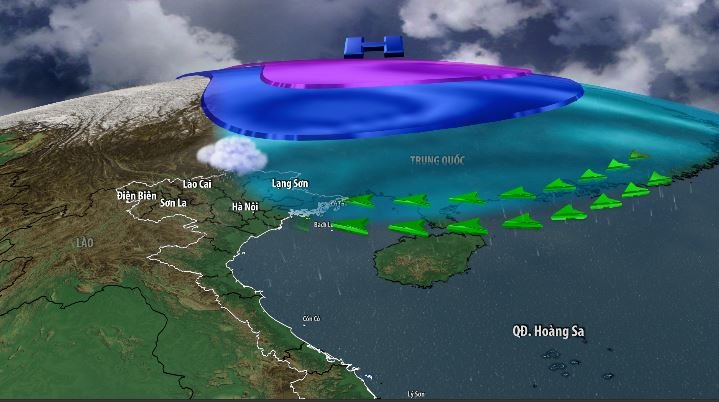
On the day and night of January 1, 2026, it will expand its influence to the areas of the Northeast region.
From January 2nd, cold air will expand to the Northwest, North Central and then deeply penetrate the Central Central region.
Forecast due to the influence of cold air, from about the night of January 1, 2026, the North and North Central regions will turn cold both day and night, especially the mountainous areas will have severe cold.
The lowest temperature in the plains is from 13-16 degrees C, the highest is 18-20 degrees C, the mountainous areas have lower temperatures. This may be a cold spell lasting for many days in the North and North Central regions.
Also due to the influence of cold air, on the night of January 1, 2026 and January 2, 2026, the North may experience scattered showers and thunderstorms, locally with moderate to heavy rain.
In general, under the influence of weak La Nina, the weather forecast for this New Year's Day is not too extreme, but there are still short-term cold air waves, especially in Northern Vietnam and high latitude areas in the Northern Hemisphere.


