
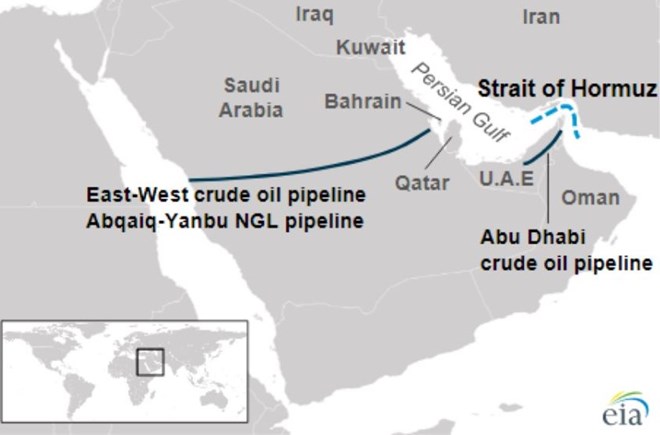
Just hours after US and Israeli airstrikes caused the Hormuz Strait to be almost blocked, Saudi Arabia - the world's largest crude oil exporter - immediately launched an unprecedented contingency plan: Activating a 1,200km East-West pipeline, running across the Arabian Peninsula.
Built in the 1980s, this pipeline connects huge oil fields in the east with Yanbu port on the Red Sea coast.
Instead of passing through Hormuz - the "throat" of global energy - Saudi oil is now pumped directly to the west for export.
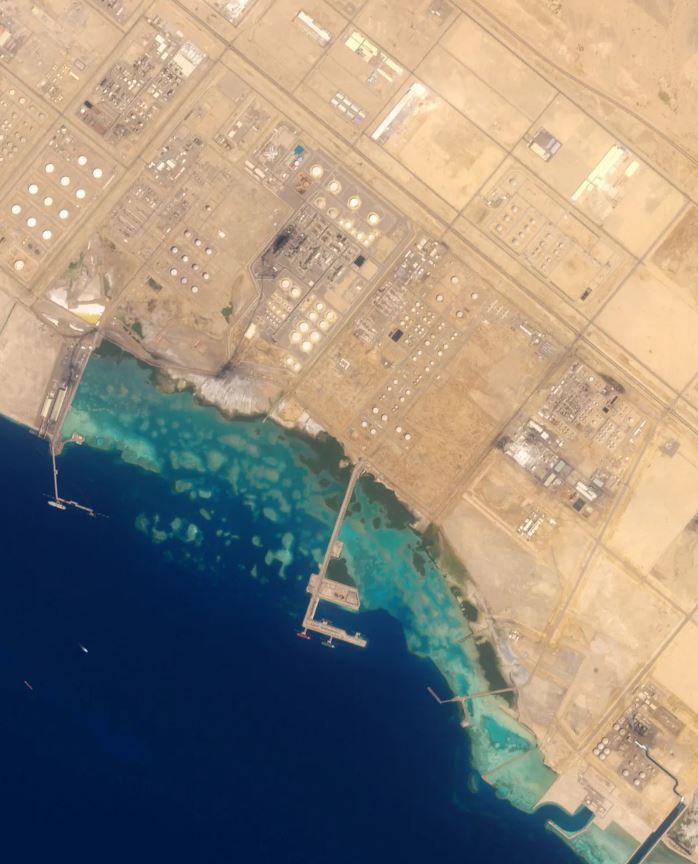
In Yanbu, a "floot" of oil tankers is pouring in every day. Transport data shows that oil exports from here have jumped to about 3.66 million barrels/day - equivalent to nearly half of the pre-war level. At one point, this port loaded and unloaded more than 4 million barrels/day, a multi-fold increase compared to before the crisis.
In the context of about 20 million barrels of oil/day - equivalent to 1/5 of global consumption - often passing through Hormuz, the disruption of this route has forced many countries to cut production. However, Saudi Arabia has its own "way out".
Experts assess that the East-West pipeline is becoming a "strategic move" to help reduce pressure on the market. The existence of this alternative shipping route contributes to reassuring buyers that not all Middle Eastern oil is stuck.
However, this solution is not entirely safe. Yanbu itself has also become a target of attack. An airstrike targeting the joint venture oil refinery here shows that the risk of escalating to energy infrastructure is completely real.
In fact, this pipeline system is not new to the current crisis. It is a product of the Iran-Iraq war in the 1980s, when Riyadh was concerned that the Ormuz line was threatened.
After many upgrades, the current capacity reaches about 5 million barrels/day, and can even be pushed up to 7 million barrels in emergency situations.
As soon as the war broke out, Saudi Arabian national oil and gas group Aramco quickly contacted customers, requesting to reroute ships to Yanbu. In just a few days, dozens of super ships changed routes. A large oil refinery in India also immediately purchased the first shipments from this route, showing that the alternative plan is beginning to be effective.
However, the price to pay is not small. To maintain oil flow, shipping lines have to spend up to 450,000 USD/day for each ship. At the same time, Saudi Arabia is also forced to cut production by up to 2.5 million barrels/day due to the eastern facilities being affected by the conflict.
Risks are not stopping there. Ships leaving Yanbu still have to pass through the Bab el-Mandeb Strait, another hotspot that has been attacked by Houthi forces for a long time. If this route continues to be threatened, the oil market may fall into even stronger volatility.
In the context that Brent oil prices have increased by more than 50% in just 3 weeks, to over 110 USD/barrel, the role of the East-West pipeline is becoming even more vital. Not just a temporary solution, it is reshaping how the Middle East responds to geopolitical shocks.
In the context of a global energy crisis spreading, Saudi Arabia's "forgotten pipeline" unexpectedly became a pillar in maintaining market stability - at least while Hormuz is still being squeezed.


