
On April 13, Iran warned that "no ports in the Persian Gulf and the Gulf of Oman are safe" if its ports are threatened, as the US prepares to impose maritime blockades around the Strait of Hormuz - a key energy transportation route in the world.
According to Iranian state media, the Islamic Revolutionary Guard Corps (IRGC) emphasized: "Maritime security in the region is either for everyone, or will not be for anyone". Tehran considers the US plan "illegal".
Previously, the US military announced that it would begin to implement a blockade of all ships entering and leaving Iranian ports from 10 am on April 13 (ET time), ie 9 pm on April 13 Vietnam time, after weekend talks in Pakistan failed to reach an agreement. This move is seen as a new escalation in the US-Iran conflict, which has been tense for a long time.
US President Donald Trump announced that the US Navy will block all ships involved in paying fees to Iran when passing through the Strait of Hormuz. According to Washington, Tehran is allowing some oil tankers to pass through this route and collect fees of up to 2 million USD per trip - an important financial source for the operations of the Iranian government and army.
The blockade, if fully implemented, could cut off this cash flow, while tightening economic pressure on Iran. However, this move also poses a risk of seriously disrupting the global energy supply chain.
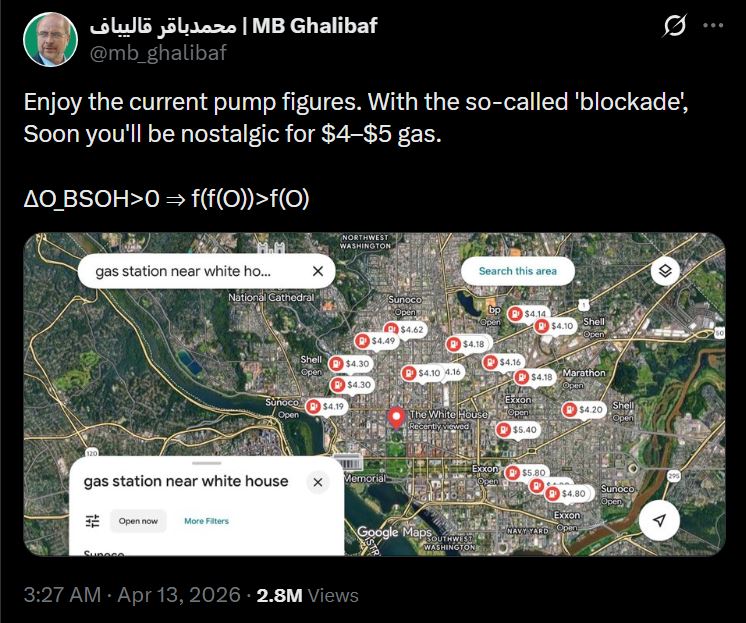
Reacting to the US warning, Iranian Parliament Speaker Mohammad Bagher Ghalibaf said the US would soon regret it, posting a picture of gasoline prices in the US, with the message: "Enjoy the current prices, because soon Americans will have to reminisce about the level of 4-5 USD/gallon". He also hinted that any increase in tension in Hormuz would lead to a exponential oil price shock.
In fact, the market reacted immediately. US WTI crude oil prices jumped more than 8%, to about 104.5 USD/barrel, while international Brent oil surpassed 102 USD/barrel. This is a rare time oil prices have returned to the 100 USD mark amid escalating geopolitics.
Not only the energy market, Asian stocks are also under pressure. South Korea's Kospi index at one point fell 2%, while Japan's Nikkei also slightly fell. Investors are worried that a prolonged conflict scenario will deeply affect global growth.
It is still unclear which countries will join the US in the blockade campaign. Britain said it is making efforts to build a "wide alliance", but has not pledged to participate directly. Australia also confirmed that it has not received a request for support.


