
President Donald Trump's unexpected statements about controlling the Strait of Hormuz and "oil gifts" from Iran are fueling international controversy. Meanwhile, the Middle East terrain continues to escalate with airstrikes, power outages and warnings of land warfare.
On March 29, US President Donald Trump suddenly announced that Iran had accepted "most" of Washington's demands and would begin shipping a "gift" of 20 oil tankers to the US tomorrow to "prove their seriousness".
The statement was made on Air Force One, amid tensions in the Middle East region showing no signs of cooling down.
According to Mr. Trump, the US has issued a list of 15 requests to end the conflict and Tehran "agrees with most points".
Why don't they agree? They are proving that they are serious," he said, while revealing that the amount of oil Iran has committed to transfer not only stopped at 10 ships as before but has increased to 20.
However, what is more controversial is Mr. Trump's statement that the US "has controlled" the Strait of Hormuz - the world's most important oil transportation route, which once accounted for 20% of global oil trade by sea. In an interview with Israeli media, he even called this place the "Trump Strait".
This statement immediately faced skepticism as there was no evidence that the US was actually in control of this strategic area.
Not stopping there, Mr. Trump also caused a shock when he publicly expressed his intention to "take Iran's oil" and left open the possibility of occupying Kharg Island - the country's key oil export center. "We can do it very easily," he said, while acknowledging that long-term control would not be simple.
At the same time, Mr. Trump affirmed that he is coordinating "closely and comprehensively" with Israeli Prime Minister Benjamin Netanyahu in negotiations related to Iran, while emphasizing strong support for Tel Aviv.
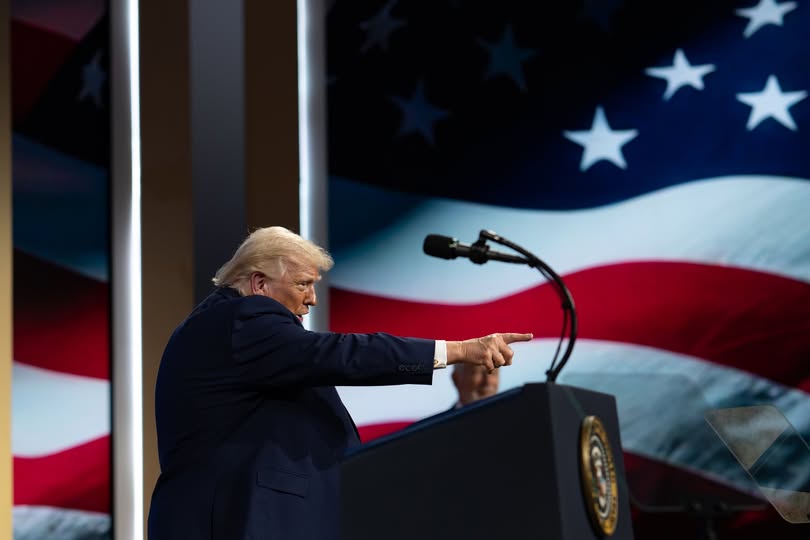
In the opposite direction, the actual situation shows a completely different picture. The capital Tehran fell into widespread power outages after a new wave of Israeli airstrikes. The Iranian Parliament accused the US of "deceiving public opinion" by both signaling negotiations and secretly preparing for a ground attack.
The Iranian Parliament Speaker warned that the country's forces are "waiting for US soldiers to set foot on the ground to deliver a devastating blow.
Tensions escalated as a US naval ship carrying about 3,500 soldiers entered the area, while the Pentagon is said to be considering deploying more special forces.
However, the White House has not officially approved any landing operations.
In another notable development, Iran announced that it has "effectively blockaded" the Strait of Hormuz against hostile ships, pushing the risk of disruption to global energy supplies to a new high.
Mr. Trump's repeated, imposing statements are causing observers to question: Is this a strategic step to force Iran to concede, or just a psychological blow in an increasingly unpredictable geopolitical game in the Middle East?


