
According to the latest weather news updated on July 31 (Manila time), super typhoon Dolphin still maintains Category 5 intensity according to the classification scale of the US Joint Typhoon Warning Center (JTWC), marking 42 consecutive hours at the strongest super typhoon level.
The Japan Meteorological Agency (JMA) updated that the wind of Typhoon Dolphin is maintained at about 205km/h and the central pressure is 910hPa (on an average of 10 minutes).
Meanwhile, the JTWC recorded winds maintained for one minute reaching 260km/h, with a central pressure of about 915hPa, equivalent to a category 5 super typhoon.
Experts say Dolphin has accumulated more than 22 cyclone energy units (ACE), reflecting the huge amount of energy that the storm generates throughout its life cycle. The ACE index is calculated based on the maximum sustained wind speed of the storm in a 6-hour cycle and is often used to assess the strength and duration of a tropical cyclone.
Microsatellite data from the GPM GMI satellite shows that Dolphin may be about to enter the storm eye (ERC) replacement cycle for the third time. This is the process of the old storm eye gradually being replaced by a new storm eye ring outside, which may cause the storm intensity to temporarily fluctuate before strengthening again.
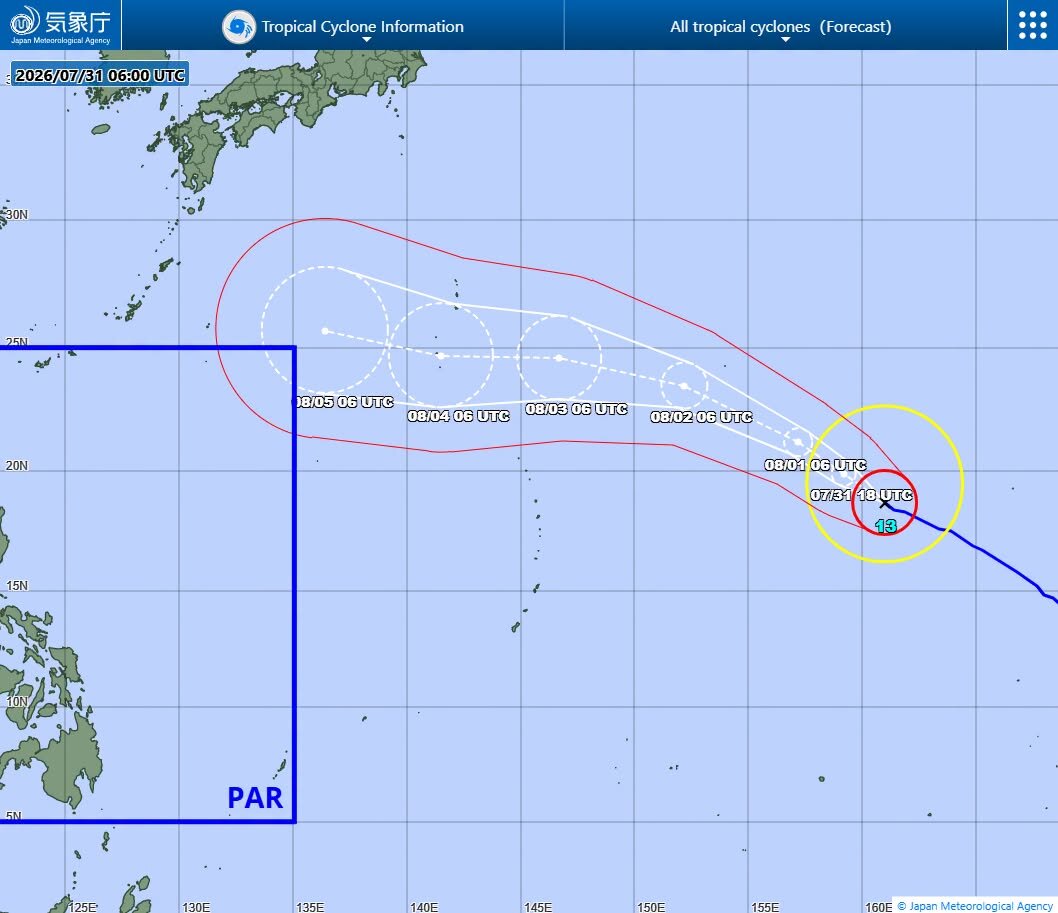
In terms of orbit, Dolphin is forecast to continue moving northwest in the next 72 hours under the impact of subtropical high pressure in the northeast.
From August 2nd, when a new subtropical high pressure area forms on the Korean peninsula becoming the main navigation system, the storm is forecast to gradually move westward, advancing towards the Ryukyu Islands of Japan until around August 5th.
Meteorological agencies recommend that people in Taiwan (China), the Ryukyu Islands of Japan and coastal provinces in eastern China continue to closely monitor reports about super typhoon Dolphin.
Meanwhile, the Philippine Atmospheric Administration (PAGASA) also warned that the super typhoon could increase the intensity of the southwest monsoon (Habagat), leading to heavy rain in many areas of the country.


