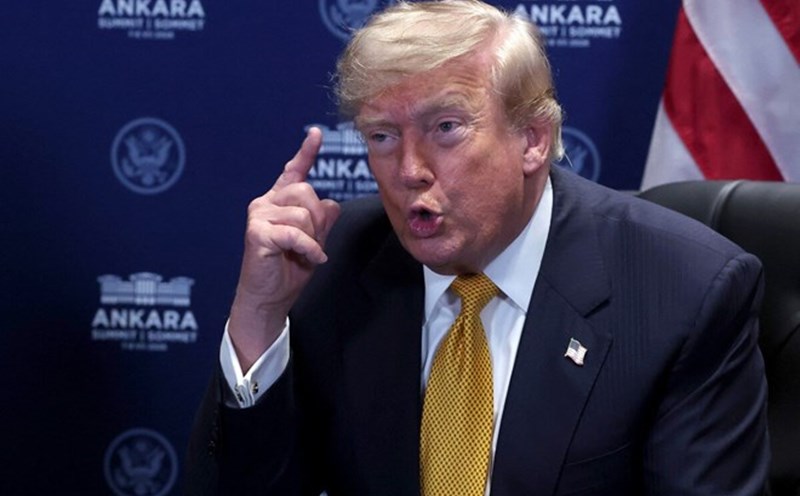
On July 8 (Washington time), according to Xinhua, US President Donald Trump said that he could not yet determine whether a full-scale military conflict between the US and Iran would recur, but affirmed that Washington would quickly win if this scenario occurred.
Speaking to reporters on Air Force One after the end of the NATO Summit in Turkey, Mr. Trump was asked if the US was returning to a large-scale military confrontation with Iran.
I don't know," Mr. Trump replied.
However, the US leader emphasized that if a full-scale conflict actually breaks out, the US will quickly gain the upper hand.
If that happens, we will win very quickly," Trump said.
The statement was made in the context that relations between Washington and Tehran continue to have many complex developments after prolonged military tensions in recent times.
According to published information, the US and Israel launched a military campaign against Iran from February 28.
After months of fighting, in June, the US and Iran signed a memorandum of understanding, in which the two sides agreed to establish an immediate ceasefire on all fronts, including Lebanon.
This agreement was once expected to contribute to de-escalating tensions in the Middle East and create conditions for the parties to seek diplomatic solutions.
However, less than a month later, the situation showed signs of escalation again.
On July 8, US President Donald Trump accused Iran of violating its commitments in the bilateral agreement.
He also declared the ceasefire between the US and Iran "no longer in effect", raising concerns about the risk of conflict breaking out again.
To date, Iran has not issued an official response to the latest statement of the US President.
Observers believe that Mr. Trump's refusal to confirm the possibility of resuming the war, while emphasizing Washington's military advantage, reflects the US's tough stance in relations with Iran.
These statements were also made in the context that the international community continues to closely monitor developments in the Middle East, as any escalation between the US and Iran could affect regional security as well as the global energy market.