
The Japan Meteorological Agency (JMA) said on the morning of December 12 that a 6.7 term richter earthquake occurred east of the East Sea of Japan, causing the JMA to issue a Tsunami warning. There were no immediate records of damage or casualties.
According to the German Geological Research Center (GFZ), the earthquake occurred near Hachinohe, Hachinohe Shi city, Aomori province.
The earthquake occurred at an average depth of about 37km below the center of the impact, at around 12:34 local time.
A second report released by the French National Seismic Monitoring Network (ReNaSS) later assessed the earthquake as 6.5 degrees. Meanwhile, the RaspberryShake citizen earthquake network recorded the same earthquake with a magnitude of 6.7 degrees.
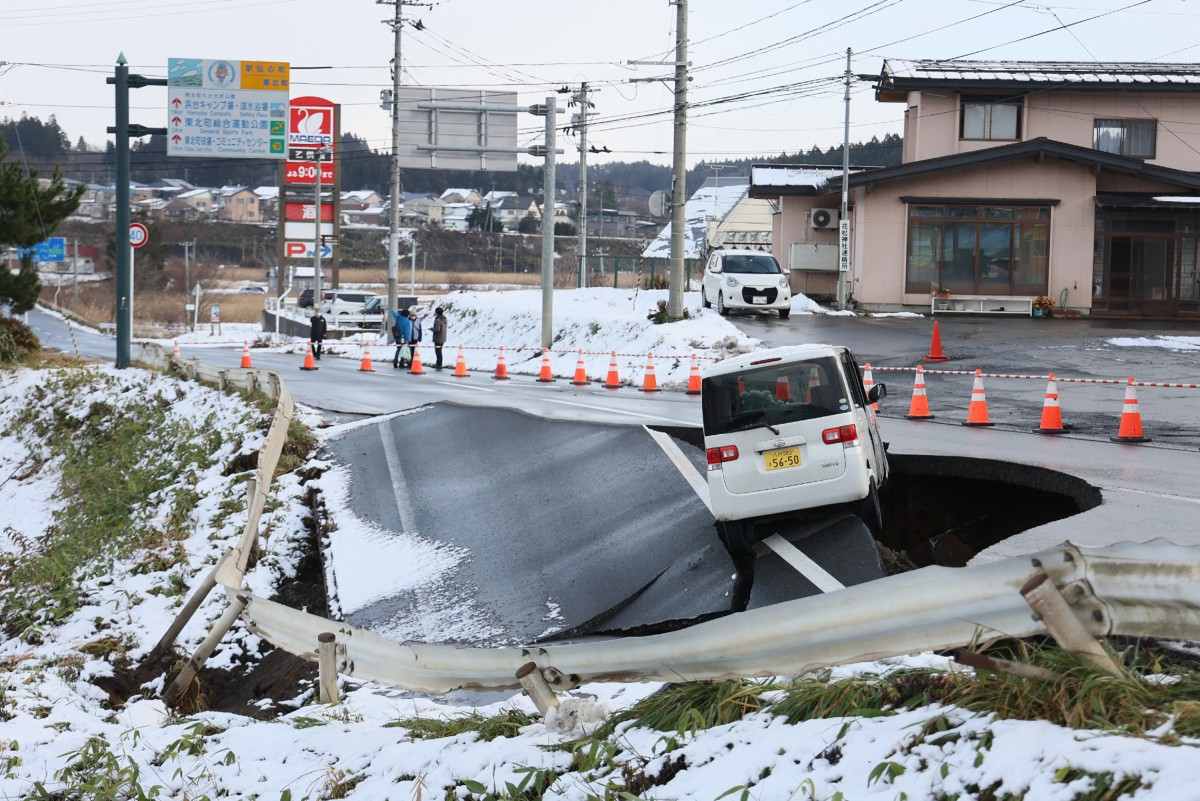
Based on initial data, the earthquake was likely clearly felt by people in the shocking area, but did not cause serious damage, except for fallen furniture from shelves, broken glass doors and some other minor damage.
The latest earthquake occurred just days after a 7.5 degree richter earthquake on the night of December 8 off the coast of Aomori province, the northernmost tip of Honshu Island, caused minor sunslides in coastal communities in the Pacific Ocean, injuring at least 34 people and causing minor damage to several structures.
Notably, during the earthquake in Japan on the night of December 8, many witnesses said they saw blue light splashing through the night sky, shining brightly for a few seconds before disappearing. This phenomenon was immediately associated with the Earthquake Lights (EQL), one of the biggest mysteries of seismic science.
According to the US Geological Services Administration (USGS), seismic light can appear as thin lightning, light bulbs, light bands or stable reflection, occurring before or during strong earthquakes. However, this agency emphasized that science has not yet had a definitive answer.
Geophysicists divide it into two viewpoints.
The skeptical group believes that the light could just be an incident from an electrical line or transformer that explodes when the ground shakes.
The group believes that some light phenomena are actually caused by tectonic pressure underground.
A 2014 study by the American Earthquake Association analyzed 65 cases of certified EQL, ranging from 3.6 to 9.2 earthquakes. The results showed that 80% of earthquakes with accompanying lights were stronger than 5 degrees.
Most of them appear in the continental drift zone, where vertical faults create conditions for electricity to flow due to deep bottom pressure transmitted directly to the surface.
Stones such as bazalt and gabbro contain crystal defects that can create dien tichum when subjected to extreme compression, thereby glowing when ionizing the air.
lightning often appears before or during cracks, reinforcing the hypothesis that EQL is involved in the buildup and release of tear immediately before a strong earthquake.
Japan, a country on the Pacific Ring Road, continues to be vigilant as the aftershocks and risk of natural disasters have not yet ended after a series of strong earthquakes this week.


