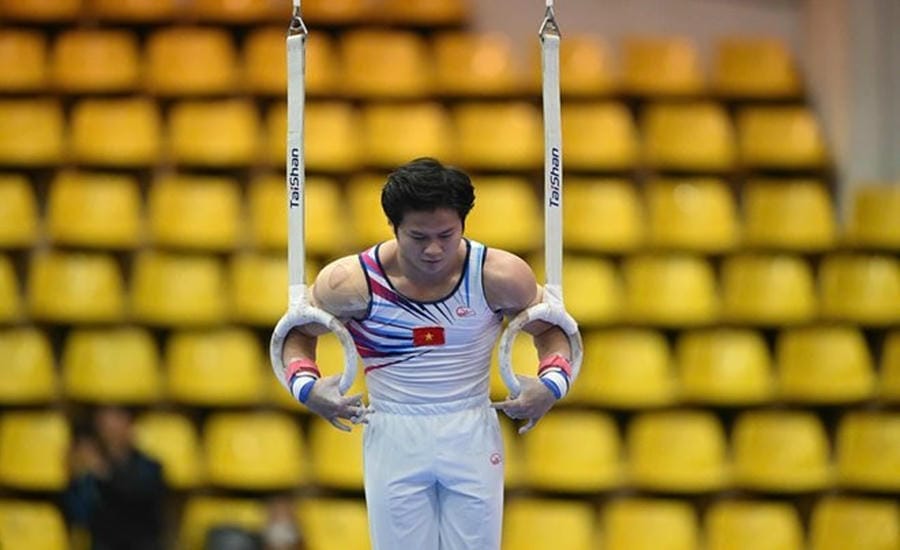
Big stars participate
The attraction of ASIAD 20 comes from the fact that many faces who made their mark at the Paris 2024 Olympics continue to compete in the continental arena.
Host Japan owns a squad of athletes with high achievements. In gymnastics, Daiki Hashimoto won the men's All-Around Gold Medal at the 2020 Tokyo Olympics and together with the Japanese Team won the men's Team Gold Medal in Paris 2024. In swimming, Rikako Ikee is a special name when she won 6 Gold Medals at ASIAD 2018. After a period of leukemia treatment, she returned to competition and continued to participate in the Olympics.
In badminton, South Korea has An Se Young - a player currently holding the world No. 1 position. The athlete born in 2002 was a 2024 Paris Olympic champion, won a World Gold Medal in 2023 and continues to be a leading candidate for the women's singles championship at ASIAD 20.
Meanwhile, Carlos Yulo is the Philippines' top hope in gymnastics. At the Paris Olympics, the athlete born in 2000 won 2 Gold Medals in the backstroke and crossbar events, becoming the first Filipino athlete to win 2 Gold Medals in the same Olympics. Yulo also won the world championship and is expected to continue to bring home medals for the Philippines at Aichi-Nagoya.
The Chinese sports delegation brought a very strong force, in which Wang Chuqin is one of the most notable stars. The world No. 1 tennis player once won the Gold Medal in men's team and mixed doubles in table tennis at the Paris Olympics. At ASIAD 20, Wang Chuqin registered to compete in men's singles, men's team and mixed doubles with Sun Yingsha.
Not only outstanding individuals, China also participated in ASIAD with a composition of 815 athletes, including 36 Olympic champions. Names such as: Sun Yingsha, Wang Manyu, Chen Yuxi, Wang Zongyuan, Zou Jingyuan, Sun Mengya or Li Wenwen create a very large depth for the number one sports delegation in Asia.
Vietnamese sports face a fierce medal race
If China aims to maintain the No. 1 position, Japan, South Korea and many other strong sports delegations will create great pressure in each sport.
Japan has home advantage along with leading athletes in gymnastics, swimming, judo and many Olympic sports. Meanwhile, South Korea continues to place expectations on badminton, archery, taekwondo and martial arts.
In Southeast Asia, Thailand sets a target of 14 Gold Medals, significantly higher than Vietnam's target of 4 Gold Medals or more. Sepak Takraw and teqball are the two sports that Thailand expects the most, with a total of 7 Gold Medals. These are also events in which Vietnam can create direct competition.
Indonesia only sets a target of 4 Gold Medals. Compared to 7 Gold Medals at ASIAD 2022, Indonesia's target is reduced because 3 events that once won medals no longer appear in this program. Mountain climbing and weightlifting are identified as the two sports that bring home Indonesia's main Gold Medals.
For Vietnam, the goal of 4 or more Gold Medals is built on sports with real competitiveness instead of chasing quantity. Shooting, sepak takraw and karate continue to be expected sports after winning Gold Medals at ASIAD 19. In addition, sports such as rowing, taekwondo, athletics, gymnastics and some martial arts contents can create more opportunities.
Vietnam does not have a high-class and Olympic-level athlete force like: China, Japan or South Korea. Therefore, the ability to complete the target depends heavily on whether the main athletes reach their peak performance and take advantage of their forte events.
ASIAD 20 is also taking place in the context that the level of Asian countries is narrowing the gap. Therefore, there is a basis to believe that Vietnamese sports will complete the initial targets set.