
Domestic pepper prices: Sideways
As of 1 pm today (May 14), domestic pepper prices continued to remain unchanged, averaging 143.100 VND/kg. Currently, key areas are trading in the range of 141.500 - 144,000 VND/kg.
Domestic pepper prices have maintained stability for 2 consecutive days after a slight increase, currently the listed prices in regions are as follows:
Gia Lai province trades at the milestone of 141. 500 VND/kg.
Dong Nai and Binh Phuoc after an increase of 500 VND/kg, listed at a price of 143,000 VND/kg.
Meanwhile, Dak Lak and Lam Dong continued to remain unchanged, successively offering for sale at the highest purchase price of 144,000 VND/kg.
Compared to the same period last month, the current pepper price is 3,600 VND/kg higher, when the price is only at 139,500 VND/kg.
World pepper prices: STABLE after a volatile day
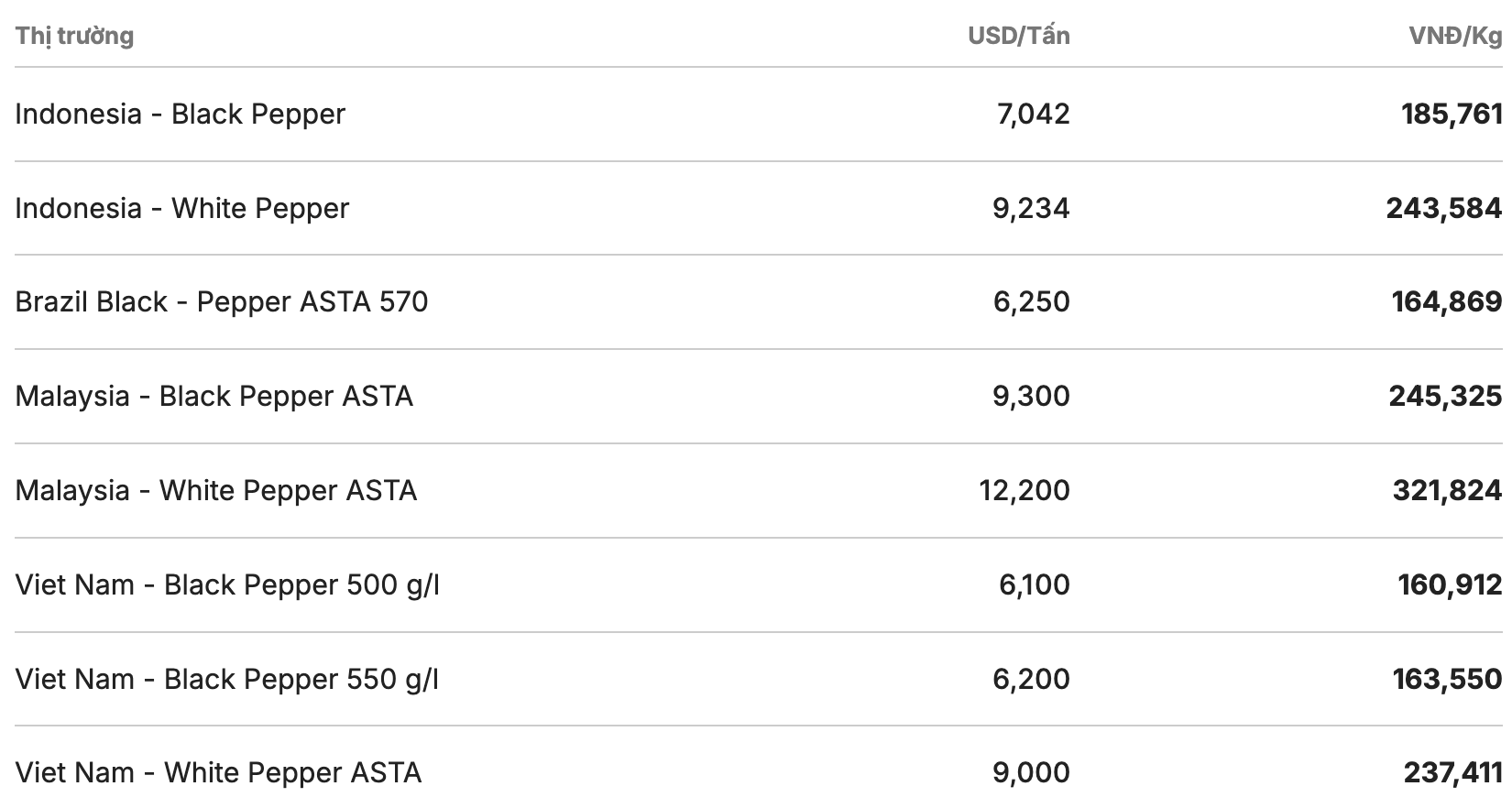
In the world market, pepper prices are mostly stable in countries. The two items of black and white pepper in Indonesia are unchanged, trading in the range of 7,042 - 9,234 USD/ton (equivalent to 185,761 VND/kg - 243,584 VND/kg).
The Brazilian market maintained an increase of 100 USD/ton, listed at 6,250 USD/ton (about 164,869 VND/kg). Meanwhile, black and white peppers remained unchanged, trading at 12,200 USD/ton and 9,300 USD/ton.
In Vietnam's pepper export market, the price of black pepper of 500 g/l and 550 g/l remains at 6,100 - 6,200 USD/ton. In the same direction, ASTA white pepper is offered for sale at 9,000 USD/ton (equivalent to 237,411 VND/kg).
Assessments and forecasts
Pepper farmers reduced sales to the market along with continuous buying demand from Europe, the US and China, which supported high price levels. Buyers are increasingly shifting to planned and forward purchase strategies, especially in the context of upcoming changes in European Union regulations.
The impact of weather and crop conversion by farmers has caused Vietnam's 2026 pepper production to be forecast to decrease by about 15-20% compared to the previous crop, reaching only 170,000-180,000 tons. Supply is increasingly tightened even though Vietnam still plays the role of the main supply source.


