
Domestic pepper prices
As of 1:30 PM today (September 23), domestic pepper prices slightly decreased by 100 VND/kg, down to 137,300 VND/kg. Currently, the listed price range is in the range of 136,000 - 140,000 VND/kg.
At the end of the recent transaction, Gia Lai and Dong Nai both anchored at the threshold of 136,000 VND/kg.
Similarly, Ho Chi Minh City kept the price unchanged at 136,500 VND/kg.
Dak Lak area is set at 138,000 VND/kg.
In Lam Dong, pepper prices are currently at the highest level in the whole region at 140,000 VND/kg.
World pepper price
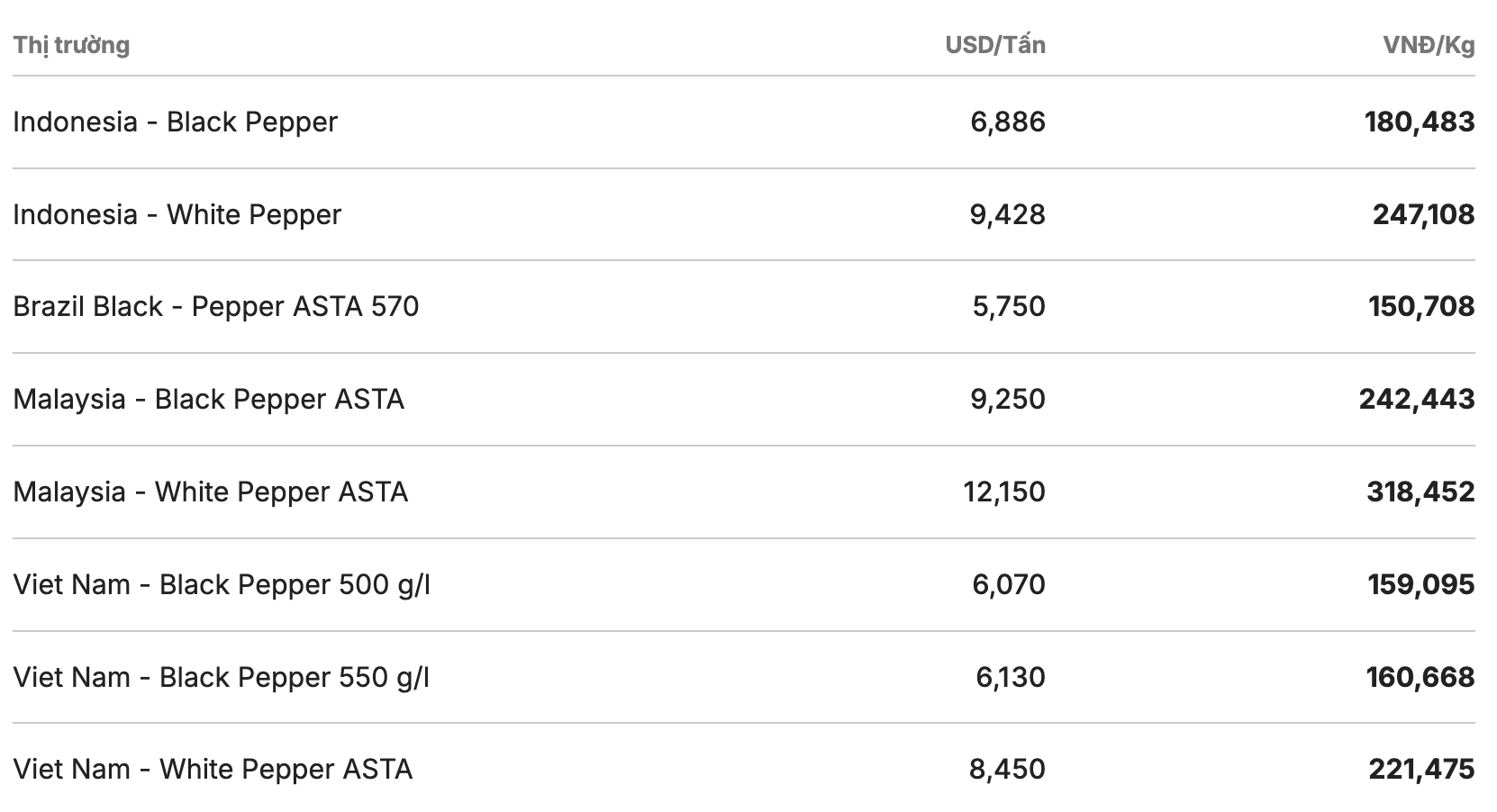
In the world market, pepper prices remain unchanged in all countries. Indonesia's black and white peppers are traded in the range of 6,886 - 9,428 USD/ton (equivalent to 180,483 VND/kg - 247,108 VND/kg).
Similarly, the price of Brazilian black pepper still sold to the market is 5,750 USD/ton (about 150,708 VND/kg). Black and white Malaysian peppers are advertised for sale at 12,150 USD/ton and 9,250 USD/ton respectively.
In Vietnam's pepper export market, black pepper prices of 500 g/l and 550 g/l continue to trade at 6,070 - 6,130 USD/ton. ASTA white pepper price offered for sale at 8,450 USD/ton (equivalent to 221,475 VND/kg).
Assessments and forecasts
According to data from the Vietnam Customs Department, from the beginning of the year to September 15, 2026, Vietnam's pepper exports reached 202,414 tons, worth 1.32 billion USD, an increase of 15.2% in volume and 10.3% in value respectively compared to the same period last year.
The rate of increase in volume is higher than the rate of increase in value because the average export price decreased by 4.2%, reaching 6,503 USD/ton.
According to the Vietnam Pepper and Spice Plant Association (VPSA), global pepper production in 2026 is forecast to continue to be lower than the forecasts at the beginning of the year because production in Vietnam, Indonesia and India all decreased due to the impact of unfavorable weather and reduced yields. Although Brazil recorded an increase in production, this increase is still not enough to compensate for the shortage from key producing countries.


