
Domestic pepper prices
As of 11:30 AM today (July 2), domestic pepper prices continued to decrease slightly, listed at 134,200 VND/kg. Currently, key areas are trading in the range of 134,000 - 135,000 VND/kg.
Domestic pepper prices after a sudden sharp decrease, provinces and cities are almost unchanged, except for Dak Lak province. This area decreased by another 2,000 VND/kg compared to the previous trading session, anchored at the mark of 135,000 VND/kg.
Gia Lai province and Ho Chi Minh City traded at the threshold of 14,000 VND/kg.
In the same direction, Dong Nai put it on the market at a price of 133,000 VND/kg. This is the lowest price in the region.
Lam Dong offers for sale at a purchase price of 135,000 VND/kg.
World pepper price
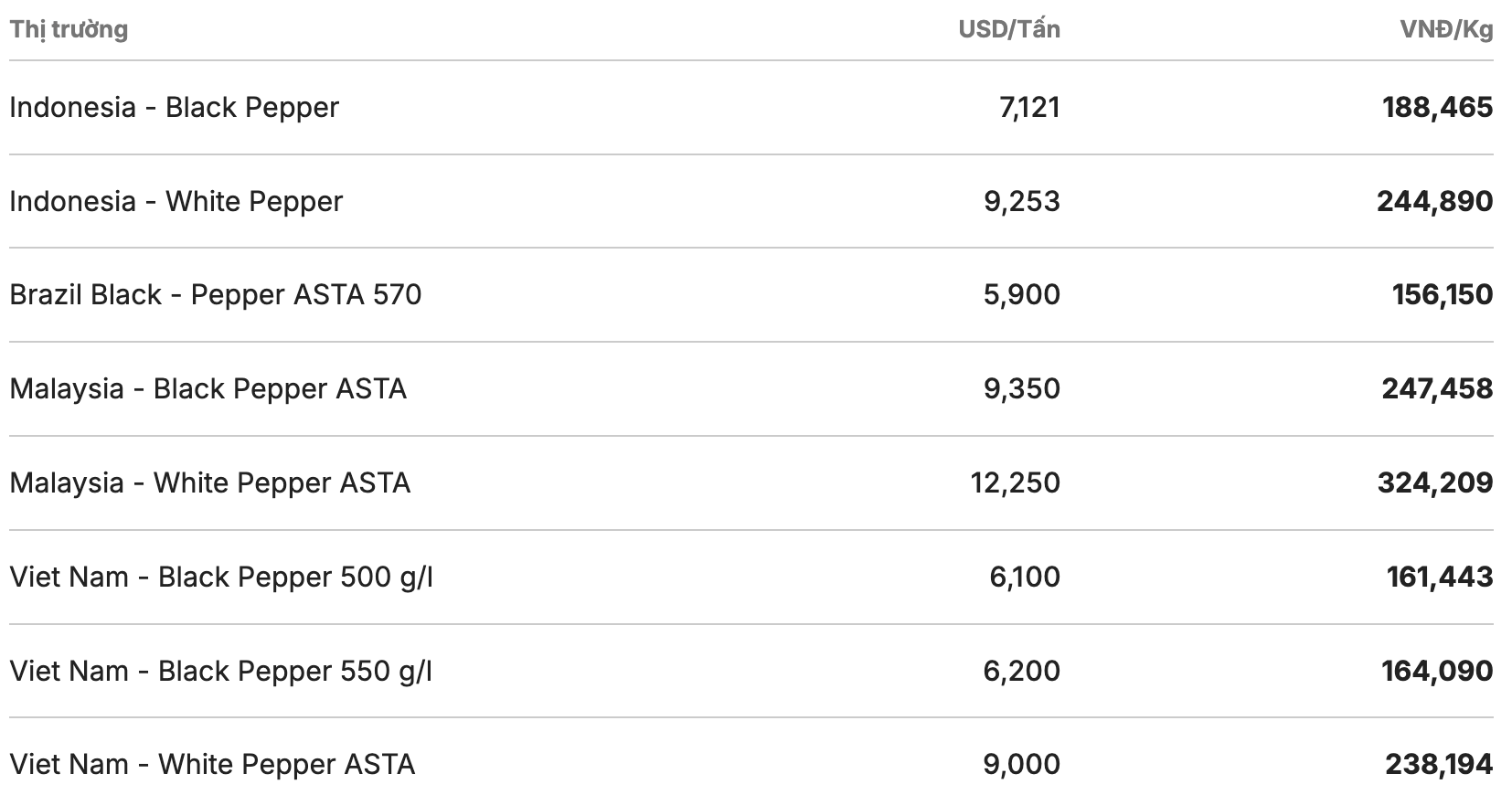
In the world market, pepper prices maintained a sideways trend in all countries. The two items of black and white pepper in Indonesia are no exception, trading in the range of 7, 121 - 9, 252 USD/ton (equivalent to 188,465 VND/kg - 244,890 VND/kg).
Meanwhile, the price of black pepper in Brazil sold to the market is 5,900 USD/ton (about 156.150 VND/kg). Notably, black and white pepper in Malaysia are still trading at high prices, respectively 12,250 USD/ton and 9,350 USD/ton.
In Vietnam's pepper export market, the price of black pepper of 500 g/l and 550 g/l remains at 6,100 - 6,200 USD/ton. In the same direction, ASTA white pepper is offered for sale at 9,000 USD/ton (equivalent to 238,194 VND/kg).
Assessments and forecasts
According to data from the European Statistical Agency (Eurostat), the average import price of pepper from Vietnam into the EU in the first 3 months of the year was at 7,576 USD/ton, lower than the EU average (8,471 USD/ton), showing that Vietnamese pepper still maintains a price competitive advantage, but at the same time also reflects the potential to increase added value through deep processing and developing high-quality product lines is still quite large.
Compared to the same period in 2025, Vietnam's market share decreased from 40.3% of the EU's total pepper imports to 34.0%, showing increasing competitive pressure from other sources of supply, and also reflecting that pepper consumption demand in the EU has not fully recovered.
In the coming time, the advantage of stable supply, processing capacity and tariff preferences from the Vietnam - EU Free Trade Agreement (EVFTA) will continue to be an important factor helping Vietnamese pepper maintain its leading position in this market.


