
Domestic pepper prices: Keeping the price range unchanged
As of 1:30 PM today (May 29), domestic pepper prices remain stable, averaging 139,400 VND/kg. Currently, key areas are trading in the range of 137,000 - 142,000 VND/kg.
Domestic pepper prices have remained unchanged for 5 consecutive days, currently the listed prices in regions are as follows:
Gia Lai province traded at the threshold of 137,000 VND/kg.
Dong Nai and Ho Chi Minh City are listed at prices of 137,000 VND/kg and 139,000 VND/kg respectively.
Meanwhile, Dak Lak and Lam Dong remained unchanged, offering for sale at the highest purchase price of 142,000 VND/kg.
World pepper prices: STABLE
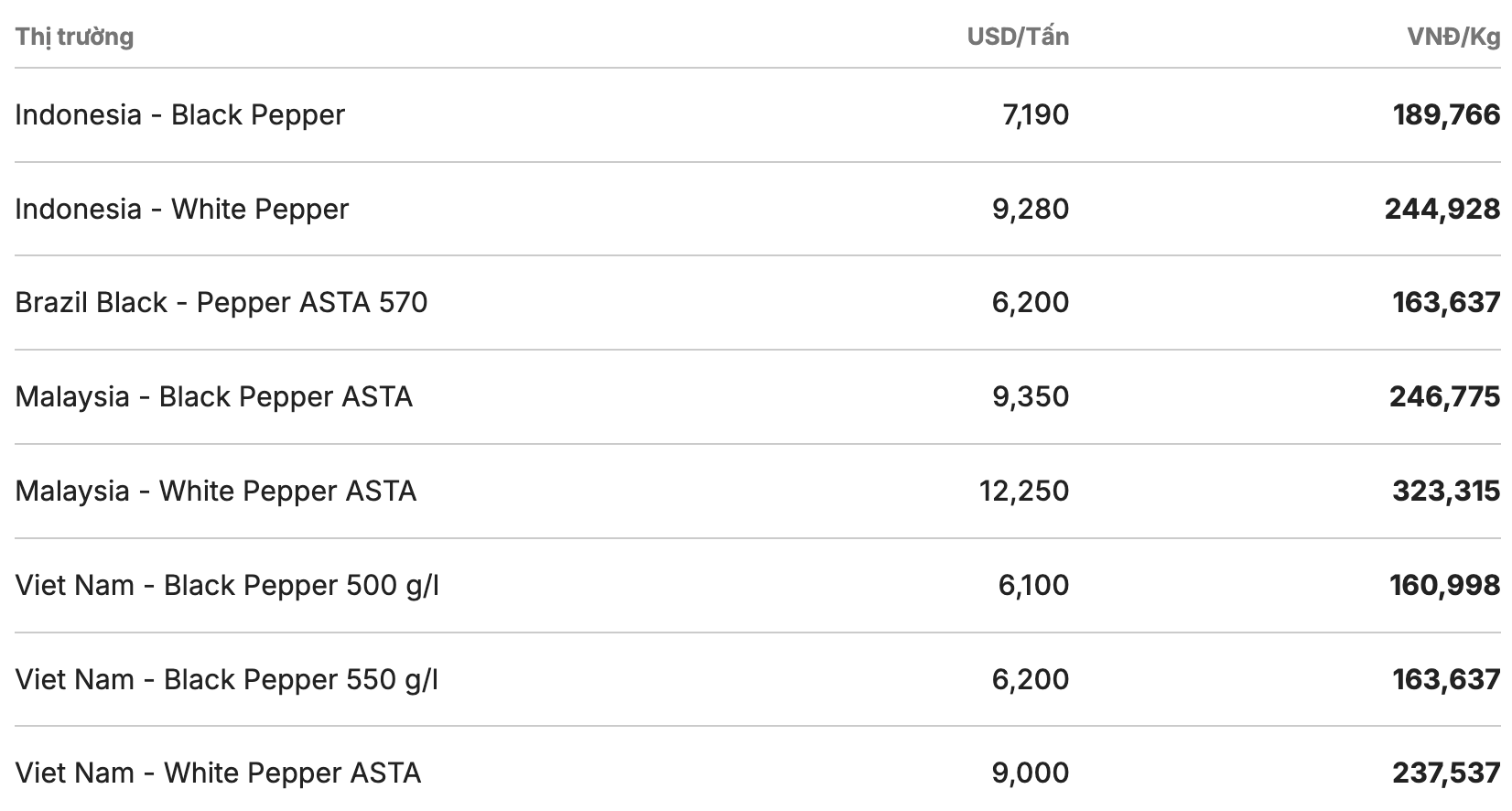
In the world market, pepper prices are stable in countries. The two items of black and white pepper in Indonesia are no exception, trading in the range of 7,190 - 9,280 USD/ton (equivalent to 189,766 VND/kg - 244,928 VND/kg).
The Brazilian market also went sideways, holding at 6,200 USD/ton (about 163,637 VND/kg). Notably, black and white peppers are still trading at high prices, respectively 12,250 USD/ton and 9,350 USD/ton.
In Vietnam's pepper export market, the price of black pepper of 500 g/l and 550 g/l remains at 6,100 - 6,200 USD/ton. In the same direction, ASTA white pepper is offered for sale at 9,000 USD/ton (equivalent to 237.537 VND/kg).
Assessments and forecasts
The trend of the pepper industry has strongly shifted to green production models to meet increasingly strict requirements from major import markets such as the US and Europe.
The pepper market is currently entering the final stage. Weak purchasing power from some international markets, combined with the cautious sentiment of traders, has caused domestic purchasing prices to fall sharply in some areas last week. However, many farmers still choose to keep goods instead of selling them.
The Vietnam Pepper and Spice Plant Association (VPSA) said that the overall picture of the entire pepper and spice industry in the first 4 months of the year shows a fairly positive growth momentum, in which growth in volume is higher than growth in value, reflecting that exports have been strongly expanded in terms of commodity scale, but the growth rate of turnover has not been fully corresponding because the export prices of some commodity groups have not increased evenly.


