
Shifting the market, taking advantage of FTAs
According to the Vietnam Association of Seafood Exporters and Producers (VASEP), in December 2025, seafood export turnover reached about 840 million USD, down 15% compared to November 2025 and down nearly 4% compared to the same period last year.
The main reason is that businesses are more cautious when exporting to the United States, in the context that many major seafood species are banned from import according to MMPA regulations (Water Mammal Protection Act) and concerns about anti-dumping duties on shrimp from the beginning of 2026.
However, if calculated for the whole year 2025, seafood exports reached over 11.34 billion USD, an increase of 13% compared to 2024.
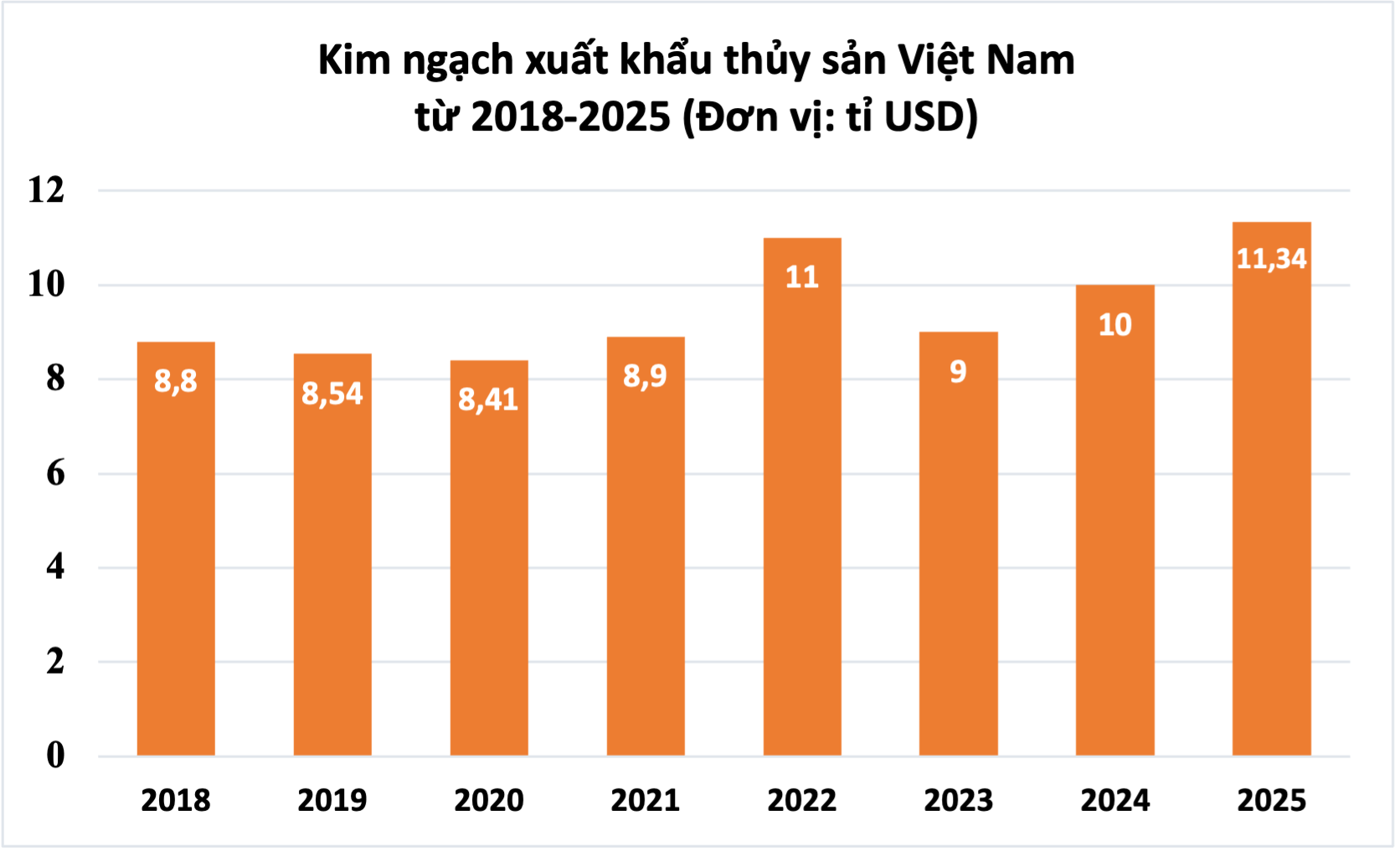
According to VASEP's assessment, 2025 is considered one of the most challenging years for the seafood industry, from the risk of applying countervailing taxes, anti-dumping duties, high production costs to increasingly strict technical barriers. However, in that context, seafood exports recorded unexpected breakthroughs thanks to three key factors.
First, the instability in the global market has increased the demand for food reserves, leading to an increase in seafood import demand in many countries.
Second, the proactiveness and flexibility of the Vietnamese seafood business community plays a very important role. Businesses have early identified risk milestones related to taxes and technical barriers, thereby adjusting production plans, delivery and market redirection to minimize negative impacts.
Third, the advantages from free trade agreements (FTAs) continue to be effective, helping seafood exports break through in markets in the CPTPP, EU and RCEP blocs, thereby compensating for the decline or slow growth in some major markets.
Ms. Le Hang - Deputy Secretary General of VASEP - said that one of the highlights of seafood exports in 2025 is that businesses have "pivoted" the market to compensate for instability from the United States. In the context of the United States market experiencing many instabilities in tax policies and technical barriers, the structure of Vietnam's seafood export market has had clear adjustments.
Installing the input data system
Assessing the market in 2026, Mr. Nguyen Hoai Nam - General Secretary of the Vietnam Association of Seafood Exporters and Producers (VASEP) - said that there will continue to be many difficulties and challenges for the seafood industry.
At the conference summarizing the work of the Ministry of Industry and Trade in 2025, the period 2021 - 2025 and deploying key tasks for 2026, Mr. Nguyen Hoai Nam proposed that the Government and the Ministries of Industry and Trade, and the Ministry of Agriculture and Environment actively support the anti-dumping campaign, the anti-subsidy investigation of the United States for Vietnam's shrimp industry, so that the shrimp industry can overcome the investigation phases in the coming time.
VASEP Secretary General also proposed that the Ministry of Industry and Trade consider the proposal to abolish quotas for Vietnamese shrimp exported to Korea within the framework of the VKFTA Trade Agreement at the review period in 2025-2026.
In particular, Mr. Nguyen Hoai Nam proposed that the Government and the Ministry of Industry and Trade, and the Ministry of Agriculture and Environment pay attention to directing 2 contents related to infrastructure to create a premise for sustainable fisheries and the marine economy.
First, establish a raw input data system, interconnected from the fishing port to the central government. This is the foundation for management work, is basic information for the Government to have appropriate directions and policies. Data is transparent, establishing a data system should start right now. Second, there needs to be a plan to build a seafood auction market. Having data and auction markets implemented will be a premise for transparency and effective fisheries management" - Mr. Nam suggested.


