
Expected spending of 78,143 billion VND for compensation, support and resettlement
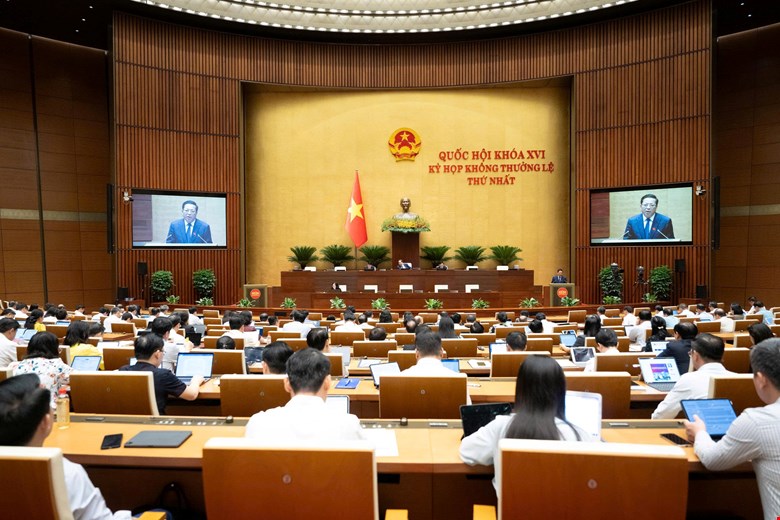
According to the program of the first non-scheduled session of the 16th National Assembly, on the morning of August 6, on behalf of the Government, Member of the Party Central Committee, Minister of Construction Tran Hong Minh presented to the National Assembly the investment policy for the Ring Road 5 - Hanoi Capital Region investment project.
The project is invested with the goal of forming a highway connecting Hanoi Capital with localities in the region, in order to meet sustainable transportation needs, create spillover momentum, open up a new space for economic development, and create a premise for socio-economic development.
The project is expected to contribute to reducing traffic congestion and environmental pollution; completing and synchronizing the Hanoi Capital Ring Road system.
According to the Government's report plan, Ring Road 5 - Capital Region is about 349km long, passing through 7 localities, including Hanoi, Ninh Binh, Hung Yen, Hai Phong, Bac Ninh, Thai Nguyen and Phu Tho.
The project includes a main expressway line with a scale of 6 lanes, design speed 100-120km/h and a parallel road with a minimum scale of 2 lanes, design speed 60-80km/h.
According to the submission, the route of the project is researched and selected to ensure compliance with the plan, the shortest possible length, and limiting the volume of site clearance. The route option has been agreed upon in writing by 7/7 relevant localities.
According to preliminary reports, to implement the project, the land clearance scope is about 4,011ha with compensation, support, and resettlement costs of about 78,143 billion VND.
Regarding investment forms, the Government proposes to apply public-private partnership (PPP) investment methods and public investment forms.
The preliminary total investment is about 288,268 billion VND, including the main expressway section of 215,192 billion VND implemented with the central budget and the parallel road of 73,076 billion VND made with local budget capital. The Government plans to allocate about 59,700 billion VND for the project in the 2026-2030 period.
Project investment preparation starts from 2026, implementation in 2027 and basic completion of the project in 2030. The remaining sections will be implemented in the 2026-2030 period; continue to mobilize capital sources to prioritize early investment, striving to complete the entire route before 2035.
Request to fully review land and residents affected by project implementation
Presenting the appraisal of the submission on this project, Member of the Party Central Committee, Chairman of the Economic and Finance Committee Phan Van Mai proposed to review and unify the data in the entire dossier and appendix attached to the draft resolution before submitting it to the National Assembly for voting.
Regarding total investment, capital sources, land and materials, the appraisal agency proposed to supplement and clarify capital sources, capital source structure, capital allocation progress, the ability to balance and allocate capital of the central budget and local budgets, especially for localities expected to be allocated large capitals such as Hanoi and Hai Phong in each phase.
The appraisal agency also requested to carefully assess the impact on the medium-term public investment plan and the capital needs for many other important national projects being implemented in the same period. At the same time, fully supplement the commitment documents of 7 localities with projects passing through on the progress of local budget capital allocation for the parallel road section and compensation and resettlement support work.
The appraisal agency said that some opinions suggest that only 59,700 billion VND can be balanced in the 2026 - 2030 period, therefore, it is proposed that the Government study investing in phase 1 of the project corresponding to the capital and capital balancing capacity to ensure feasibility and efficiency.
At the same time, comply with the law on public investment and regulation 189 of the Central Government and guidance 63 of the Central Steering Committee. The Economic and Finance Committee proposed to review data on rice land, forest land, defense land, number of affected households, resettlement. Prepare land funds, resettlement infrastructure and livelihood stabilization solutions. It is necessary to have a comprehensive plan on construction materials, landfills, ensure legal supply sources, control environmental impacts...


