
Distinguishing between associate professor and professor titles
Minister of Education and Training (MOET) Nguyen Kim Son has just signed a Government report on receiving and explaining the opinions of National Assembly deputies, and an inspection report by the National Assembly's Committee on Culture and Society on the draft Law on Higher Education (amended).
Regarding the title of professor and associate professor, there are opinions that the explanation of the title of associate professor in the draft Law is unclear; it is recommended to express it in the direction of concise regulations, distinguishing based on capacity and reputation; study decentralization and authorization for higher education institutions that are qualified to establish a separate scientific title council to consider recognizing the title of professor and associate professor based on the unified national standard framework prescribed by the Ministry of Education and Training.
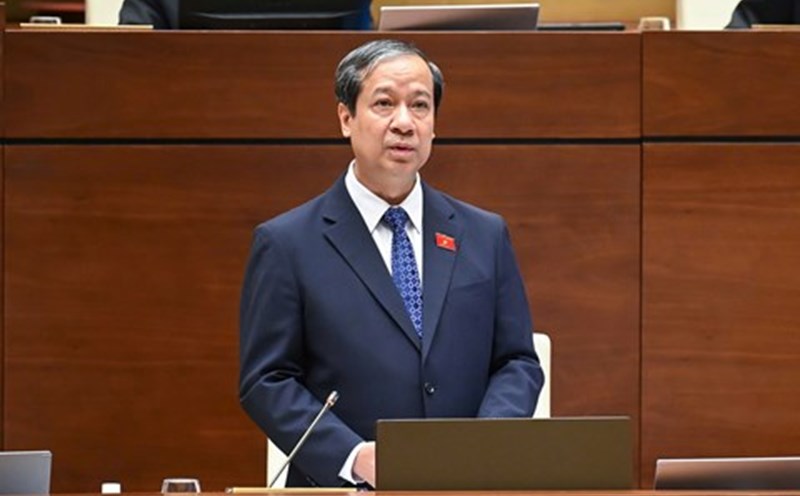
Regarding this content, the Government said that Article 29 of the draft Law on Higher Education clearly stipulates the system of lecturer titles in higher education institutions, including professors, associate professors and other titles.
Accordingly, a professor is the highest title, demonstrating capacity, scientific prestige and the role of leading expertise, discovering and creating new knowledge; Associate Professor is the title of associate professor, with in-depth expertise in a specific field of science; other titles prescribed by the Government.
Thus, the draft Law has demonstrated the nature and basic role of titles, meeting the requirements for comments on the description of capacity and prestige. The Law only identifies titles and the principle of appointment, not going into details about capacity, prestige or decentralization for recognition, to avoid overlap with the Law on Teachers, ensuring that the Law on Higher Education is a framework law and remains comprehensive and flexible for higher education institutions.
Regarding the decentralization proposal, the Government believes that authorizing higher education institutions to qualify to establish a separate scientific title council to consider recognizing the title, Article 29 has opened a decentralization mechanism when stipulating that higher education institutions are allowed to appoint professors and associate professors based on national unified standards issued by the Ministry of Education and Training.
This ensures that higher education institutions have the right to take the initiative in organizing the recognition of titles but still comply with general standards managed by state agencies. The content of deeper decentralization, including the method of establishing the council, the procedures for considering recognition, detailed criteria and decentralization of responsibilities, will be studied and guided in documents guiding the implementation of the Law on Teachers and the Law on Higher Education, to ensure system synchronization, feasibility in practice and suitability with the characteristics of each higher education institution.
This also helps higher education institutions take the initiative in improving lecturer capacity, developing a team of professors and associate professors, while ensuring fairness and transparency in the recognition of titles.
Proposal to explain associate professor as the title of associate professor
Some opinions say that the explanation of the title of associate professor as the title of associate professor in the draft law is not convincing. At the same time, it is recommended to consider assigning the Government to regulate other lecturer titles without clarifying the content.
Regarding this content, the Government clearly stated in the draft law that stipulates the system of lecturer titles in higher education institutions, including: lecturer, main lecturer, associate professor and professor, in which the associate professor is the title of associate professor.
The above regulation is in line with international practice, reflecting the professional development process of university lecturers according to capacity orientation and professional standards, and at the same time being consistent with the provisions of the Law on Education and current documents on standards, appointment and recognition of the titles of professor and associate professor.
The phrase "near-appearing title" both shows the arrangement of positions and creates motivation for the team of scientists to strive, not simply the administrative rank.
Academic titles at the level of capacity and professional standards, aim to accurately reflect the layered nature of the university lecturer title system, in line with the international nature of the lecturer team and professional standards in higher education.
Regarding the opinion that the Government should regulate other lecturer titles when the content is not clear, the Government believes that this is an open regulation but limited, only applicable in cases where special training types arise.
Such as art, national defense, security, health, or specialized research training facilities.
Based on the proposal of the Ministry of Education and Training, agree with ministries and branches to manage professional fields. This regulation ensures flexibility, does not create arbitrary mechanisms, while maintaining unity in managing the university lecturer team nationwide.


