
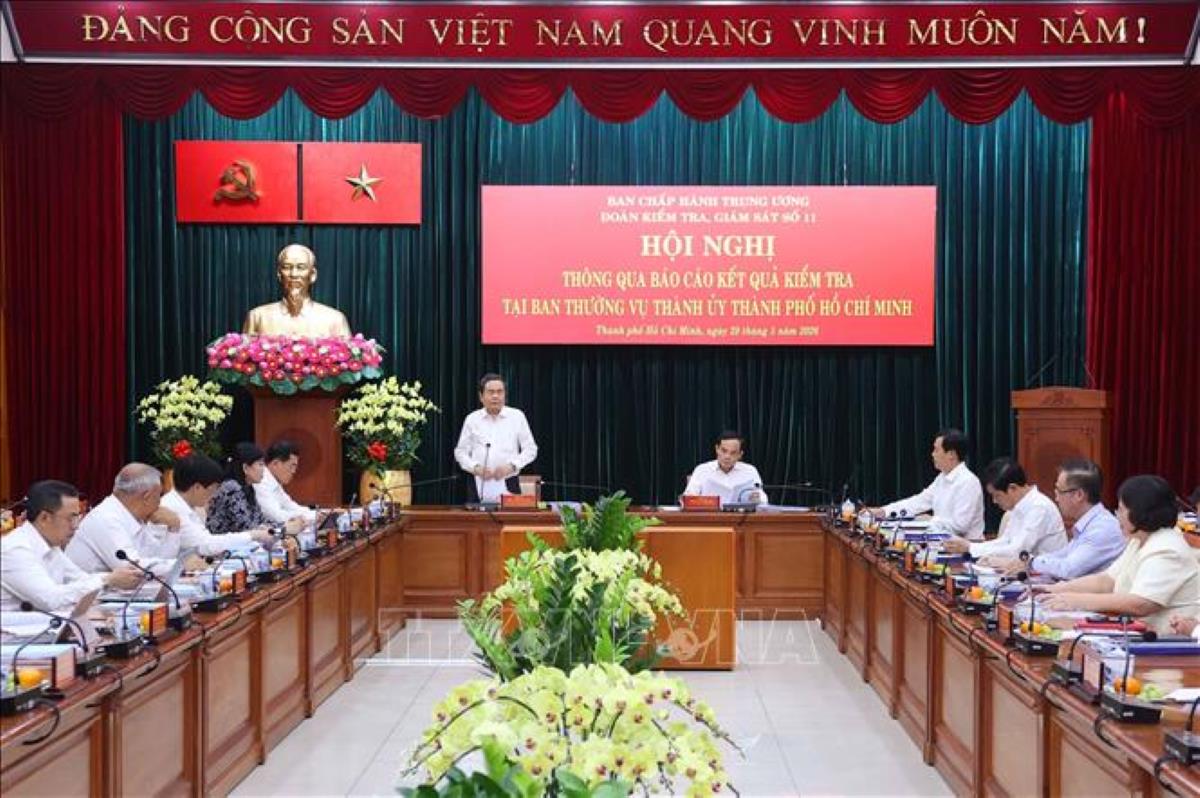
On the afternoon of May 29, Inspection and Supervision Delegation No. 11 of the Politburo and Secretariat led by Politburo Member, National Assembly Chairman Tran Thanh Man chaired a conference to approve the draft Report on the results of inspection and supervision (phase 2) for the Standing Committee of the Ho Chi Minh City Party Committee.
The draft report focuses on 4 major contents, including: leadership, direction, organization and operation of agencies, units, and localities when operating local governments at 2 levels; leadership, direction and organization of implementation to ensure that the growth target for the period 2026 - 2030 reaches 10% or more according to the Resolution of the 14th Party Congress; the implementation of Resolution 57-NQ/TW of the Politburo on breakthroughs in science, technology, innovation and national digital transformation; and the work of reviewing, evaluating, and ranking the quality of Party organizations, party members and leaders and managers according to the regulations and conclusions of the Politburo.
Speaking at the conclusion of the conference, Politburo Member, National Assembly Chairman Tran Thanh Man acknowledged and praised the Standing Committee of the Ho Chi Minh City Party Committee for promoting the spirit of solidarity, high determination, proactiveness, dynamism, creativity and decisiveness in organizing the implementation of tasks in the past time.
Based on the report and opinions at the conference, the National Assembly Chairwoman requested the Standing Committee of the Ho Chi Minh City Party Committee to continue to fully implement the tasks and solutions pointed out by the inspection and supervision delegation; at the same time, thoroughly grasp and effectively implement Resolution 09-NQ/TW of the Politburo on building and developing Ho Chi Minh City in the new era.
The National Assembly Chairwoman requested Ho Chi Minh City to urgently complete the draft Law on Special Urban Areas, submit it to competent authorities so that the City has a new development method, along with a superior institutional framework.
In addition, Ho Chi Minh City needs to promote public investment disbursement; urgently remove obstacles related to procedures, land, compensation for resettlement; and at the same time, effectively apply special mechanisms according to Resolution 260/2025/QH15 amending Resolution 98/2023/QH15 of the National Assembly.
The National Assembly Chairwoman also reminded Ho Chi Minh City to improve the quality of growth, regularly pay attention to the fields of education, health, environment; strengthen flood control, reduce traffic congestion, prevent and combat drugs and crime.
Regarding the 2-level local government model, the National Assembly Chairwoman requested Ho Chi Minh City to continue to improve it in the direction of streamlining, effectiveness, efficiency and substance; promote decentralization and delegation of power associated with power control and accountability; build a set of criteria for evaluating operational efficiency in a quantitative direction, taking people and businesses as the center of service.
Ho Chi Minh City is also proposed to continue to promote its pioneering role in implementing Resolution 57-NQ/TW; focus on building a shared data ecosystem, developing strategic digital infrastructure, promoting substantive digital transformation; prioritizing the development of high-quality human resources in the fields of artificial intelligence (AI), semiconductors, big data, core technology and innovation.
In addition, the National Assembly Chairwoman emphasized the requirement to strongly innovate the work of reviewing, evaluating, and ranking Party organizations, cadres, and party members in a substantive, quantitative direction, associated with work products, output efficiency and responsibility of heads; promote the application of digital technology in management and cadre evaluation.
Along with that, Ho Chi Minh City needs to continue to strengthen inspection and supervision; tighten discipline and order; resolutely overcome the situation of avoidance and shirking responsibility; promptly detect and remove difficulties and obstacles right from the grassroots level, not allowing large bottlenecks to arise for a long time.


