
The press conference was chaired by Deputy Chairman of the Presidential Office, Assistant President Can Dinh Tai, and attended by Deputy Chief Justice of the Supreme People's Court Nguyen Van Tien.
Completing specialized trial institutions according to international standards
The Law on Specialized Courts at the International Financial Center was passed by the 15th National Assembly on December 11, 2025, with the number 150/2025/QH15, including 44 articles, 05 chapters and takes effect from January 1, 2026.
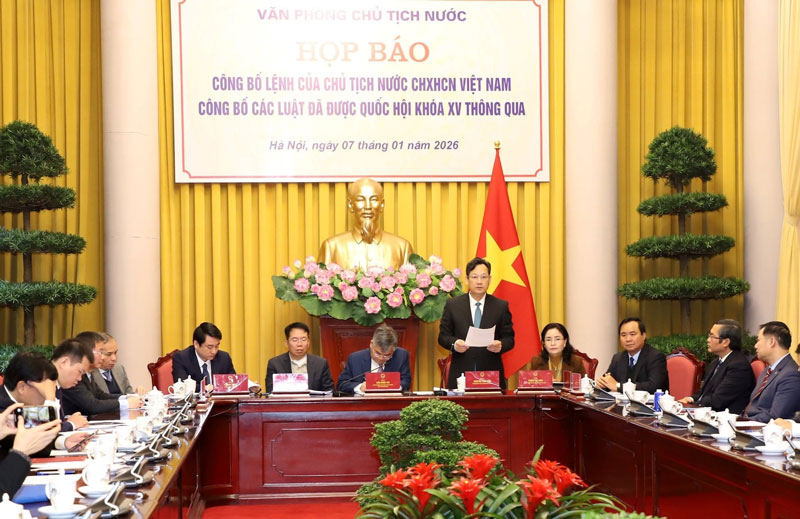
The Law is built to promptly meet the requirements of reality, implement the policy of the Politburo, and at the same time implement Law No. 81/2025/QH15 amending and supplementing a number of articles of the Law on Organization of People's Courts and Resolution No. 222/2025/QH15 of the National Assembly on International Financial Centers in Vietnam.
Speaking at the press conference, Deputy Chief Justice of the Supreme People's Court Nguyen Van Tien emphasized that the promulgation of the Law on Specialized Courts at the International Financial Center is an important component in the overall institution to ensure that the International Financial Center operates stably and effectively, thereby strengthening the confidence of domestic and foreign investors.
Accordingly, specialized courts are organized in the system of People's Courts but operate according to a modern, professional model, with a specific dispute resolution mechanism, compatible with international standards and practices, meeting the requirements of cross-border investment and business transactions.
The Law comprehensively regulates tasks and powers; organizational structure; jurisdiction; order and procedures of proceedings; enforcement of judgments and decisions; team of Judges, Court Secretaries, representatives of procedural parties, as well as conditions to ensure the operation of specialized Courts.
Notably, the Law establishes 09 principles of organization and operation, including specific principles such as: independence according to adjudication authority; fair, transparent, impartial, objective, quick, and effective resolution of cases; flexible procedural procedures according to international standards and practices.
An important new point of the Law is allowing parties to agree to apply Vietnamese law, foreign law or international trade practices in cases where transactions have at least one party being a foreign individual or organization, thereby creating a legal corridor consistent with international dispute resolution practices in the field of finance - trade.
According to the provisions of the Law, Special Courts are established and located in Ho Chi Minh City, including the Court of First Instance, the Court of Appeal and the assisting apparatus. The organizational structure of special courts includes the Chief Justice, Deputy Chief Justice, Chief Justice, Deputy Chief Justice, Judge, Court Secretary, other civil servants and employees.
In particular, Specialized Court Judges are appointed by the President from two sources: foreigners and Vietnamese citizens. The Law clearly stipulates the standards, conditions for appointment, term, working regime, management, supervision, responsibilities of Judges, as well as cases of dismissal, dismissal, demotion and protection of Judges in the process of performing their duties.
Specialized courts have the authority to resolve cases arising between members of the International Financial Center with each other or between members of the International Financial Center with other agencies, organizations, and individuals who are not members of the International Financial Center according to the provisions of the Law.
The language and writing used before the Court are English or English accompanied by a Vietnamese translation; judgments and decisions of the Court are issued in English or English accompanied by a Vietnamese translation.
Regarding judgment enforcement, the Law stipulates that the first-instance trial is conducted by 01 Judge; in case the case is complicated, at the request of the parties, the Chief Justice of the Special Court may decide to conduct the first-instance trial by a Council of 03 Judges; conduct the appellate trial by a Council of 03 Judges.
Specialized courts have the authority to issue decisions to enforce judgments and decisions that have taken legal effect; Judges who execute judgments are entitled to apply necessary measures, including coercive measures, and may request the police force to coordinate to ensure order and safety in accordance with the law.
Prioritize recovery, increase efficiency in handling difficult businesses
Also at the press conference, Deputy Chief Justice of the Supreme People's Court Nguyen Van Tien introduced the key contents of the Law on Bankruptcy and Recovery, which was passed by the 15th National Assembly on December 11, 2025 at the 10th Session and took effect from March 1, 2026.
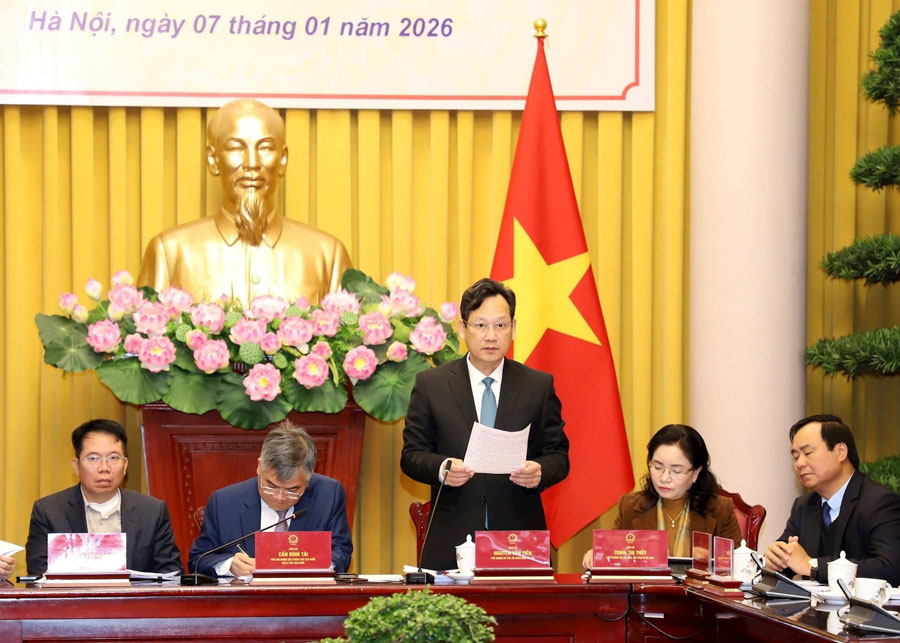
The Law on Recovery and Bankruptcy includes 88 articles, 08 chapters, stipulating the principles, order, and procedures for resolving cases of recovery and bankruptcy of enterprises, cooperatives, and cooperative unions; clearly defining the tasks and powers of the person carrying out the procedures and the rights and obligations of the subjects participating in the recovery and bankruptcy procedures.
One of the highlights of the Law is emphasizing the role of the State in supporting businesses and cooperatives facing difficulties through policies on taxes, fees, credit, interest rates, land, technology, digital transformation and other support measures.
These regulations aim to create conditions for businesses and cooperatives to restore production and business operations or withdraw from the market in an orderly manner, thereby contributing to improving the investment and business environment and sanitizing the economy.
The law stipulates that the state budget ensures the advance payment of bankruptcy costs in cases where the applicant is a worker, trade union, tax management agency, social insurance agency or in cases where the enterprise or cooperative no longer has or does not have enough assets to pay the costs as prescribed. This advance payment will be immediately returned to the state budget when the assets of the enterprise or cooperative are sold.
Overcoming the limitations of the Bankruptcy Law 2014, the Law on Recovery and Bankruptcy allows the implementation of procedures on the electronic environment, in parallel with the traditional paper-based method, thereby saving time, costs and effort for related parties.
In particular, the Law stipulates procedures for restoring business operations independently of bankruptcy procedures, prioritizing the application of restoration to create opportunities for businesses and cooperatives to overcome difficulties, maintain operations and develop production and business.
The law also expands the subjects with the right to file requests for the application of bankruptcy procedures, including tax management agencies and insurance agencies, in order to definitively handle businesses and cooperatives owing taxes and insurance debts for a long time, no longer existing or not operating in reality but cannot withdraw from the market due to lack of applicants.
In addition, the Law supplements simplified recovery and bankruptcy procedures for businesses and cooperatives with few creditors, small debts or small and micro-scale debts; and at the same time improves regulations on resolving cases of recovery and bankruptcy with foreign elements, including requesting support from courts and competent foreign agencies and recognizing and enforcing judgments and decisions on recovery and bankruptcy of foreign courts.
The Law also reduces and simplifies a number of procedures, simplifies procedures for reviewing court decisions; amends the appellate power of the People's Procuracy to a recommendation; strengthens decentralization, delegation of power and coordination between the Court and relevant agencies, organizations, and individuals in the process of resolving recovery and bankruptcy cases.


