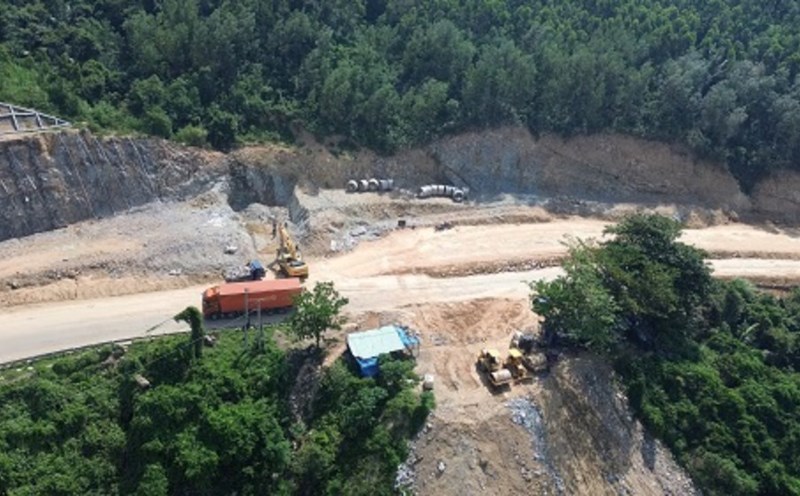
On the afternoon of December 8, the National Assembly discussed the investment policy for the Vinh - Thanh Thuy expressway construction investment project.
Agreeing with the project investment policy, delegate Tran Nhat Minh (Nghe An Delegation) proposed to clarify the content related to the investment scale. The draft stipulates that when completed, the project will follow the 6-lane standard, but in the 2026-2030 period, 4 lanes will be implemented, and the entire route will be cleared with a scale of 6 lanes.
To facilitate the implementation process, the delegate proposed to revise the heading of Clause 5, Article 2 to: "Preliminary total investment and capital for the period 2026-2030", to accurately reflect the scope and demand for capital use in this period.
When the Resolution is passed by the National Assembly, the People's Committee of Nghe An province is decentralized as the investment management agency.
This is a great opportunity for the province to promote socio-economic development, strengthen international and inter-regional coordination, and at the same time improve the capacity of local infrastructure management and public investment. The government and people of Nghe An will make every effort to implement the project on schedule, the delegate added.
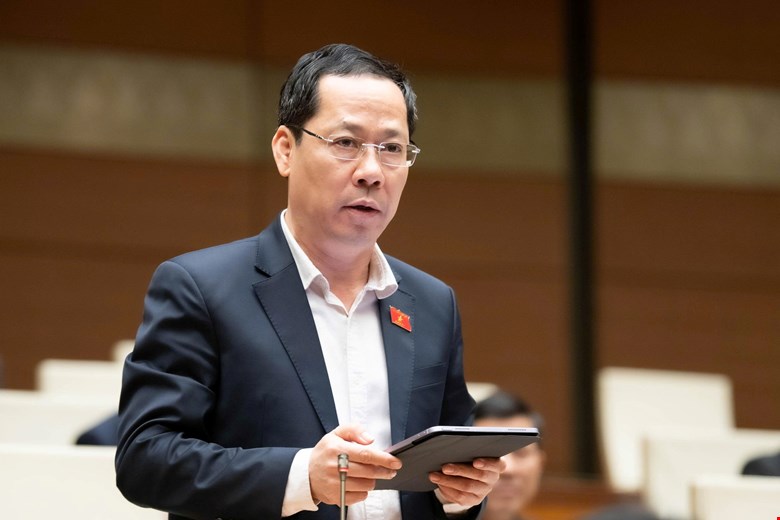
Delegate To Van Tam (Quang Ngai Delegation) agreed with the use of public investment and the application of special mechanisms to implement the project, especially the assignment of some tasks to the commune-level government is appropriate, because the commune-level government performs political tasks locally, so it will be convenient in implementation.
Regarding the investment scale, the delegate suggested investing in the project with a scale of 6 lanes in the period of 2026-2030 because of the strategic significance of this route and the expectation of creating development momentum for Nghe An.
In addition, the delegate suggested prioritizing site clearance, resettlement, and ensuring stable people's lives. It is expected that the project area will pass through the old Thanh Chuong district, and people's lives will still be difficult. Therefore, resettlement, ensuring jobs and stabilizing people's lives are extremely necessary.
The delegate suggested that in addition to applying advanced and modern technology, it is necessary to immediately deploy the application of high technology in construction organization, adapting to climate change. Nghe An is an area greatly affected by natural disasters and climate, so this content needs to be clearly regulated instead of just "encouraged".
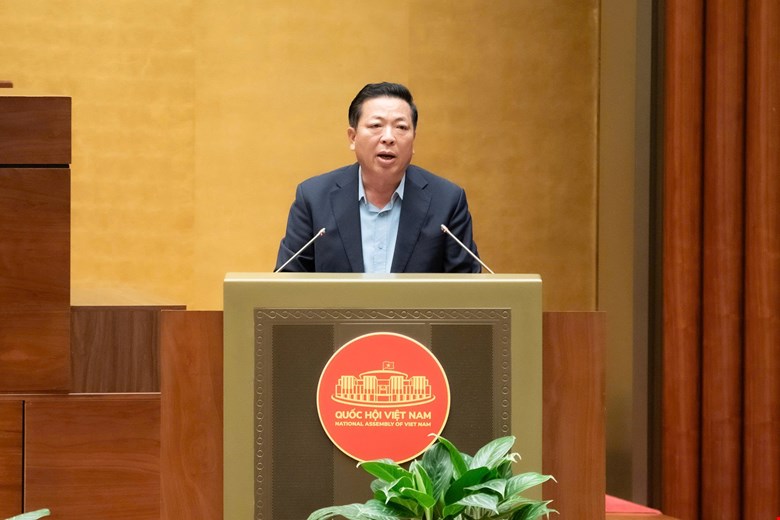
Explaining later, Minister of Construction Tran Hong Minh emphasized that the project plays an important role in the socio-economic development strategy of the Central region.
Currently, there are routes 8, 9 and 12 connecting to Laos and to domestic ports, but most of them are only on the scale of mountainous, narrow, and low- mobility grade III roads.
Meanwhile, the development requirements along the East-West corridor, especially connecting Laos, Myanmar, Thailand and China, both railway and road, are being dat very urgently. The completion of this connection is also associated with promoting operations at a series of seaports.
Regarding the investment scale, the Minister stated that in phase 1, the section on the Vietnam side is about 60km long, calculated according to traffic demand until 2035 with a scale of 4 lanes and by 2045-2050, it will be increased to 6 lanes. Therefore, the proposal for the first phase with 4 lanes is completely suitable.