
In the afternoon of April 22, the National Assembly discussed the draft Resolution of the National Assembly on piloting the institution of public lawyers.
Delegate Phan Thi My Dung (Tay Ninh Delegation) said that the draft design stipulates that public lawyers are also cadres, civil servants, and public employees (CBCCVC), but must have sufficient criteria and conditions as a lawyer according to the current Law on Lawyers.
The delegate agreed with the regulation that CBCCVC before being certified as public lawyers must undergo a lawyer training course.
However, the regulation stipulates that they must train as lawyers, so the question is where to train. Currently, according to the provisions of law on lawyers, they must train at legal practice organizations such as law offices and law firms.
Thus, CBCCVC must both perform assigned professional tasks and go to law offices and law firms for internships, the internship period is at least 6 months, so what is the management mechanism?
During the probationary period, how are the professional tasks of the assigned agency and unit performed?", the delegate raised the issue.
With the specific characteristics and differences between public lawyers and current lawyers, delegates proposed not to stipulate probationary periods.
The delegate also proposed to remove the regulation that public lawyers must participate in the bar association as stipulated in the draft because there will be overlaps contrary to other related legal regulations such as the Law on Cadres and Civil Servants; the Law on Public Employees and the law on finance.
When a person who is a CBCCVC recognized as a public lawyer must participate as a member of a professional social organization - that is, a bar association - it will arise legal situations of two parallel management mechanisms.
At that time, public lawyers must comply with the regulations on the charter of the Bar Federation, the internal regulations of the Bar Association, and must participate in fulfilling lawyers' obligations such as contributing to the association fund, the principles of commendation and discipline of the association, but at the same time must comply with regulations on party members and CBCCVC.
And when violations occur, is the determination of disciplinary responsibility according to public service law or according to professional principles of lawyers? This leads to overlapping conflicts, professional social organizations also have the right to handle their members, and state agencies and units must also handle according to the law on CBCCVC.
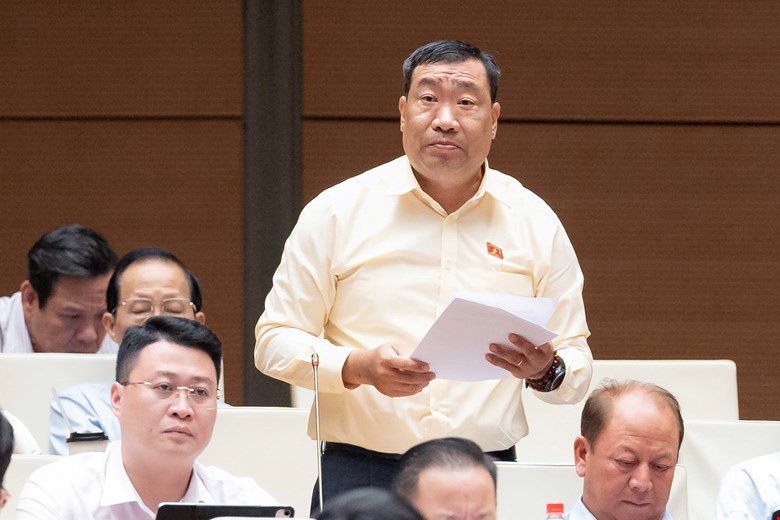
Delegate Thach Phuoc Binh (Vinh Long) agreed with the fact that public lawyers must have at least 5 years of experience working regularly and directly in the legal field.
However, to ensure feasibility, the delegate proposed to clarify the content of the concept of experience in the legal field. It is necessary to concretize it in the direction that experience must be associated with direct legal activities such as legal affairs, inspection, adjudication, supervision, investigation, and judgment enforcement.
The delegate also proposed to study and supplement regulations on legal foreign language standards for some positions, especially public lawyers participating in handling international investment and trade disputes. This is an important condition to ensure the ability to work independently in the international legal environment.


