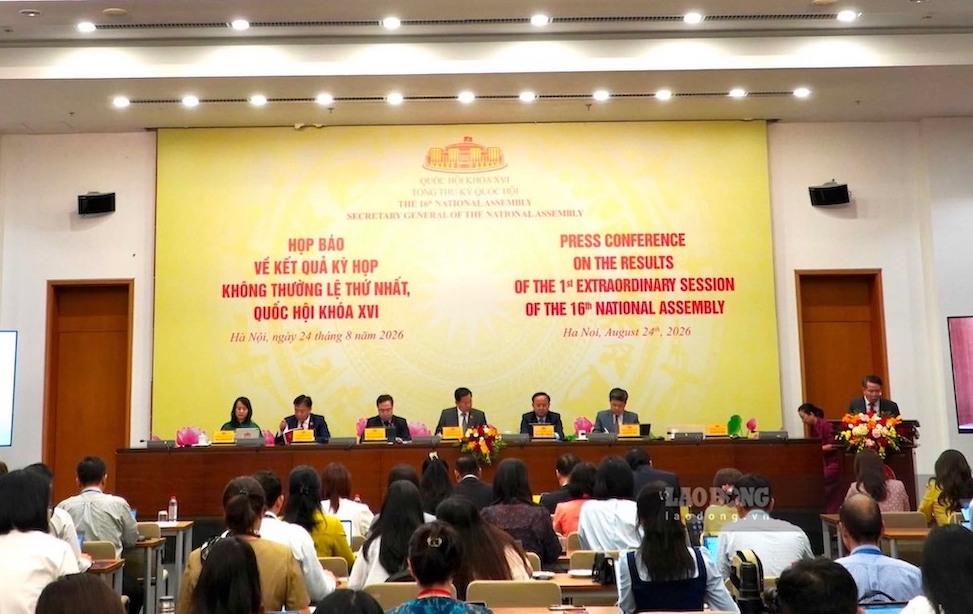
At the press conference concluding the extraordinary session of the 16th National Assembly held on the afternoon of August 24, Member of the National Assembly who is a full-time member of the National Assembly's Economic and Finance Committee Pham Thi Hong Yen clarified the contents related to policy orientations on land, real estate and housing expected to be included in the National Assembly's schedule at the upcoming 2nd session.
Towards a healthy real estate market
According to Ms. Yen, at the session, the orientations for amending the 2024 Land Law, the 2023 Housing Law and the Real Estate Business Law were discussed and initially commented on by the National Assembly. These are policies that directly impact people, businesses and the introduction of land resources into socio-economic development.
Regarding planning work, the amendment is in the direction of combining the allocation of land use targets with the organization of development space, towards building a unified plan within the scope of an administrative unit.
With the mechanism of land recovery, compensation, support and resettlement, the policy shifts from the mindset of compensating for recovered assets to rebuilding people's lives when the State recovers land. Requirements for housing, resettlement infrastructure, schools, health stations, transportation, public services, livelihoods, jobs, income and people's consensus are set out in this process.
The database system on land, housing and real estate is built to increase fairness, publicity, transparency and harmony of interests between the State, land users and investors.
Along with that, it is to promote administrative reform, digital transformation, improve databases, handle existing problems in certificate issuance, simplify procedures and strengthen decentralization and delegation of power, and enhance the responsibility of localities in land management.
Regarding the Law on Real Estate Business and the Housing Law, the orientations are discussed to remove bottlenecks in the development of the real estate market under the market mechanism with state management.
The policy aims to diversify subjects and types of market participants, while increasing the ability to control and regulate for the market to develop healthily, transparently, stably, and sustainably; expand opportunities to access housing, develop rental housing at reasonable prices and focus on people facing housing difficulties, towards ensuring social security,...
However, according to Ms. Pham Thi Hong Yen, the three draft laws still have some overlapping contents. The drafting agencies and the appraisal agency will continue to study and complete them to submit to the National Assembly for discussion and consideration at the second session in October, with the goal of removing the identified bottlenecks.
New tax policies affect 2.7 million individuals and business households
Ms. Yen said that many laws and resolutions considered and passed by the National Assembly at the session are of great significance in completing the legal framework, removing bottlenecks, and aiming for double-digit growth in 2026 and the following years.
Among the mentioned policies, tax policies, Resolution on reducing personal income tax and corporate income tax stipulate a 30% reduction in tax payable in two years 2026 and 2027 for individuals and businesses, organizations with revenue not exceeding 10 billion VND.
The policy is expected to affect 2.7 million individuals and business households, equivalent to 99% of the total number of households and individual businesses nationwide, along with about 865,000 businesses and organizations, equivalent to 81% of the total number of businesses.
Directly reducing the amount of tax payable will contribute to removing difficulties in financial resources, creating conditions for business households and businesses to increase reinvestment resources, expand production and business, contributing to the implementation of the country's socio-economic growth goals" - Ms. Yen assessed.
In addition to tax policies, the Law amending and supplementing a number of articles of the Investment Law is also assessed to have a wide impact on people and businesses. The Law cuts, consolidates and narrows the scope of conditional business lines from 198 business lines in the 2025 Investment Law to 137 business lines.
The goal of the amendment is not only to cut administrative procedures and business conditions but also to innovate management methods. The State will focus on controlling truly necessary risks, while creating more favorable space for investment and business activities...