
According to the 2019 Labor Code, the retirement age of workers in normal conditions is adjusted according to a roadmap, reaching 62 years old for men by 2028 and 60 years old for women by 2035.
From 2021, the retirement age for male workers increases by 3 months each year, and female workers increase by 4 months. In 2027, male workers retire when they reach 61 years and 9 months old, an increase of 3 months compared to 2026; female workers retire when they reach 57 years and 4 months old, an increase of 4 months.
In addition to regulations on retirement age in normal working conditions, according to the Labor Code, employees with reduced working capacity; doing especially heavy, hazardous, and dangerous jobs; working in areas with particularly difficult socio-economic conditions can retire at a lower age but not exceeding 5 years compared to the regulations at the time of retirement, unless otherwise prescribed by law.
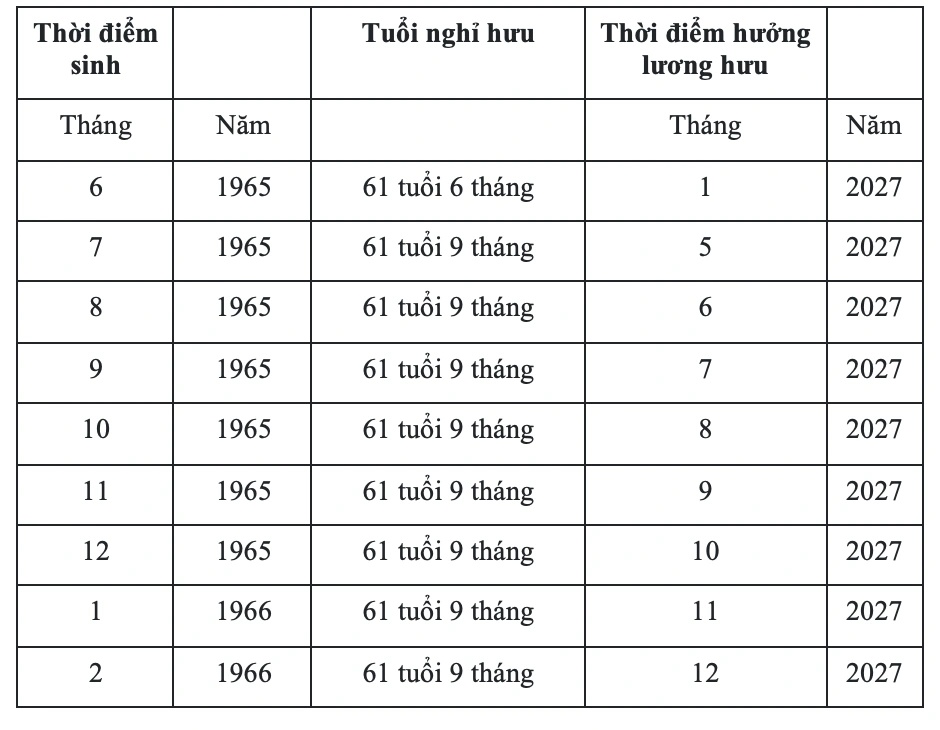
At the same time, based on Appendix 1 of the retirement age roadmap in normal working conditions attached to the corresponding month and year of birth issued with Decree 135/2020/ND-CP regulating the retirement age calculation table according to the year of birth, the detailed table to look up the retirement age of male workers according to the latest year of birth 2027 is as follows:
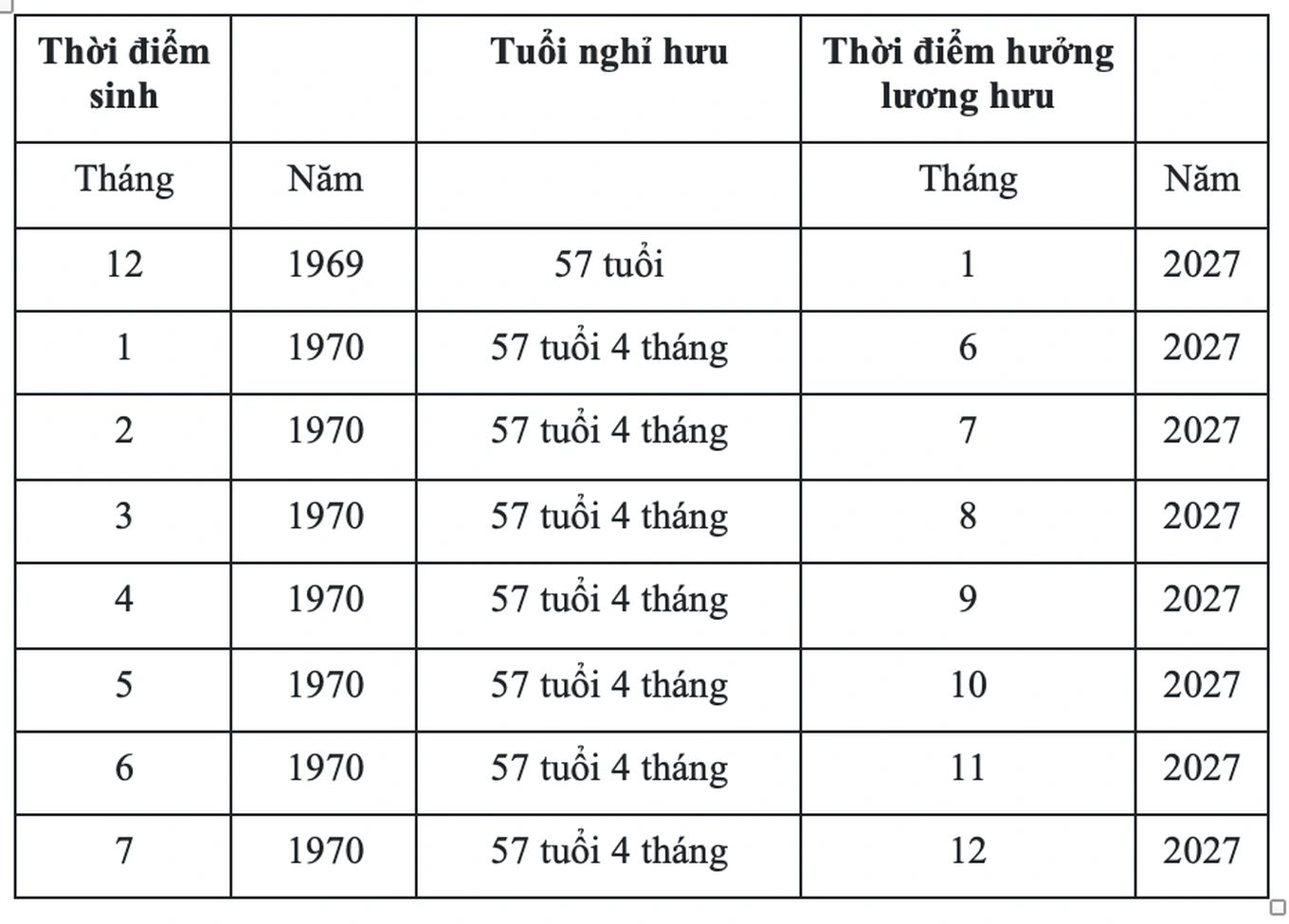
2027 retirement time lookup table for female workers:
According to the Law on Social Insurance (BHXH) 2024, employees are eligible for pension when they reach retirement age according to the provisions of the Labor Code and have compulsory social insurance contributions for 15 years or more.
Thus, the conditions for enjoying pensions for employees working in normal conditions in 2027 when having a compulsory social insurance contribution period of 15 years or more and reaching retirement age according to regulations (male workers are 61 years and 9 months old; female workers are 57 years and 4 months old).
The monthly pension level is calculated based on the average salary used as the basis for social insurance contributions and the social insurance contribution period.
For female workers, the benefit level is equal to 45% of the average salary for 15 years of social insurance contribution, then for each additional year of contribution, an additional 2% is calculated, with a maximum of no more than 75%.
For male workers, the benefit level is equal to 45% of the average salary for 20 years of social insurance contributions, then for each additional year of contribution, an additional 2% is calculated, with a maximum of no more than 75%. In case men have a contribution period of 15 years to less than 20 years, the benefit level is 40% for 15 years, then for each additional year of contribution, an additional 1% is calculated.
When employees retire early, receive early pensions due to reduced working capacity, the benefit level is calculated as above, then for each year of early retirement, it decreases by 2%. If the early retirement period is less than 6 months, it does not decrease, from 6 months to less than 12 months, it decreases by 1%.


