
This information is stated in a survey report of nearly 5,000 people conducted by the United Nations Development Program (UNDP) in collaboration with the Mekong Development Research Institute (MDRI).
According to the survey results, up to 16.84% of respondents said they had contacted neighborhood group leaders, village heads, and hamlet heads to resolve issues related to individuals, families, or authorities. This rate is almost double compared to the number of people contacting commune/ward officials and civil servants directly, at 8.63%.
Notably, more than 84% of meetings with village heads and residential group leaders were evaluated as effective by the people.
The survey also shows that not organizing district level is assessed by many people as a plan that brings positive improvements in the provision of public services, especially in the ability to contact the government and resolve administrative procedures.
About 65.2% of respondents believe that removing the district level helps improve public administrative services; 61.1% assessed that contact conditions with the government have improved.
However, in reality, instead of going to commune-level officials, many people still prioritize contacting village heads and neighborhood group leaders - people who live right in residential areas, understand the situation and can support quick handling of daily problems.
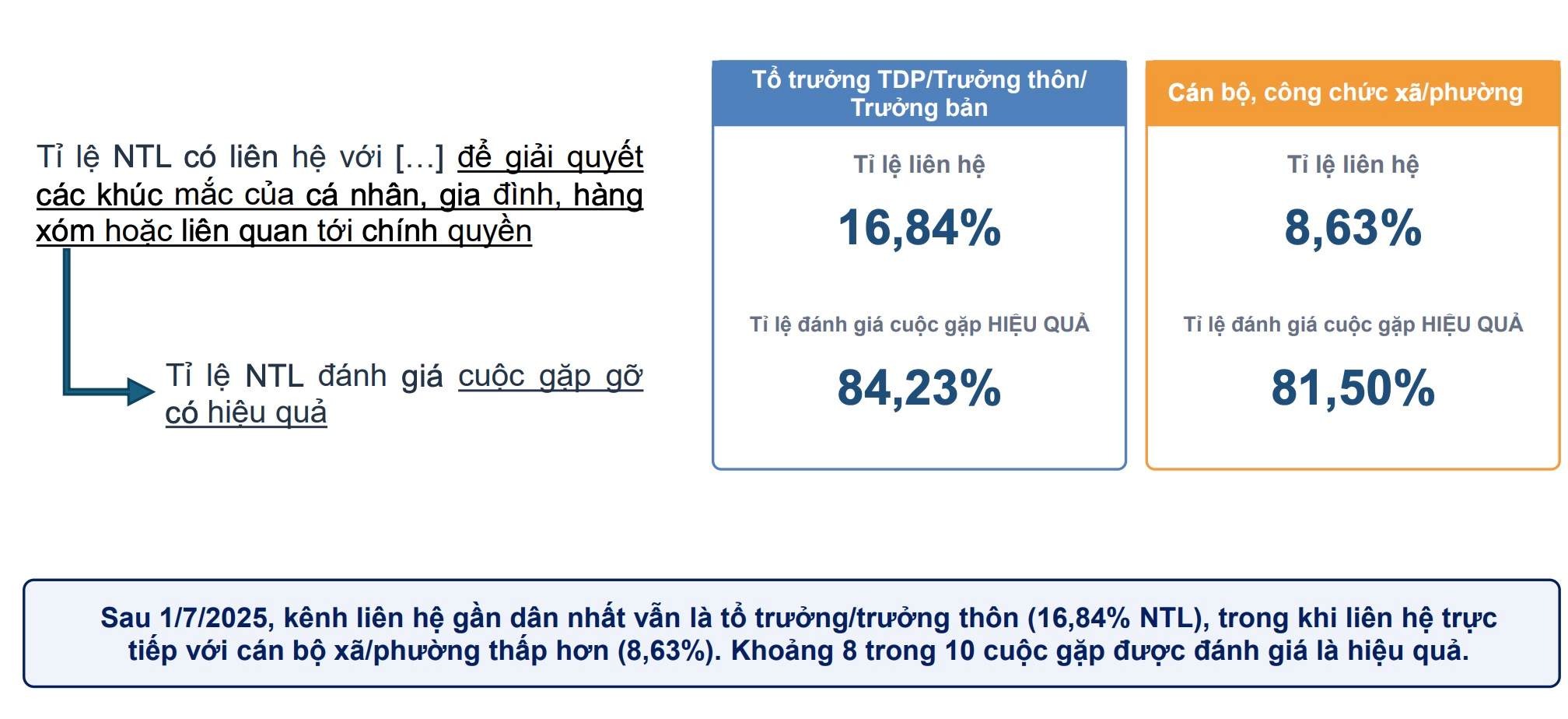
The survey report stated: "After July 1, 2025, the closest contact channel to the people is still the group leader and village head.
This result also shows that the role of village heads and residential group leaders is still very important in the context of the local government apparatus being arranged and streamlined.
However, along with the requirements of digital transformation and increasing work pressure, this team also faces higher requirements for technology skills, work handling ability and appropriate remuneration mechanisms.
Exchanging about this content, M.A. Nguyen Minh Nhut - a public policy expert - said that in fact, the team working in villages and residential groups is mainly part-time, and the elderly have existed for a long time.
According to him, in the context of strong digital transformation, this team currently not only does grassroots mobilization work but also has to proficiently use electronic identification applications, online public services and social networks to support people.
Workers in villages and residential groups need to adapt to the rapid development of technology and innovate their working methods" - Mr. Nhut said.
The expert believes that the current allowance fund and concurrent position mechanism partly helps stabilize income so that this team can feel secure in their work. However, besides financial support, it is necessary to strengthen digital skills training such as using management software, public service portals, digital communication skills, online reflection and access to population data in the working process.
Mr. Nhut also said that there should be appropriate forms of recognition for those who quit their jobs in residential groups and villages after arrangement, such as commendation and gratitude according to seniority and work achievements to recognize their contributions at the grassroots level.
Agreeing with the view that it is necessary to increase motivation for the grassroots team, Dr. Dao Hung - University of Economics and Law (Vietnam National University Ho Chi Minh City), said that it is necessary to increase allowances for village heads and residential group leaders from surplus funds after mergers and concurrent positions.
According to Mr. Hung, reducing the number of focal points through mergers and concurrent appointments will create a budget savings. This should be considered a resource of the local community to increase allowances for the force working directly at the grassroots level.


