
Elevating Vietnam's scientific capacity
On the occasion of the 120th Anniversary of Traditional Day (May 16, 1906 - May 16, 2026), Vietnam National University, Hanoi received more good news. That is, the School of Management and Business (HSB) under Vietnam National University, Hanoi was officially awarded the QS Stars 5 Stars for Business Schools certificate by prestigious international education ranking organization QS Quacquarelli Symonds (QS - UK).
As of May 2026, Vietnam has only had three educational institutions meeting QS Stars 5 Stars standards, including VinUniversity, British University Vietnam and School of Management and Business (HSB), Vietnam National University, Hanoi. Among them, HSB is the first public school to achieve this certification.
Prof. Dr. Hoang Dinh Phi - Rector of the school - said that QS 5 Stars is not only a recognition of HSB's training quality and university governance capacity, but also affirms the international competitiveness of the self-reliant public university model in Vietnam.
In the coming time, HSB will continue to promote digital transformation, develop science and technology, internationalize and connect businesses to train a generation of globally capable leaders, entrepreneurs and managers" - Prof. Dr. Hoang Dinh Phi said.
The success of HSB is only part of the overall success of Hanoi National University over 120 years.
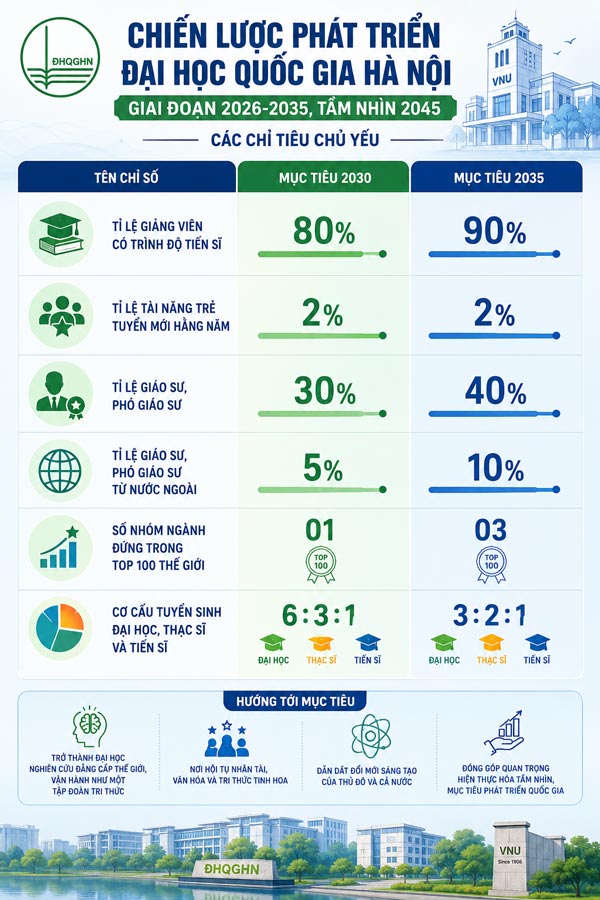
At the end of December 2025, Hanoi National University issued the Development Strategy of Hanoi National University for the period 2026-2035, vision 2045. The strategy affirms its mission: "Converging and nurturing talents, developing human resources and elite knowledge, leading innovation, implementing national strategies and jointly building the future of humanity". Vision to 2045 "to become a world-class research university, operating like a knowledge corporation; a place to gather talents, culture and elite knowledge, leading innovation of the Capital and the whole country, making important contributions to realizing the vision and goals of national development".
Highlight in the development strategy for the period 2026-2035, vision 2045, Vietnam National University, Hanoi identifies "Excellent research associated with training elite" as one of the most important strategic pillars. This orientation not only elevates the scientific capacity of Vietnam's leading universities but also builds a knowledge ecosystem, innovation and talent training, directly contributing to the development of Hanoi Capital and the country in the knowledge economy era.
The new strategy aims to build influential research programs, form strong research groups and excellent scientific centers, thereby creating knowledge and technology breakthroughs. VNU-Hanoi prioritizes the development of basic science, interdisciplinary science, key techniques and strategic technologies - fields that can create a foundation for innovation and knowledge economic development.
This orientation is not only aimed at enhancing the scientific position of VNU-HN on the international academic map, but also contributes to affirming the role of universities as a center of knowledge and strategic thinking, a place to provide scientific arguments to serve policy making and national development.
New standards in university training
Attending and speaking at the 120th Anniversary of Traditional Day (May 16, 1906 - May 16, 2026) of Hanoi National University, General Secretary and President To Lam requested Hanoi National University to focus on performing well 7 key tasks. These tasks are a major action program, requiring Hanoi National University to overcome the limits of a normal university to become a center of intelligence, a gathering place for Vietnamese intelligence, leading innovation and contributing to solving major problems of the country.
The General Secretary and President requested Hanoi National University to "reflection itself in national responsibility" as a starting point of fundamental significance. The two words "nationality" are not just a name, but honor, responsibility and mission.
In an era where national destiny is increasingly decided by knowledge, science, technology, innovation and human quality, Vietnam National University, Hanoi must rise even stronger, become a leading academic pillar, a major creative center, a pioneering force of Vietnamese higher education; and at the same time be a typical and prestigious face of Vietnamese intelligence in the international arena" - General Secretary and President To Lam emphasized.
The General Secretary and President also requested to build Hanoi National University into a modern, multi-disciplinary, multi-field university, operating under the innovation university model. "Essence" here is not a title to be proud of, but must be measured by academic quality, the ability to create new knowledge, the ability to train talents, develop strategic technology and make practical contributions to the country.
This requirement is also consistent with the orientation "Excellent research associated with elite training" in the strategy of Vietnam National University, Hanoi.
The General Secretary and President also emphasized that Hanoi National University must be a place that dares to go ahead, dares to experiment and pave the way for new models in education, science, technology, innovation and digital transformation; must be a pioneer in implementing the Party's strategic resolutions; focus on solving major national problems, especially strategic technology, core technology, source technology and technology products bearing Vietnamese brands.
Hanoi National University has the task of providing a practical basis for the Party and State to continue to improve development policies. The school needs to become a gathering place for national intelligence (big scientists, leading technology experts, technology entrepreneurs, outstanding students...) to research, master and develop foundational technologies such as artificial intelligence, semiconductors, biotechnology, new materials, new energy, big data, green and sustainable technology.
The seven tasks set by the General Secretary and President are not only for Hanoi National University, but also suggest a new standard for Vietnamese higher education. That is the standard of responsibility, spirit of liberation, creative capacity, service ability and aspiration to reach out to the world with the most important goal of creating a knowledge foundation for national development.
Assoc. Prof. Dr. Truong Ngoc Kiem (photo) - Director of the High-Tech and Innovation Park, Vietnam National University, Hanoi - said that immediately after the speech of the General Secretary and President, the Director of Vietnam National University, Hanoi directed the development of an action program to implement the assigned tasks.
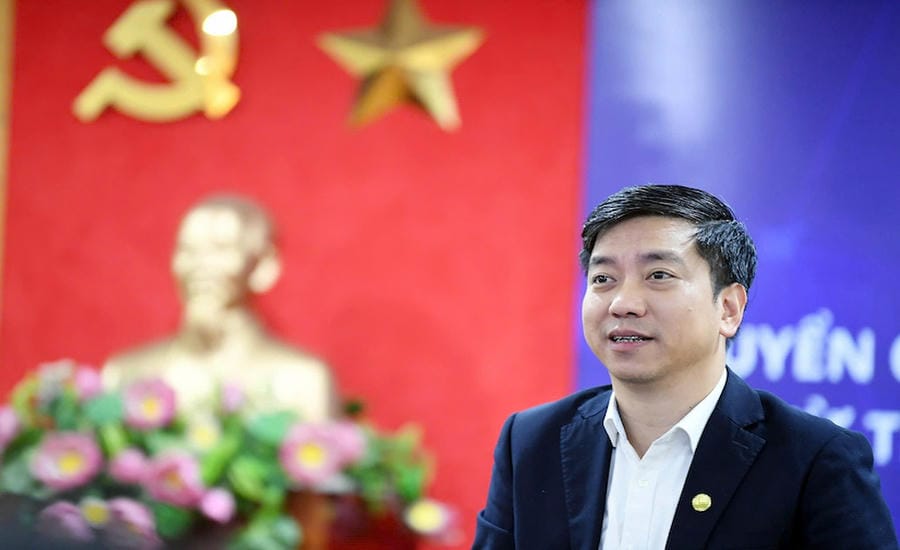
For the High-Tech Park and Innovation, the two immediate tasks are to review the entire system, the results of science and technology and innovation activities of Hanoi National University over the years; and at the same time promote connections with localities and businesses to bring research results to serve practice.
Prof. Dr. Nguyen Dinh Duc (photo) - University of Technology, Vietnam National University, Hanoi - said that the profound point in the speech of the General Secretary and President is that they have recognized Hanoi National University throughout its history, present and future.
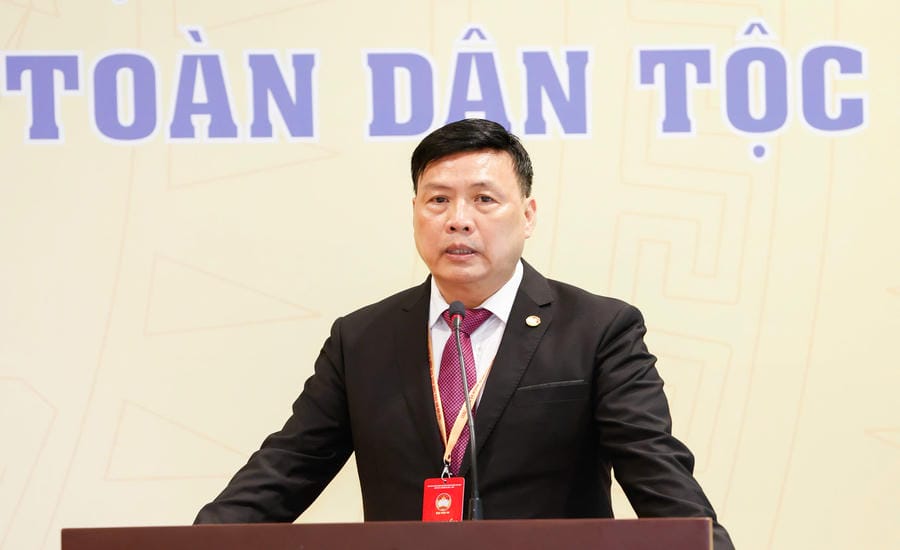
He especially emphasized the requirement to build Hanoi National University into an elite, modern, multidisciplinary, multi-field university and operate according to the innovation university model.
To achieve that goal, according to him, first of all, it is necessary to fundamentally innovate the university governance model towards governance based on goals, quality, output products and social impact.
In addition, it is necessary to remove bottlenecks in institutions, finance, human resources and university autonomy.
He emphasized the role of policies to attract talent, innovate training in an interdisciplinary direction, develop critical thinking, digital capacity and social responsibility for students. At the same time, it is necessary to promote academic diplomacy, build academic culture, freedom of research and scientific integrity to enhance Vietnam's intellectual position in the international arena. Tuong Van wrote.


