
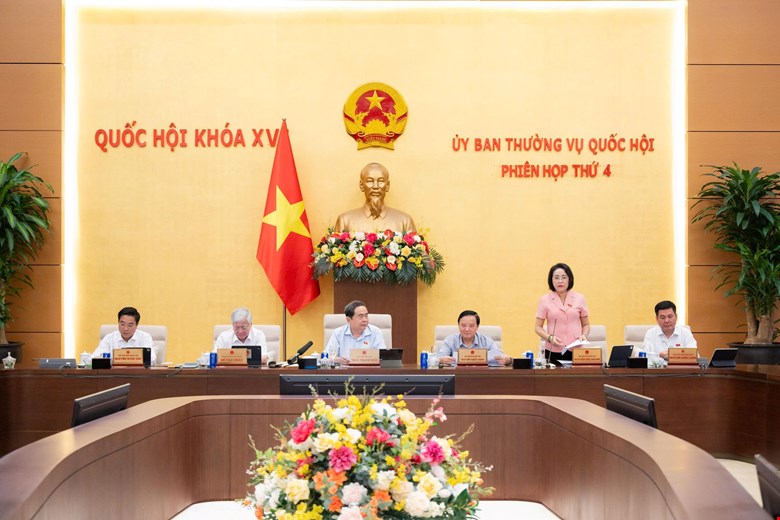
On the morning of July 15, the National Assembly Standing Committee gave opinions on the draft Law amending and supplementing a number of articles of the Publishing Law (draft Law).
Member of the Party Central Committee, Minister of Culture, Sports and Tourism Lam Thi Phuong Thanh presented a summary report on the draft Law.
After more than 12 years of implementation, in addition to the advantages and advantages, the 2012 Publishing Law has revealed some limitations and inadequacies, focusing on 3 major groups of issues.
Typically, administrative procedures, decentralization, and delegation of power are no longer suitable for the 2-level local government model; the number of procedures is still large, concentrated at the central and provincial levels, not meeting the requirements of administrative reform and digital transformation.
Minister Lam Thi Phuong Thanh said that the draft Law aims to promptly institutionalize the Party's guidelines and policies on publishing, culture, digital transformation, international integration and the private economy; overcome limitations and inadequacies, complete the legal corridor, and create motivation for publishing, printing and distribution activities, especially in the digital environment.
According to Minister Lam Thi Phuong Thanh, the draft Law on innovation in state management in the direction of strengthening management by data, digital technology and post-inspection; expanding the scope of operation of publishing houses, allowing participation in publishing - media groups and corporations; innovating regulations on governance and personnel in a professional and modern direction.
In particular, the draft Law for the first time creates a legal basis for the publishing - media group model to strengthen linkages, focus resources and improve the competitiveness of the publishing industry.
Accordingly, the draft Law stipulates that publishing and media groups are groups of companies, without legal status, not required to register for establishment according to the provisions of the law on enterprises, operating under the parent company - subsidiary company model, having relationships with each other through share ownership, contributed capital or other links, in which the parent company is the publisher.
Fundamentally innovate state management methods, simplify and drastically reduce administrative procedures; strengthen the protection of copyright, prevent and combat illegal printing and protect publishers.
Expressing the viewpoint of the thẩm tra agency, Chairman of the Committee for Culture and Social Affairs Nguyen Dac Vinh said that the Standing Committee basically agreed with the scope of regulation and subjects of application of the draft Law.
However, some opinions suggest that the draft Law has supplemented publishing activities in cyberspace. It is proposed that the drafting agency study and clarify this content to avoid expanding the scope of regulation of the Law.
The Standing Committee of the Committee believes that the addition of regulations on the model of publishing and media groups is necessary to institutionalize the Party's policy.
However, it is proposed that the drafting agency review and carefully study the regulations on the model of publishing and media groups in the draft Law to be consistent with the reality in Vietnam; ensure feasibility, create a favorable legal corridor for building and forming key national publishing and media groups, multi-platform, multi-product.


