
On December 13, in Hanoi, Politburo member and Prime Minister Pham Minh Chinh attended a national conference to summarize the Judicial work in 2025, the 2021-2025 term, orient the work for the 2026-2030 term and deploy key tasks in 2026.
In his speech, Prime Minister Pham Minh Chinh emphasized that in the overall achievements of the country, the Judiciary has made many practical and comprehensive contributions and clearly demonstrated its role as the "legal gate" agency of the Government, taking the lead in the "revolution" of building and perfecting institutions and laws.
The Prime Minister stated that 2026 is a very important year, the year of holding the 14th National Party Congress; the first year of implementing the Resolution of the 14th National Party Congress and Party Congresses at all levels.
The head of the Government emphasized 3 strategic orientations including:
First, promote the core role in advising on the strategy for building and perfecting institutions; prioritize the synchronous construction of development institutions, focusing on the legal system; innovate thinking to make laws, shifting from "management by law" to "creating development institutions".
Eliminate the thinking of "if you don't know, you can still manage", "if you can't manage, then ban"; promote decentralization and delegation of power along with resource allocation, improve the implementation capacity of subordinates and strengthen supervision and inspection.
Promote comprehensive digital transformation, extensively applying information technology, artificial intelligence and big data in the judicial sector, especially developing and promulgating legal documents, organizing law enforcement; build a system to measure the quality of law enforcement based on the satisfaction of people and businesses.
Prioritize the development of high-quality judicial human resources, with strong ethics and political will, deep expertise, understanding of international law, being proficient in technology, perseverance and courage, especially in the face of new and creative issues.
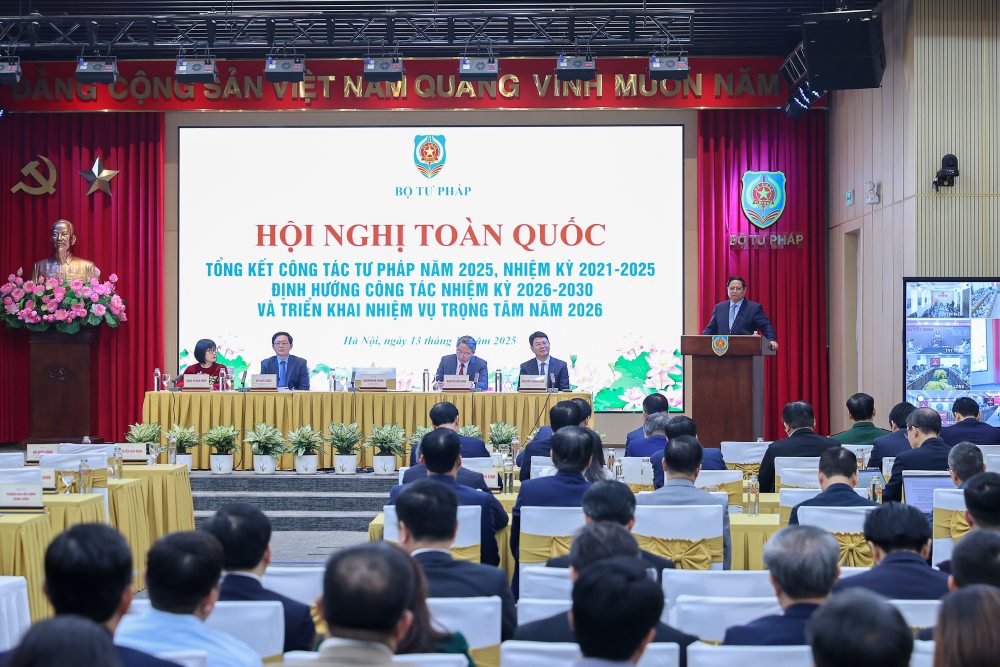
The Prime Minister requested to continue studying institutional improvement and effectively organizing the implementation of legal regulations on civil judgment enforcement and administrative judgment enforcement; strive to complete and exceed assigned targets; ensure 100% of judgments and decisions of the Court on administrative cases are legally valid and are monitored for enforcement.
Effectively implement the provision of full online public services in key areas such as civil status, certification, registration of security measures, shortening time, reducing compliance costs for people and businesses.
Strictly implement the arrangement of a streamlined, effective and efficient apparatus in conjunction with building a team of Judicial staff with qualities, capacity, and qualifications to meet the requirements of tasks in the new period.
Receive and inherit the function of controlling administrative procedures from the Government Office, ensuring continuity and efficiency. Building a culture of "honesty - professionalism - efficiency" in the judicial sector, taking the satisfaction of people and businesses as the highest measure.
Each agency, unit, cadre and civil servant must uphold the spirit of the rule of law, be exemplary in complying with and implementing legal regulations.
Resolutely fight against and strictly handle acts of taking advantage of "bottlenecks" and legal openness to take advantage of policies and the situation of superiors "legalizing" to subordinates, promoting the role of inspection and supervision, the role of the people as masters.


