
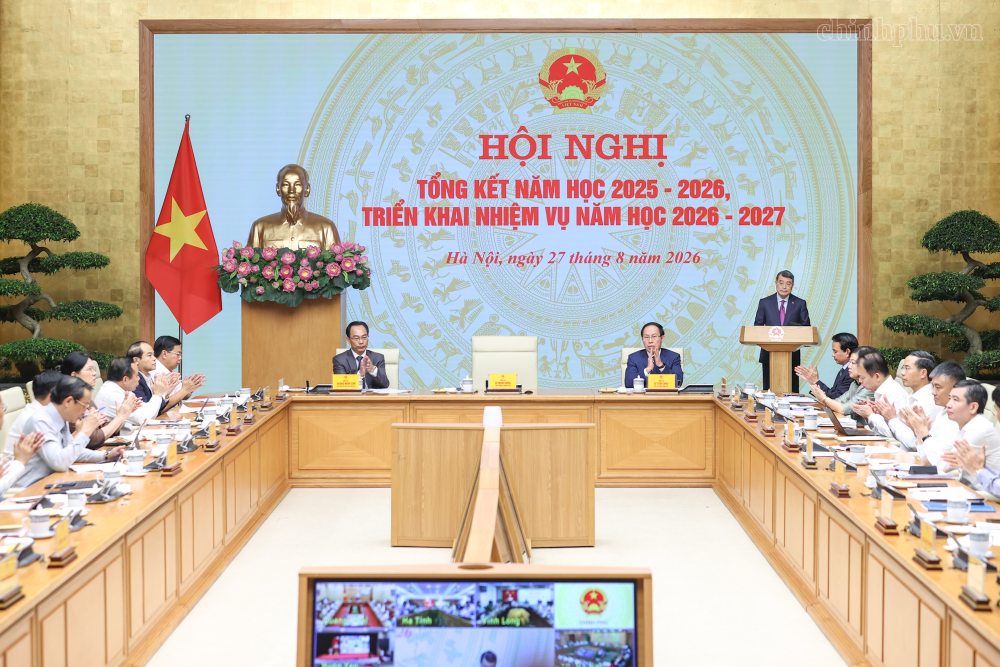
On August 27, at the Government Headquarters, Politburo Member, Prime Minister Le Minh Hung chaired the Conference to summarize the 2025-2026 school year and deploy tasks for the 2026-2027 school year.
Concluding the meeting, the Prime Minister acknowledged, highly appreciated, praised and congratulated the important and positive results of the entire education sector in the past academic year, contributing to the common achievements of the country.
Besides the achieved results, the Prime Minister pointed out that there is still a shortage of teachers, classrooms, functional rooms, and teaching equipment, which is an issue that needs to be especially prioritized and focused on to be resolved immediately and effectively in the coming time.
Teaching and learning methods, tests, and assessments are still heavily focused on scores and exams; the quality of textbooks is still limited.
The situation of achievement disease, cheating, distorted tutoring and extra classes, negativity in exams, and the burden of costs for families and parents still occurs, causing frustration and affecting the reputation of the industry.
We talk about achievement disease in exams, but for teachers teaching students, the first thing must be ethics, awareness of complying with the law; respecting the law must be put first; violations and cheating in exams like that cannot be said to be just achievement disease but are awareness of law compliance, especially of teachers," the Prime Minister said.
In the new school year, the Prime Minister emphasized the requirement to focus on drastically handling existing problems and limitations in personnel and facilities; ensuring "sufficient schools, sufficient classes, sufficient teachers"; not allowing students not to go to school because of difficult circumstances.
Review and handle the situation of lack of classrooms, functional rooms, equipment; overload of schools and classrooms in urban areas and industrial parks. Substantive innovation from within the education sector, from school governance, teaching staff to teaching and learning content and methods, exams, tests, and assessments.
Continue to review the general education program and textbooks, promptly adjust inadequacies. Innovate inspection and evaluation work; resolutely fight against achievement disease and fraud in teaching and learning. Review regulations on records, books, and reports; stop the occurrence of types of records and books outside regulations, avoid unnecessary waste of time outside of expertise for teachers.
The Prime Minister requested the Ministry of Education and Training to direct and guide the substantive innovation of school governance, content, teaching methods, inspection, and evaluation; seriously rectify achievement disease, especially to overcome and prevent fraud and negativity; ensure school discipline and safety.
Overcome the situation of teacher surplus and shortage and disparity in conditions and access to education between regions; handle immediately, not to let the situation of textbook shortage occur, especially in difficult areas, ethnic minority areas, mountainous areas, border areas, and islands.
The Ministry of Home Affairs continues to coordinate with the Ministry of Education and Training to complete regulations on job positions, on that basis, propose the payroll of the education sector from the Central Government and localities to report to the Central Organization Committee, report to competent authorities for decision, and then assign the total payroll to localities to be autonomous in recruiting and using.
Continue to review the current situation of the contingent of state management civil servants in education and training at the commune level, organize training, fostering, professional standardization and appropriate arrangement.
Localities review needs, recruit all assigned staff; mobilize, arrange, and use teachers effectively, not allowing the situation of teacher surplus and shortage to last for a long time.
Review planning, prioritize land funds and investment capital for areas lacking schools, urban areas, industrial parks, difficult areas, and border areas; strengthen the review of redundant public headquarters to continue arranging for educational institutions.


