
The Standing Agency of the Central Steering Committee for Science and Technology (S&T) Development, Innovation (IS) and Digital Transformation (CĐS) has just issued Notice No. 24-CQTTBCĐ dated July 7, 2026, concluding the conclusion of General Secretary, President To Lam, Head of the Steering Committee at the National Conference summarizing 1 year and 6 months of implementing Resolution No. 57-NQ/TW.
The notice clearly states that on July 1, 2026, at Dien Hong Hall, General Secretary, President To Lam, Head of the Central Steering Committee for S&T, Innovation and Digital Economy Development (hereinafter referred to as the Steering Committee) chaired the National Conference to summarize 1 year and 6 months of implementing Resolution No. 57-NQ/TW dated December 22, 2024 of the Politburo on breakthroughs in national S&T, Innovation and Digital Economy development (hereinafter referred to as Resolution No. 57-NQ/TW).
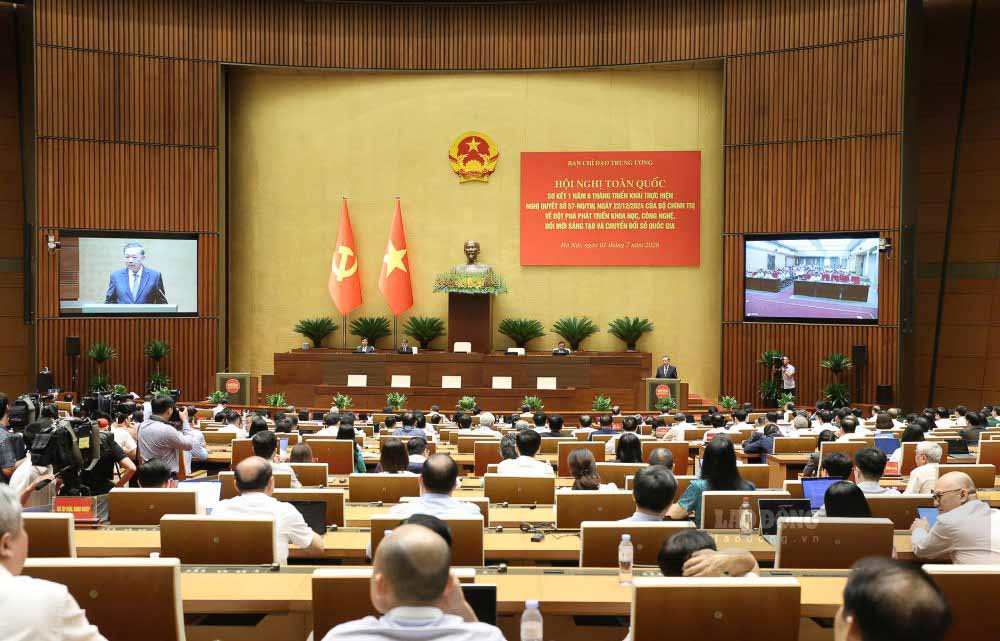
After listening to the Preliminary Report on 1 year and 6 months of implementing Resolution No. 57-NQ/TW; based on the orientations and directions of the Politburo, the Secretariat and the comments and exchanges of ministries, agencies, localities, and businesses, General Secretary, President To Lam, Head of the Steering Committee concluded as follows:
1. After 1 year and 6 months of implementation, Resolution No. 57-NQ/TW has created positive changes in the awareness and actions of the entire political system. KHCN, ĐMST and CĐS are identified as the main driving forces for innovating development models, improving productivity, competitiveness, management effectiveness and national autonomy capacity.
Institutions, mechanisms, and policies have been gradually improved; many bottlenecks and obstacles have been reviewed and removed. The national digital economy has achieved many positive results; digital infrastructure continues to be invested in; shared digital platforms have initially been effective.
The National Public Service Portal, the National Population Database and the VNeID application continue to be completed, connected, and exploited effectively, contributing to reducing administrative procedures, business conditions, improving service quality, reducing costs for businesses and people; e-commerce, cashless payments and artificial intelligence applications in some fields have created specific socio-economic efficiency.
In S&T and innovation, 10 strategic technologies associated with 30 strategic technology products and 20 major national problems have been identified; basic research activities, applied research and linkages between the State, schools, research institutes and businesses have initially been effective, contributing to bringing research results into practice.
Some Vietnamese businesses are gradually mastering technology, developing products to serve the domestic and export markets; many localities have proactively applied S&T and innovation to production, business, management, tourism development, building supply chains and traceability, thereby forming many creative models and ways of doing things, bringing practical efficiency.
2. Besides the achieved results, the implementation of Resolution No. 57-NQ/TW still has many shortcomings, limitations, bottlenecks in institutions, infrastructure, human resources, data, network security, information security and capital disbursement; actual results are not commensurate with policies, resources and political determination, have not created many specific strategic products, and have not made clear contributions to growth, labor productivity and national governance capacity.
The weakest stage today is the organization of implementation; in the same conditions, where the organization of implementation is drastic, the head directly directing creates specific products and results; where the implementation is still formalistic, slow, and the head has not fully promoted responsibility in leadership and direction, implementation discipline, changes are limited.
3. To overcome the above limitations, creating a clear shift from policy to practical results, it is required that Party committees, Party organizations, ministries, branches, localities, agencies, and units thoroughly grasp the major orientations of the Politburo, and organize the serious, drastic, and substantive implementation of tasks, solutions, programs, and plans to implement Resolution No. 57-NQ/TW and the 100-day Action Plan to handle bottlenecks in IoT issued by the Steering Committee, focusing on the following 4 key requirements:
First, continue to thoroughly grasp Resolution No. 57-NQ/TW associated with the implementation of the Resolution of the 14th Party Congress.
It is necessary to deeply understand that S&T, innovation and digital transformation are the main driving forces for innovating development models, establishing new growth models; and are the inevitable path to realize the country's two 100-year goals. In the context of increasingly fierce technological competition, the implementation of Resolution No. 57-NQ/TW is not only aimed at overcoming the risk of lagging behind but also directly contributing to improving strategic autonomy capacity, ensuring national defense, security and national sovereignty.
Each Party committee, Party organization, cadre, party member, especially the head, must identify the implementation of Resolution No. 57-NQ/TW as an important and regular political task; do not consider this a separate task of specialized agencies.
The implementation must be synchronous and drastic throughout the political system, from the Central to local levels, creating conditions for businesses and people to actively participate.
Second, strongly shift to creating specific products, results and values, directly contributing to the double-digit growth target.
The tasks of implementing Resolution No. 57-NQ/TW are only considered completed when there are operating products, verified data, actual users and measurable efficiency.
The results of implementation should not only stop at the issuance of documents, the development of plans, the organization of conferences or the establishment of apparatus, but must be shown by technology being mastered, data being connected, administrative procedures being reduced and simplified, productivity being improved, businesses developing, benefits brought to people, society and the level of contribution to growth.
Continue to promote digital transformation in the political system; and at the same time promote digital transformation in enterprises and the whole society, develop digital economy, data economy associated with innovation in management methods and improve labor productivity. It is necessary to ensure that data is accurate, sufficient, clean, alive, interconnected, and shared; restructure nghiệp vụ processes; build a team of cadres, civil servants, and employees with digital skills and a culture of working in the digital environment.
Regarding S&T and innovation, it is necessary to closely link the creation of new knowledge, mastering technology and transforming it into new values for society. Focus resources on mastering and developing strategic technologies into specific products, especially artificial intelligence, big data, robotics and automation, biotechnology and biomedicine, materials and energy, semiconductor chips, network security, quantum technology, unmanned aerial vehicles, marine, ocean and ground technology.
For each strategic technology, it is necessary to clearly define targets according to the milestones of 1 year, 3 years, 5 years and 10 years on mastered technology, product formation, export capacity and contribution to growth, defense, security, and national autonomy capacity. Ministries and agencies assigned to take the lead are not only responsible for processes and procedures but also responsible for the final product, results, efficiency and practical impact.
At the same time, it is necessary to especially attach importance to ensuring network security, information security, data security and national digital sovereignty; do not trade security and safety for development, but also do not slow down innovation because of risk concerns.
All digital systems, databases, and digital platforms must be designed, built, and operated according to requirements to ensure security and safety from the beginning. Agencies, units, and localities are primarily responsible for security and safety of information and data systems under their management.
Third, create synchronous changes from the Central to local levels, from agencies in the political system to the whole society.
Central ministries and sectors must promote the role of creating and developing industries and fields; proactively review and improve institutions, mechanisms, and policies; promptly issue standards, regulations, processes, and overall architecture. For major national problems, strategic technology, national databases, and inter-sectoral and inter-regional tasks, the agency assigned to preside over must directly direct and organize implementation to the end and be responsible for the results. At the same time, strengthen guidance, support, and accompany localities, overcome the situation of uncoordinated deployment, scattered investment, duplication, and lack of connection.
Localities must proactively organize implementation, be creative within the framework of law and according to decentralized and delegated authority; based on practical conditions, comparative advantages and development needs to choose the right focus and key points, avoiding spreading out. Each locality must clearly identify practical problems that need to be solved by science and technology, innovation and telecommunications; proactively register to take on major problems, propose mechanisms, models, and new ways of doing things; promptly reflect difficulties from practice to propose to the Central Government to amend and improve the institution.
The business community strengthens investment in research and development, technology innovation, digital technology, high-quality human resource training and participation in national strategic technology programs, truly becoming the center of the innovation ecosystem. Large corporations and enterprises in the state and private sectors promote their leading and pioneering roles in mastering core technology, developing Vietnamese technology products, deeply participating in the global value chain and forming innovative ecosystems with spillover effects.
Research institutes, universities and the team of scientists continue to promote their core role in creating new knowledge, new technologies and high-quality human resources; focusing on solving practical problems of the country, sectors, localities and businesses. For research, application and technology development activities, taking application efficiency, transfer and commercialization as one of the important measures; at the same time, continue to value basic research, especially in foundational and strategic fields.
To create a foundation of knowledge and human resources for the development of S&T, innovation and digital technology, it is necessary to have strong enough policies to attract and value Vietnamese talents, experts and intellectuals at home and abroad; form strong research groups, effectively connect the global network of Vietnamese intellectuals. International cooperation must shift from focusing on attracting capital to attracting knowledge, technology and experts, associated with improving research and development capacity and mastering domestic technology.
At the same time, it is necessary to especially attach importance to preparing domestic human resources. Right from the 2026-2027 school year, the education and training sector, higher education institutions and vocational education institutions must review training programs, prioritize strategic technology fields; promote digital skills training, innovation capacity and artificial intelligence application. Identifying improving the quality of human resources is the task of the entire political system, not just the education and training sector.
Fourth, strongly innovate leadership, direction, inspection, supervision and evaluation of implementation results.
Heads of all levels must directly lead, direct, inspect and be responsible for the results of implementing Resolution No. 57-NQ/TW within their scope of responsibility. Tasks under their authority must be proactively resolved, tasks beyond their authority must promptly report and propose to competent authorities for consideration and decision; do not wait, shirk, or evade responsibility.
The results of implementing Resolution No. 57-NQ/TW must be identified as an important criterion in evaluating officials, collectives and heads; praising, rewarding, and replicating organizations and individuals who perform well, have specific products and results; and at the same time reminding, reviewing, and handling appropriately cases of formal deployment, delays, and avoidance of responsibility; encouraging and protecting officials who dare to think, dare to do, and dare to take responsibility for the common good.
Party committees and Party organizations at the central and local levels develop plans for training, fostering, and preparing cadre sources; implement the policy of increasing the proportion of cadres with S&T qualifications in Party committees from 5% to 10% - 15%. Strictly implement the Politburo's regulations on quarterly cadre evaluation; promptly replace and transfer cadres who do not meet requirements and tasks.
The Central Inspection Committee and inspection committees at all levels strengthen inspection and supervision of the leadership, direction and organization of the implementation of Resolution No. 57-NQ/TW; promptly detect, rectify, and handle manifestations of formalism, delay, irresponsibility, ensuring that policies and tasks are implemented seriously, substantively, and effectively.
4. In the context of rapid and increasingly fierce technology competition in the world, the development gap is at risk of increasing, the implementation of Resolution No. 57-NQ/TW must not be delayed, must be more determined, act more strongly, and ensure substance and effectiveness.
Request members of the Steering Committee, Party committees at all levels, Party organizations, ministries, branches, and localities to directly direct the review of tasks under their responsibilities; clearly identify obstacles, causes, responsibilities, products and completion deadlines; urgently concretize them into action programs and plans with clear timelines and responsibilities; determined to make S&T, innovation and digital transformation a strong driving force for the country's development in the new period, contributing to bringing Vietnam to rapid, sustainable, strong and prosperous development.
Regarding the proposals of Hanoi University of Science and Technology and Vingroup Group mentioned in the presentation, it is requested that the Minister of Science and Technology, the Minister of Education and Training, according to their assigned functions and tasks, urgently work with the above-mentioned units to study and handle according to their authority; for contents beyond their authority, report to competent authorities for consideration and decision.
The Office of the Party Central Committee - the Standing Agency of the Steering Committee announces to members of the Steering Committee, Party committees at all levels, Party organizations, agencies, units and localities to know and implement.


