
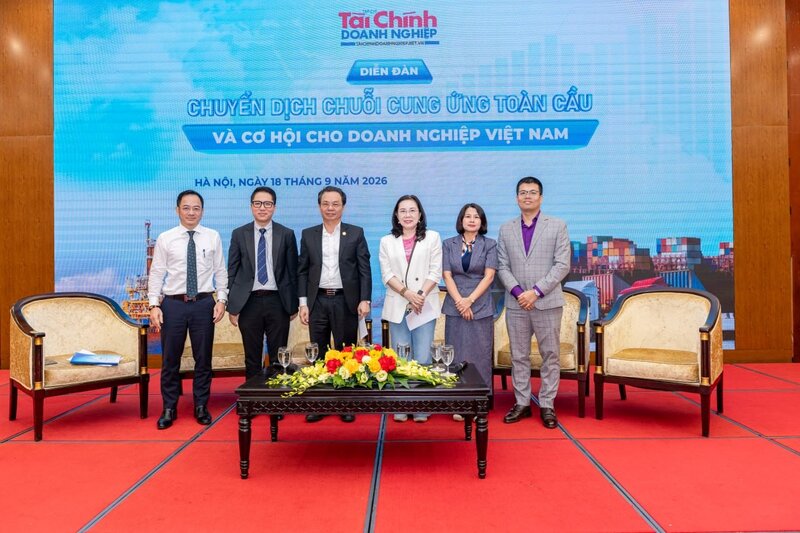
This is one of the outstanding contents discussed at the Forum "Global Supply Chain Transformation and Opportunities for Vietnamese Businesses", held on the morning of September 18, with the participation of experts, managers and the business community. The program is accompanied by Vietnam Electricity Group (EVN).
Sharing at the Forum, Dr. Pham Van Quan, Deputy Director of the Department of Industry (Ministry of Industry and Trade), said that after 40 years of renovation, Vietnam has made significant progress in the scale and capacity of the economy. Nominal GDP in 2025 reached about 514 billion USD, GDP per capita is about 5,026 USD. In the first 6 months of 2026, GDP increased by 8.18%; the industrial production index in 8 months increased by 11.9%, and the processing and manufacturing industry alone increased by 12.5%.
These results show that industry continues to be an important driving force for growth. However, along with the requirement to maintain growth rates, the problem is how to improve the quality of growth, increase the value created and retained in Vietnam.
According to Dr. Pham Van Quan, the FDI sector currently accounts for a large proportion of export turnover, while the contribution of domestic enterprises is still modest. This shows that Vietnamese enterprises still need to continue to improve their capacity to participate in higher value-added stages in the global supply chain.
From that reality, developing supporting industries is considered an important direction. Increasing the localization rate not only helps domestic enterprises be more proactive in components, raw materials and input products, but also expands the opportunity to become suppliers for multinational corporations operating in Vietnam.
To realize this goal, Dr. Pham Van Quan believes that it is necessary to simultaneously implement many groups of solutions, in which the focus is on continuing to reform institutions, improve policies, create a favorable environment for businesses to invest, innovate technology and expand production. Along with that is promoting links between FDI enterprises and domestic enterprises, technology transfer, developing domestic supplier networks and improving the ability to meet international standards.
Digital transformation and green transformation are also identified as increasingly important requirements for businesses. Not only helping to meet new standards of the international market, this process also creates conditions for businesses to improve productivity, quality and production efficiency.
Notably, the supporting industry development program for the period 2026-2035 aims to increase the localization rate in many key industries such as electronics, mechanics, automobiles, textiles and footwear. Along with that is the orientation to build a digital data platform to serve supply chain management and improve market mechanisms for domestically produced products.
Also at the Forum, according to MSc. Nguyen Anh Duong, Institute for Policy and Strategy Research, Vietnam continued to achieve positive results in attracting FDI. In 2025, Singapore led with 6.98 billion USD, followed by China with 5.19 billion USD and South Korea with 4.2 billion USD. In the first 8 months of 2026, the main investment partners included Singapore, South Korea, Hong Kong, Malaysia, China and Japan.
This capital flow creates more room for production, logistics, digital infrastructure and economic corridors. However, according to experts, capital flows and orders do not automatically transform into opportunities for domestic businesses if supply capacity does not meet requirements.
One of the notable bottlenecks is that the link between FDI enterprises and domestic enterprises is not commensurate with the scale of investment and trade. Many key export industries of Vietnamese enterprises are still concentrated in sectors with low added value, while electronic products and electronic components are mostly undertaken by the FDI sector.


