
Bitcoin price: Continue to depreciate
As of 5:26 p.m. today (December 15), Bitcoin - the world's largest cryptocurrency by market value continued to decline slightly by 0.13%, down to 89,946.70 USD.
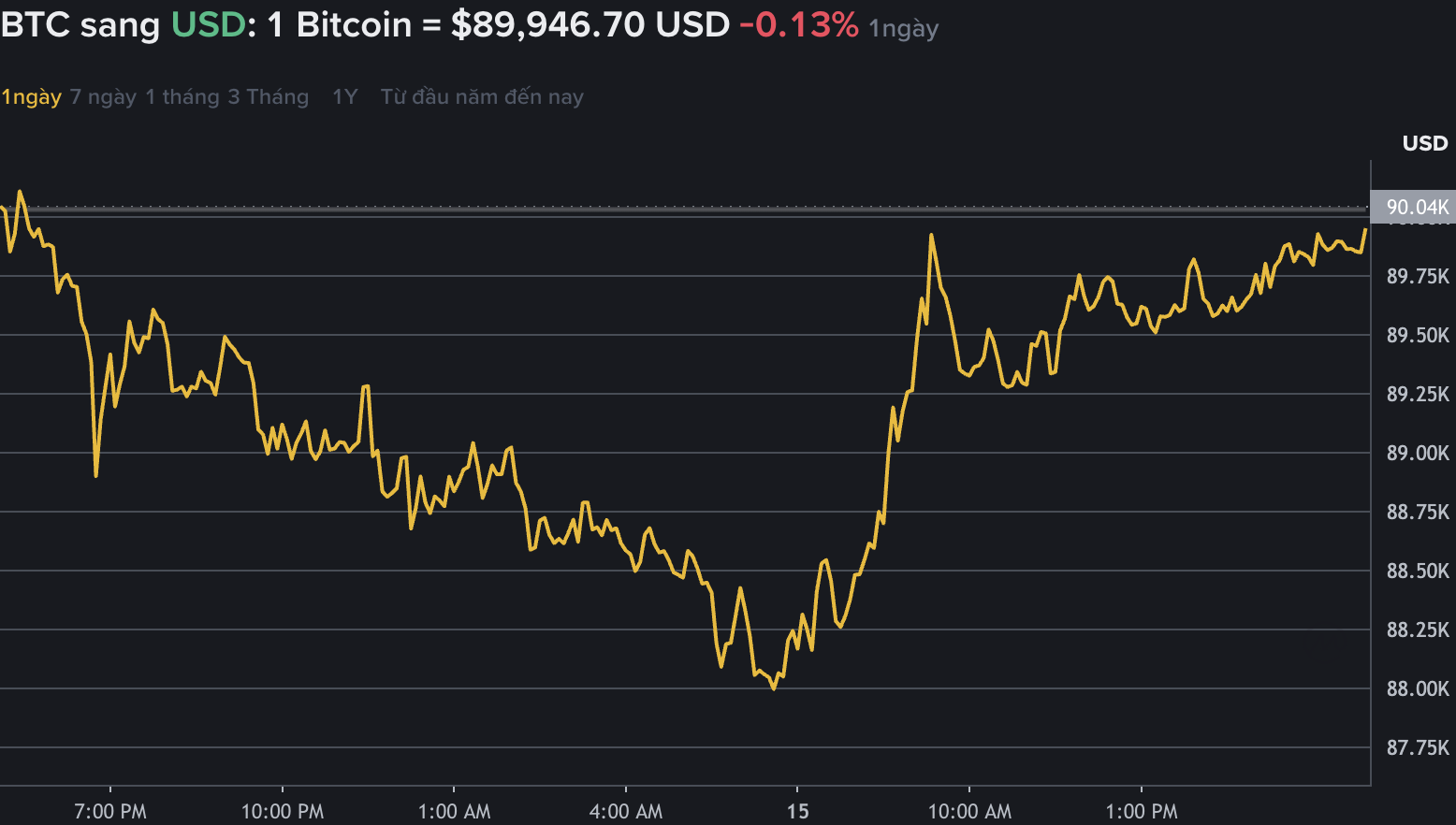
This new price contributes to bringing market capitalization to 1,792 billion USD, down 6 billion USD. Similarly, trading volume in the 24 hours was at 31.09 billion USD, down 39.08 billion USD.
Assessment and forecast
In fact, the market this year is less dramatic than the expectations of many famous Bitcoin investors. Bitcoin price once skyrocketed to a record of more than 126,000 USD in early October, but then plummeted back to the top of 90,000 USD after a flash crash on October 10, erasing all the yearly gains. This makes many investors' price targets look too far away.
Some Bitcoin price forecasts from investors, asset management companies and prominent figures in the cryptocurrency industry point out two points to note. First, not all forecasts are aiming for the end of 2025. This is important because some predictions may still be true in the future. Some people talk about the end of the decade, when Bitcoin surpassed 1 million USD, while CEO BlackRock Larry Fink described the scenario where national investment funds allocated 2-5% of their assets to Bitcoin.
Second, the motivations behind these predictions are quite similar. Many people consider the halving event (half-backing BTC) in 2024 as a catalyst to slow down the increase in supply, thereby supporting prices.
In addition, cash flow flows into spot Bitcoin ETFs in the US, businesses and even national investment funds put Bitcoin in the accounting balance sheet. Another factor is the unstable macroeconomic environment, causing investors to seek assets that are not tied to the pre-match and not under the control of a single government.
According to this logic, ambitious forecasts are not necessarily unreasonable, but perhaps they are just too optimistic about the timing. The author personally has also set a target for Bitcoin price this year at around 175,000 USD.
If we look back at 2025 without shocks from tariffs, war, persistent inflation, and a rapid crash on October 10, Bitcoin may have ended the year near the forecast average.
In fact, ETFs have recorded billions of dollars in net cash flow, businesses continue to accumulate Bitcoin, some countries have increased purchases and implemented strategic reserve policies, and there is a clear impact of supply tightening from the halving event. However, in 2025, a series of "opposites" appeared strong enough to curb the increase.
Most markets have not foraged these problems, nor have they considered whether cryptocurrency will have to compete directly with other risky assets such as artificial intelligence (AI) stocks, which have attracted much attention and capital flows this year.
For long-term investors, the lesson learned is that annual price targets are mostly for reference only. These forecasts help reveal the hypothetical of some people who understand the supply, acceptance level and macro context, but should not be a support for investment decisions.
According to analysts, the appropriate strategy to prepare for the Bitcoin trajectory in 2026 is to continue accumulating Bitcoin according to the price average method (DCA). With regular and patient buying, short-term price movements are not too important, because the high probability is that in 10 years Bitcoin will be higher than it is now.
In Vietnam, Bitcoin and other cryptocurrencies have not been recognized as a legal payment method and are not protected by law. Investors need to be cautious, avoiding risks from strong price fluctuations and fraud related to cryptocurrency.


