
According to Michael Widmer, Head of Metal Research at Bank of America (BofA), gold will continue to play a key role in hedging investment portfolios in 2026, with an average price forecast to reach 4,538 USD/ounce. Meanwhile, according to historical developments, silver prices may peak in the range of 135 - 309 USD/ounce.
Mr. Widmer said: "Gold continues to stand out as a defensive tool and a source of profit (alpha)". According to BofA, increasingly tight market conditions along with high profit sensitivity are making gold a defensive asset and an important profit driver in 2026.
Output decreases, costs increase
BofA's outlook for 2026 is based on forecasts of declining gold supply and rising mining costs. Mr. Widmer estimates that 13 major gold mining companies in North America will produce about 19.2 million ounces this year, down 2% compared to 2025, while saying that many market forecasts are currently too optimistic about output.
The average total maintenance cost (AISC) is forecast to increase by 3% to about 1,600 USD/ounce, slightly higher than the market consensus level.
However, manufacturers' profits are expected to increase sharply, with industry-wide EBITDA expected to increase by 41%, to about 65 billion USD in 2026.
Gold heads to 5,000 USD/ounce, silver may surpass
BofA forecasts that the average gold price at actual prices will reach 4,538 USD/ounce in 2026. In addition, silver, platinum and palladium are also expected to increase in price, reflecting a generally positive view of the precious metal group.
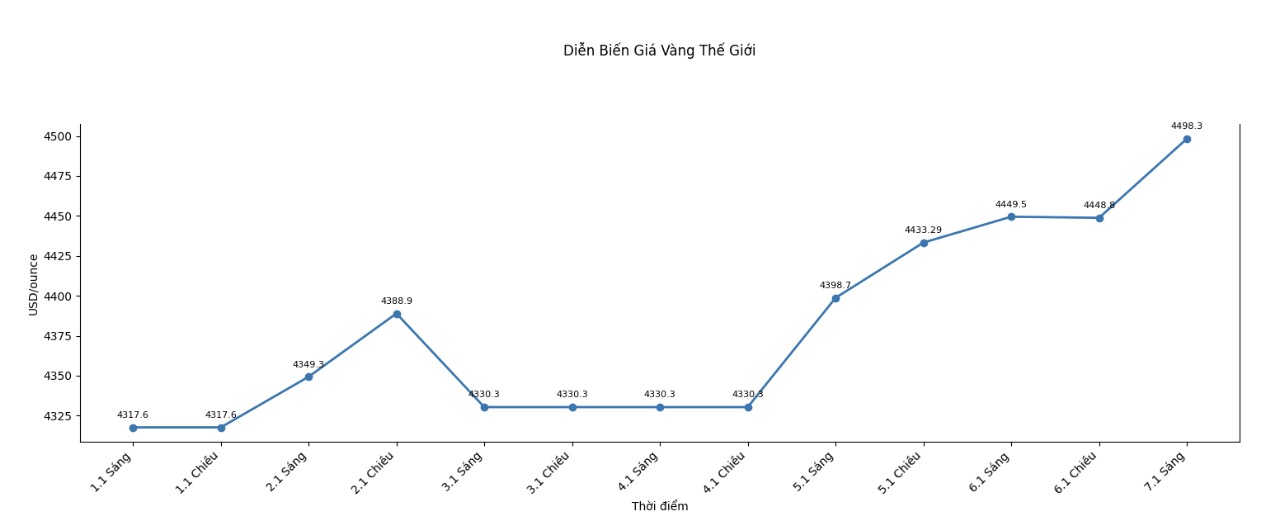
At the annual outlook conference in December, Mr. Widmer emphasized that gold's strong uptrend cycles usually only end when the initial fundamentals weaken, not simply because prices have risen.
I once said that the gold market is buying too much, but there is still a lot of room to become a tool to diversify portfolios," he said.
According to him, the favorable environment for gold is not over yet. BofA expects gold prices to reach the 5,000 USD/ounce mark in 2026. Just a 14% increase in investment demand is enough to achieve this goal - a capital increase that has appeared on average in recent quarters. Conversely, for gold to reach 8,000 USD/ounce, investment demand will have to increase by 55%.
Individual investors and central banks still have room to buy gold
Investment demand, especially from individual investors, has increased sharply recently. Capital flows into gold ETF funds since the beginning of the year have been highest since 2020. However, according to Widmer, there is still a group of important investors almost standing outside the gold market, and this may change next year.
Currently, gold accounts for about 4% of the total financial market, but in the professional investment community, wealthy investors (HNW) only allocate about 0.5% of their assets to gold.
Increasing interest in gold is taking place in the context that many investors are skeptical of the effectiveness of the traditional 60-40% allocation model. Mr. Widmer said that current studies show that holding 20% of the portfolio in gold is an effective strategy.
If analyzed from 2020 to now, it can even be argued that individual investors should hold gold over 20%, even 30% at the present time" - he said.
Not only individual investors, central banks are also expected to continue buying gold, although official reserves have reached record levels in 2025. According to Widmer, central bank gold reserves have exceeded US Treasury bond holdings, with gold currently accounting for about 15% of total reserves. However, his model shows that the optimal allocation can reach 30%.
US monetary policy is key
According to Widmer, the strong increase in gold in 2025 makes it difficult for many portfolio managers to ignore this precious metal next year.
Gold has been one of the best-performing assets in the past few years" - he said - "Many people think that gold does not generate profits, costs to hold. But in terms of price trends, gold has clearly contributed positively to the portfolio. The numbers speak for themselves".
Regarding the factor that could trigger a new wave of shifts to gold, Mr. Widmer believes that US monetary policy will play an important role in 2026. According to his model, in easing cycles - when inflation is above 2% - gold prices increase by an average of 13%.


