
The precious metal market this weekend tends to temporarily stagnate as risk-avoidance sentiment in the general market somewhat cools down, amid emerging perceptions that the US may prioritize monitoring developments and be more cautious before further steps in the Middle East.
According to records, February gold futures fell $14.1, down to $4,621.5/ounce. March silver futures fell $0.36, down to $91.055/ounce.
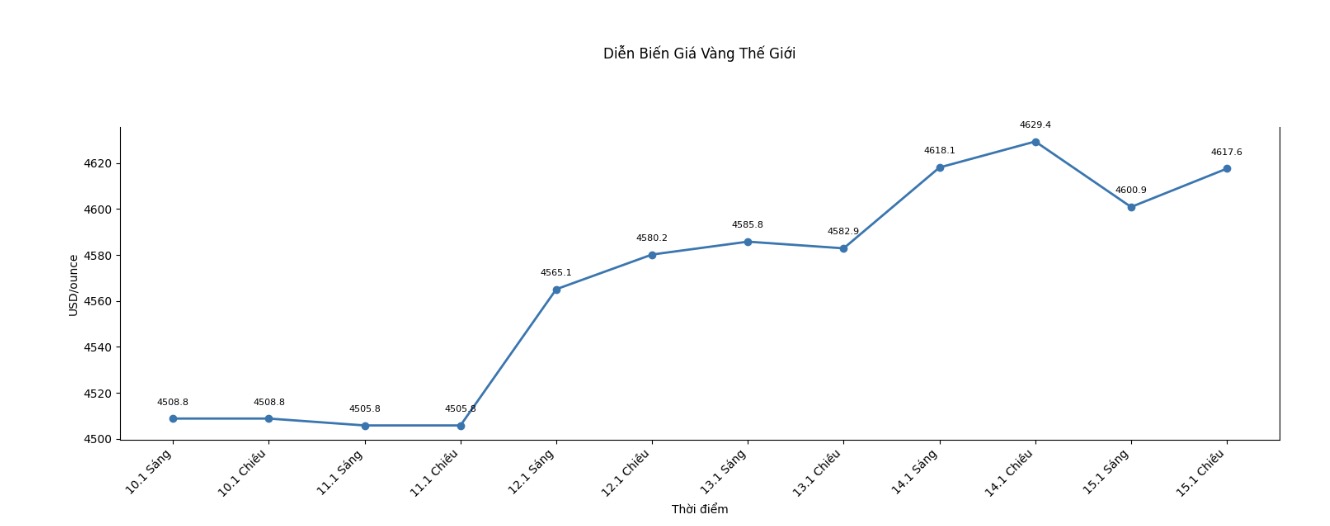
Another factor that investors are also paying attention to is US President Donald Trump's statement regarding personnel at the Federal Reserve (Fed). Mr. Trump said he has no plans to fire Fed Chairman Jerome Powell, although he said he is still monitoring information related to a review by functional agencies of the Fed's reform project.
This statement partly helps the market reduce concerns about the scenario of currency manipulation in the short term.
In addition, according to international reports, the US has not temporarily imposed new tariffs on important mineral groups, after months of review.
Instead, Washington will prioritize negotiations with partners to ensure supply and reduce the risk of supply chain breakdowns, while leaving open the possibility of applying import restrictions if agreements do not progress in a timely manner.
In Asia, the People's Bank of China (PBOC) is signaling that there is room to adjust policies towards supporting growth. PBOC said it may consider reducing interest rates and compulsory reserve ratios this year, and at the same time lowering interest rates for targeted credit support instruments by 0.25 percentage points; the one-year term interest rate for some re-lending programs is expected to decrease to 1.25% from 1.5%, effective from the beginning of next week. This move is assessed as showing that China continues to prioritize selective support measures in the context of weak demand.
Technically, the buying side of the February gold contract is aiming to close by surpassing the strong resistance zone of 4,750 USD/ounce. In the opposite direction, the selling side sets a short-term target of pulling the price below the strong support zone of 4,400 USD/ounce.
The nearest resistance level was determined at 4,650.50 USD/ounce (previous session's record high), followed by 4,675 USD/ounce. The near support zone is at 4,584.50 USD/ounce (day's bottom), followed by 4,550 USD/ounce.
The Wyckoff Market Rating indicator at 8.0 shows that the technical trend is currently strongly leaning towards the buying side, meaning that the upward momentum still prevails even though short-term price adjustments may appear.
The buying side on the March silver futures contract is holding a clear technical advantage on the chart. The next price increase target of the buying side is to bring the closing price above the strong resistance zone of 100 USD/ounce. In the opposite direction, the next price decrease target of the selling side is to pull the closing price below the strong support zone of 80 USD/ounce.
Regarding technical milestones, the nearest resistance was at a record high in the night of 93.7 USD/ounce, followed by 94 USD/ounce. The next support was determined to be at the bottom in the night of 86.125 USD/ounce, then up to 85.00 USD/ounce. The index assesses the trend according to Wyckoff at 9.5 (showing a very strong upward trend, the buying side overwhelming).
On the external market, the USD index edged up slightly. Crude oil prices fell sharply, trading around 60 USD/barrel. US Treasury bond yields for 10-year terms were at 4.136%.
Note that the world gold and silver market operates under two main valuation mechanisms including spot prices and futures contract prices. In the context of seasonal liquidity and year-end position structure, December gold futures contracts are currently the most actively traded term on the CME exchange.
See more news related to gold prices HERE...


