
Gold prices continue the accumulation trend around the threshold of 4,800 USD/ounce, in the context that the market has not recorded strong enough momentum to break through. This development appeared when the US economy still showed significant resilience, with positive consumer spending maintained, thereby continuing to support economic activity.
The US Department of Commerce said on April 16 that retail sales in March increased by 1.7%, higher than the adjusted increase of February of 0.7%.
This result exceeded the previous forecast of the economic community, when the consensus only expected retail sales in March to increase by 1.4%.
Year-on-year, US retail sales increased by 4%, showing that consumer purchasing power is still quite sustainable despite the high interest rate environment.

Notably, core retail sales, excluding cars, increased sharply by 1.9% in March, much higher than the 0.7% increase of the previous month. This figure also exceeded the forecast of 1.4% by economic experts.
Despite positive retail data, the gold market did not react too strongly after the above information. Spot gold prices were recorded most recently at 4,776.80 USD/ounce, down nearly 1% in the day.
According to Mr. Naeem Aslam - Investment Director of Zaye Capital Markets - gold prices are currently in a stalemate, as positive economic data may cause the US Federal Reserve (FED) to maintain a neutral monetary policy stance in the second half of this year.
Mr. Naeem Aslam said that this is not only a positive report, but also a strong increase in the context that the market has set quite high expectations. This forces investors to reconsider the possibility of the FED soon easing monetary policy.
According to this expert, gold is being affected by two opposing pulling forces. On the one hand, geopolitical tensions in the Middle East continue to support safe-haven demand and create a price base for precious metals. On the other hand, the rebound of the US economy increases expectations that interest rates will remain high longer, thereby putting pressure on gold.
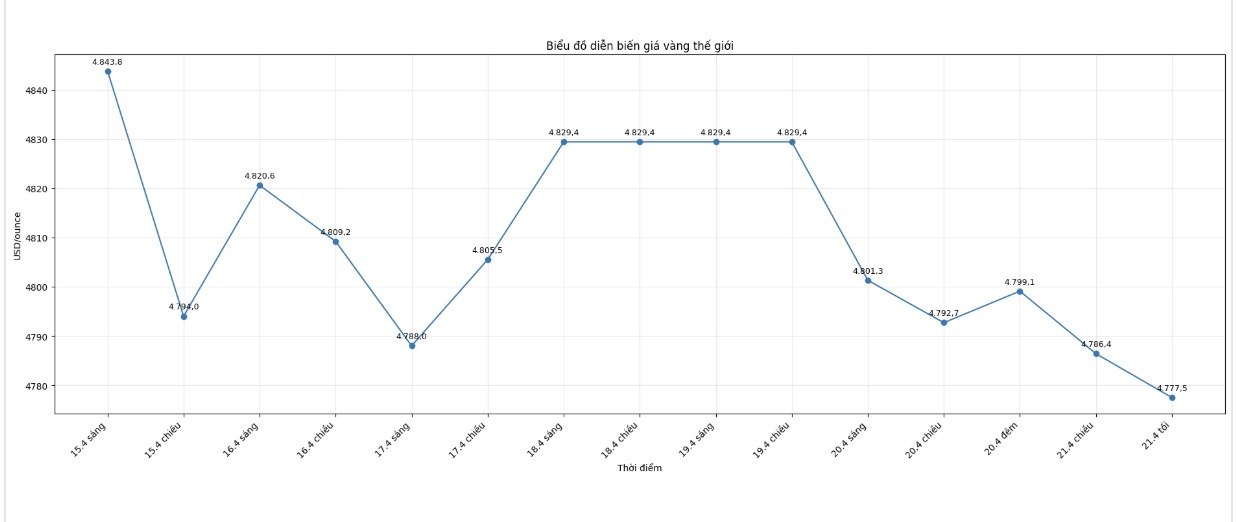
He also said that the fact that gold prices did not fall deeply, despite very positive retail data, shows that safe-haven demand related to instability in the Middle East is still creating support for the market. Meanwhile, Brent oil prices maintained above 91 USD/barrel reflecting supply risk factors, especially related to the Hormuz Strait region, are dominating energy developments more than demand prospects.
Since then, the commodity market is in a complex state: strong economic data pushes interest rate expectations high, but geopolitical risks cause commodity prices to remain high, limiting the decline of inflation-sensitive assets such as gold.
Sharing the same view, Mr. Chris Zaccarelli - Investment Director of Northlight Asset Management - said that the latest retail data is showing a contrasting picture between consumer psychology and actual spending behavior.
According to him, people may be dissatisfied with high prices and rising mortgage interest rates, but they still continue to shop. This reflects a more important reality: As long as the labor market is stable, consumers will continue to spend. Therefore, the job market is still the leading important indicator for the US economy at the present time.


