
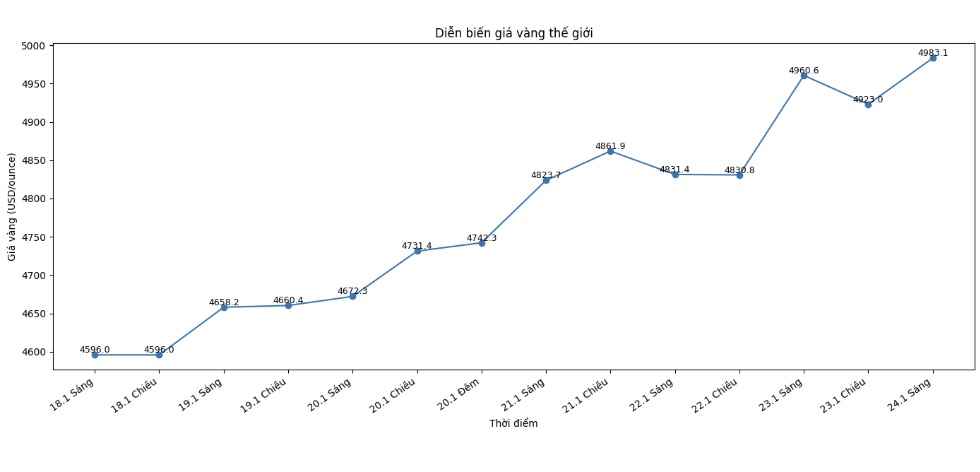
In the context of the market preparing for the possibility of gold prices reaching a milestone once considered "unimaginable" of 5,000 USD/ounce, Bank of America (one of the largest financial and banking groups in the world, headquartered in the US) has strongly raised its short-term forecast. BofA believes that gold prices could reach 6,000 USD/ounce in the spring of 2026 - the most optimistic forecast currently from a major financial institution.
History is not always a guideline for the future, but on average in the previous 4 price increase cycles, gold has increased by about 300% in 43 months. This implies that gold prices could reach 6,000 USD/ounce in the spring," BofA strategist Michael Hartnett wrote in a customer report.
This forecast means that gold prices may be 20% higher than the current historical peak.
Previously, on January 5, Mr. Michael Widmer - Head of Metal Research at Bank of America - said that gold will continue to play an important role in this year's investment portfolio.
Gold continues to stand out as a hedging and alpha-creating tool" - Widmer wrote. According to BofA, tight market conditions along with high profit sensitivity make gold an important risk hedging and profit engine in 2026.
BofA's gold price outlook for 2026 is based on forecasts of reduced supply and increased mining costs. Widmer said 13 major gold mining companies in North America expect to produce only about 19.2 million ounces this year, down 2% compared to 2025, while saying that many market forecasts are too optimistic about output.
He also forecasts that total maintenance cost (AISC) will increase by about 3%, to 1,600 USD/ounce, slightly higher than market consensus.
However, the profits of gold producers are expected to increase sharply, with the industry's total EBITDA expected to increase by 41%, reaching about 65 billion USD by 2026.

In addition, silver, platinum and palladium are also forecast to increase in price, reflecting the overall positive outlook of the precious metal group.
According to Widmer, silver may be more attractive to investors who accept high risks in exchange for greater upside potential. He noted that the current gold/silver ratio of about 59 shows that silver still has room to surpass gold. Historically, this ratio had decreased to 32 in 2011 - corresponding to a silver price of about 135 USD/ounce, and the 1980 bottom was 14, implying that the silver price could reach 309 USD/ounce.
At an online conference on annual prospects in December, Widmer said that gold price increases usually only end when the initial underlying factors weaken, not simply because prices have increased.
I once emphasized that the gold market is being overbought. But in reality, gold is still not being invested properly" - he said - "There is still a lot of room for gold to play the role of a tool to diversify portfolios.
Widmer said that a favorable environment for gold is unlikely to end soon. According to him, just an additional 14% increase in investment demand is enough to push gold prices up to the above target level - an increase equivalent to the average demand in recent quarters. Meanwhile, for gold to reach 8,000 USD/ounce next year, investment demand will have to increase by 55%.
Investment demand, especially from individual investors, has increased sharply recently, with capital flows into gold ETF funds in 2025 reaching the highest level since 2020. However, Widmer said, there is still a group of important investors almost standing outside the gold market, and this may change next year.
According to him, gold currently accounts for about 4% of the total financial market, but among professional investors, the super-rich only allocate about 0.5% of their assets to gold.
Increasing interest in gold is taking place in the context of many investors questioning the effectiveness of the traditional 60/40 asset allocation model. Widmer said that current studies show that holding 20% of the portfolio in gold may be an effective strategy.
If data from 2020 to now is analyzed, it can be argued that individual investors should allocate gold over 20%, even 30% at the present time" - he said.
Not only individual investors, central banks are also forecast to continue buying gold, even when official reserves have reached record levels in 2025.


