
Optimism is gradually returning to the gold market, as this precious metal closes a three-week downtrend after maintaining an important long-term support zone.
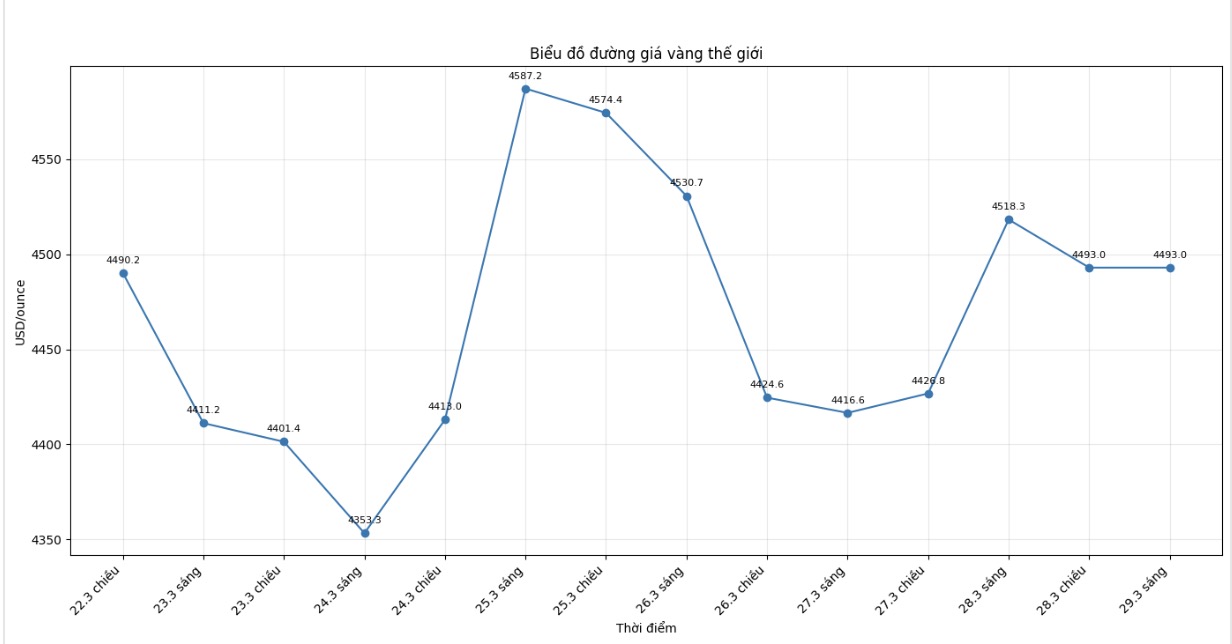
The gold market closed the week slightly up near the initial resistance level of 4,500 USD/ounce. Analysts said the precious metal has recovered significantly after falling to 4,009 USD/ounce at the beginning of the week. The upward momentum in Friday's session occurred even as oil prices and the USD went up together.
The nearest spot gold price was recorded at 4,493 USD/ounce, up more than 2.65% during the day. At the same time, the WTI light sweet crude oil contract for May delivery stood above the 99.64 USD/barrel mark, up sharply 5.46%.
Although it is too early to confirm that market sentiment has changed significantly, Mr. Michael Brown - senior market analyst at Pepperstone, said that this is a positive starting signal.
He said: "This shows that it is very likely that the market has formed a solid bottom, and the safe-haven factor of gold may be starting to reappear to a certain extent.
However, Mr. Brown noted that although price movements are positive, the market still faces many risks, especially if a prolonged war with Iran forces more central banks to convert official gold reserves into money.
Updated reserve data released by the Central Bank of Turkey on Thursday showed that the agency has converted nearly 60 tons of gold in the past two weeks.
Mr. Brown commented: "If many other central banks follow suit, it will put significant downward pressure on spot gold prices, almost completely reversing the momentum that pushed prices up in the past two to three years.
However, I think the 4,100 USD/ounce mark is an important reversal point. At least in the short term, I will be quite surprised if the price falls below this level, because buyers are likely to protect that price range very strongly if the market turns down again.
Commodity analysts at TD Securities also predict that the gold market may weaken further, as central banks use official reserves to cope with rising inflation due to rising energy costs.
According to this analysis group: "Gold is being traded as a risky asset, due to structural support from the formal sector, which is closely linked to the trend of diversification away from the USD, thereby creating USD surpluses.
The war in the Middle East has caused significant damage to the Gulf economies, while sharply reducing the surplus in East Asia, thereby creating a temporary break in demand from the formal sector.
Mr. Neil Welsh - Director of Metals at Britannia Global Markets, said that although bottom-fishing pressure has appeared this week, the gold market is still in a probing state, waiting for more signals showing that instability in the Middle East is being controlled or prolonged long enough to reactivate safe-haven demand.
He said: "That shift has not yet occurred, but conditions may be gradually forming. It is possible that gold has been pushed up too strongly in the previous uptrend. Currently, the price has decreased by about 20% compared to the peak at the end of January, and the rebound from below the 4,100 USD/ounce mark is an encouraging sign.
However, there are currently many factors dominating the price. When the temporary impacts subside, gold may return to its natural role as a safe haven asset.
Analysts believe that the prolonged conflict causing energy prices to rise is raising concerns about the stagnation, although the risks are still relatively low. According to them, this is an ideal environment for gold. In that scenario, central banks will be forced to cut interest rates right in the context of rising inflation, pulling real yields down sharply.


