
According to the assessment of the Bank of America (BofA), gold prices may continue the accumulation phase in the spring.
Despite facing short-term resistance, gold prices are still expected to close the month in a positive state when they have recovered after the sell-off at the end of January.
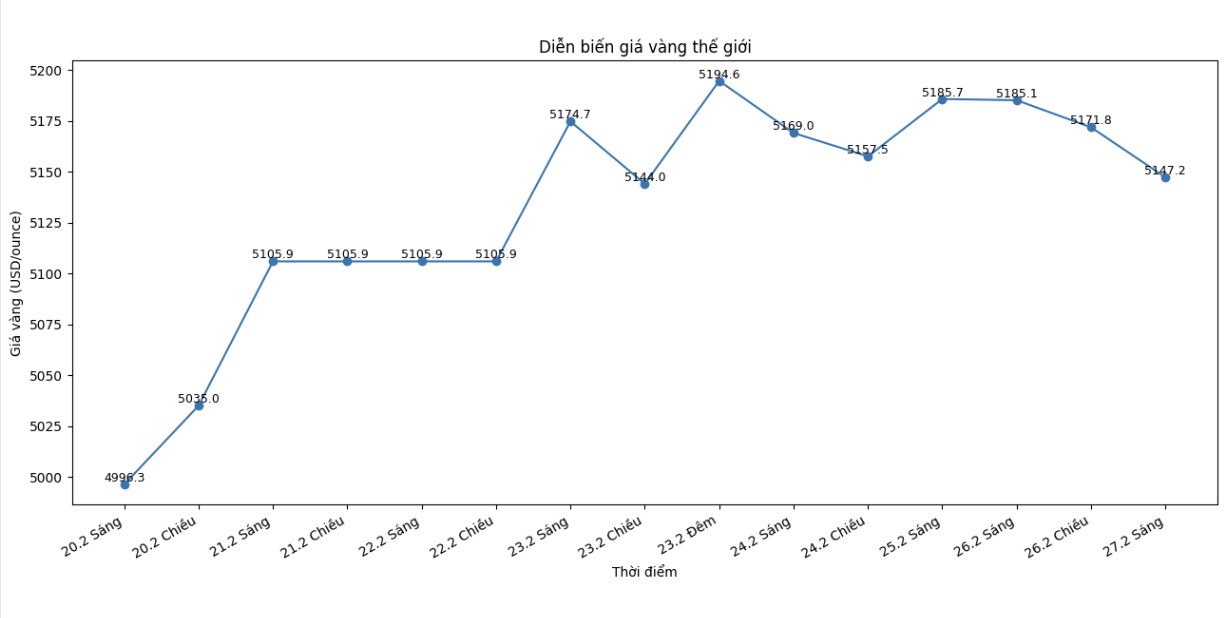
In the latest commodity report, Bank of America analysts reaffirmed the gold price target for the next 12 months at 6,000 USD/ounce.
However, they also admit that the precious metal is facing some short-term disadvantages as investors adjust their positions after a period of strong price increases.
“We are concerned about capital flows after the recent fluctuations. The increase in gold has really broken through when buying power comes from all three drivers including demand for gold bars and coins, buying activities of central banks and capital inflows into ETF funds. However, signs have emerged that investors are slowing down the rate of increasing gold weight.
Therefore, we are considering the possibility of gold prices weakening in the spring, although new instability related to tariff policies may prevent this accumulation period from prolonging" - experts said.
Besides the economic risks due to uncertainty in US tariff policies, analysts believe that the gold market also needs more clear signals from the US Federal Reserve (Fed) on monetary policy orientation.
The strong adjustment last month partly stemmed from President Donald Trump's nomination of former Federal Reserve Governor Kevin Warsh to replace Jerome Powell as Fed Chairman.
Mr. Warsh is considered a traditional policy maker, who can help the Fed maintain independence from political pressure. However, according to BofA, in the long term, this nomination is not as disadvantageous to gold as the market's initial sell-off reaction.
We acknowledge that there is still much uncertainty about the direction of the Fed under the new leadership. Most investors expect the USD to weaken and US Treasury bond yields to rise.
Usually, a weak USD will not be accompanied by a decrease in gold prices. Therefore, the bigger question lies in the impact of interest rates. Mr. Warsh once emphasized the intention to cut operating interest rates and this may support gold prices" - experts said.
However, according to analysts, interest rates are only part of the problem as the Fed still has to handle its huge balance sheet. Mr. Warsh said that he wants to narrow down the Fed's balance sheet, but BofA warned that this could be a major challenge.
After the global financial crisis, the Fed's purchase of Treasury bonds helped commercial banks have abundant reserves.
If the Fed narrows the balance sheet through quantitative tightening policies, this reserve may decrease, causing liquidity shortages and impacting the money market. At the same time, the Fed also wants to shorten the average term of the debt portfolio, but this may increase the risk of debt rollover for short-term bonds, while still pushing long-term bond yields up.
BofA believes that if the above factors occur in the context of no fiscal consolidation, raising concerns about budget deficits, investors may once again increase their gold holdings.


