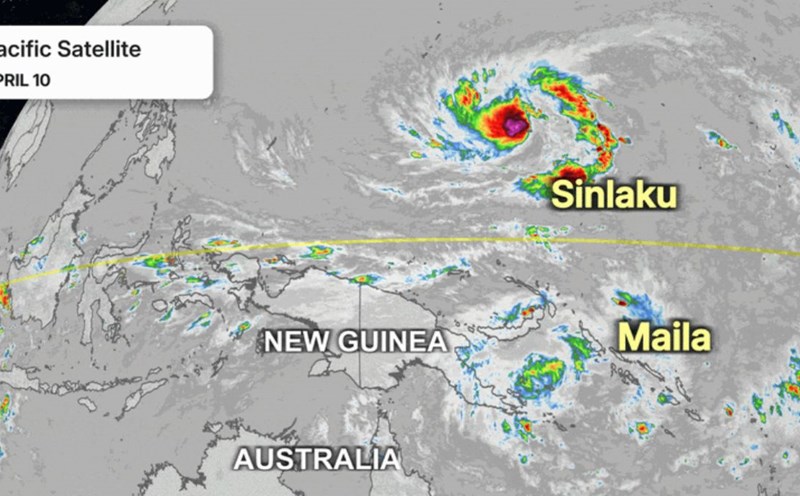
Extremely strong gusts of wind, heavy rain and the risk of flash floods put tens of thousands of people at serious risk.
Super typhoon Sinlaku is moving very quickly towards the Northern Mariana Islands - a US territory located about 9,650km west of San Francisco, where about 50,000 US citizens live.
Faced with the risk of a disaster landing, President Donald Trump has approved a federal state of emergency for this area, as well as Guam, to activate response resources from the US Federal Emergency Management Agency (FEMA).
According to the latest typhoon news on the morning of April 14 (Vietnam time), the center of the typhoon is about 240km southeast of Saipan Island. Sinlaku's maximum wind speed is up to 290 km/h, maximum gusts are about 330 km/h, moving northwest at a speed of about 16 km/h.
Even before the storm's center approached, strong winds began to affect Saipan, with gusts reaching about 80 km/h and expected to spread throughout the Mariana Islands.
Although the storm's path has moved further than Guam - an important US military center - helping the island significantly reduce the risk of direct impact, areas like Saipan still face extremely high risks.
The meteorological agency warns that when it gets closest, Sinlaku may maintain winds from about 210-250 km/h, with gusts possibly reaching over 320 km/h. This is equivalent to the super typhoon Yutu that devastated Saipan in 2018.
Local authorities have asked residents living in unreliable houses to quickly move to shelters. Schools and government agencies are closed, while flights are canceled in series.
Sinlaku is considered a rare weather phenomenon. This is only the second storm in history with such strong intensity to appear early in the year. Previously, the record belonged to super typhoon Hester formed in early 1953.
In addition to extremely strong winds, heavy rain is an equally dangerous threat. Rainfall in Guam and Rota is forecast to reach 380-510mm, while Tinian and Saipan may experience 200-380mm of prolonged rain for many days.
With a huge scale - a diameter of up to about 640km, Sinlaku can cause widespread heavy rain, even in areas far from the storm's eye. This increases the risk of flash floods, strong currents and landslides, especially in hilly areas.
At sea, large waves are expected to be about 4.5m high, combined with storm surge, which may cause coastal flooding and coastal erosion in the coming days.
Although the storm's trajectory has been narrowed, experts warn that just a small shift can cause one of the islands like Tinian or Saipan to directly catch the eye of the storm. The possibility of both of them avoiding strong impacts is gradually decreasing every hour.
In that context, the entire region is still racing against time to minimize damage before the strongest super typhoon of the year officially makes landfall.