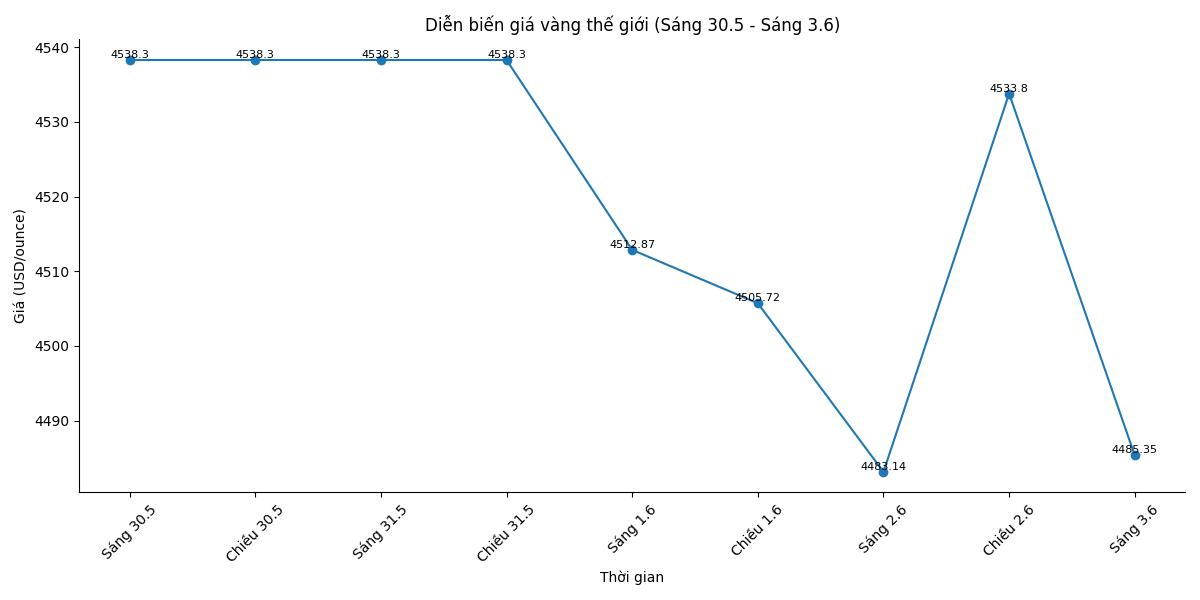
Gold prices went sideways as new fighting in the Middle East increased doubts about the prospect of reaching a peace agreement between the US and Iran to end the war that disrupted global energy flows and raised concerns about inflation.
The precious metal traded around the threshold of 4,490 USD/ounce after falling by 0.6% at one point in the first session of the day before narrowing the entire decrease.
US President Donald Trump said he is optimistic about Washington's ability to soon reach a temporary peace agreement with Tehran. This statement contradicts previous information from Iranian state media that negotiations with the US have been suspended due to the fighting situation in Lebanon.
Meanwhile, a new round of negotiations between Israel and Lebanon is scheduled to take place on Wednesday.
However, military tensions in the region continue to escalate. Iran has launched ballistic missiles targeting Kuwait and Bahrain, although these missiles were intercepted or detonated on the flight path. At the same time, the US Central Command (CENTCOM) said that US forces had conducted airstrikes on Iran's Qeshm Island.
Oil prices continued to rise for the third consecutive session, with Brent oil approaching the threshold of 97 USD/barrel.
Since the US-Iran conflict broke out at the end of February, gold prices have generally fluctuated in the opposite direction to oil prices. The precious metal fell sharply in the early stages of the war and is still about 15% lower than the level right before the conflict broke out. However, in recent weeks, prices have mainly fluctuated in a narrow range.
Prolonged disruptions to energy transportation across the Strait of Hormuz have increased concerns about global inflation. This has led central banks to tend to maintain high interest rates longer or even continue to tighten monetary policy – a disadvantage to gold and non-performing precious metals.
US economic data released on Tuesday showed that the number of job positions recruited in April increased to the highest level in nearly two years, while the number of laid-offs decreased. These figures reinforced expectations that the US Federal Reserve (Fed) will maintain high interest rates for a longer time.
In addition, Ms. Beth Hammack – Chairman of Federal Reserve Bank of Cleveland said that maintaining borrowing costs at the present time is reasonable due to uncertain economic prospects. However, she also warned that the Fed may need to act soon if inflationary pressure continues to remain high.
As of 11:14 am Vietnam time, spot gold prices slightly decreased by 0.12% to 4,485.35 USD/ounce.
On other precious metals markets, silver prices fell 0.6% to 74.60 USD/ounce. Platinum and palladium also slightly decreased. Meanwhile, the Bloomberg Dollar Spot Index - a measure of the strength of the USD - is almost flat.