
In its 2026 commodity outlook assessment report, Goldman Sachs (a leading multinational investment and financial banking corporation in the US, with great influence globally) commented that the need for high-level gold purchases at a structural level from central banks, along with cyclical support from the US Federal Reserve (Fed) cutting interest rates, will continue to push gold prices up.
The bank maintains its recommendation to hold a buying position for the precious metal.
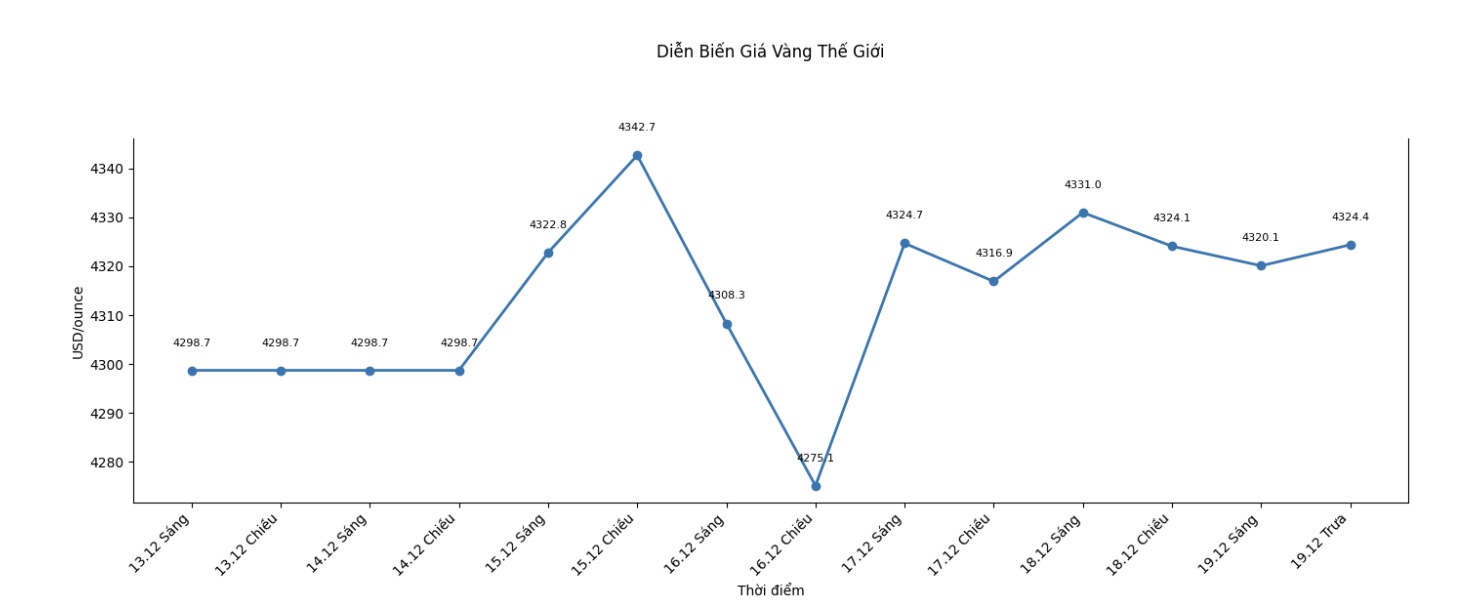
For gold, Goldman expects prices to move sideways in 2026 and average $11,400/ton in the base scenario, on the assumption that uncertainty over tariffs will continue until the US could announce a tax on refined copper in 2027, which could be announced in mid-2026.
Despite the recent increase in copper prices and the prospect of an adjustment, moving sideways in 2026, copper is still our favorite industrial metal, especially in the long term. The electrification process which accounts for nearly half of copper demand shows very strong structural demand growth, while supply from copper mines is facing specific limitations Goldman emphasized.
The three-month gold price on the London Metals Exchange (LME) was unchanged, at 11,721.5 USD/ton at 5:23 p.m. GMT on Thursday. Previously, prices set a record of 11,952 USD/ton last week.
Regarding oil, Goldman Sachs forecasts that Brent and WTI oil prices will continue to decrease, with the average in 2026 being 56 USD/barrel and 52 USD/barrel respectively.
In the absence of major supply disruptions or output cuts from OPEC, lower oil prices in 2026 are likely to be necessary to rebalance the market after 2026, the report said.
At 5:11 p.m. GMT on Thursday, Brent oil was traded at 60.04 USD/barrel, while US WTI crude oil was at nearly 56.46 USD/barrel.
Goldman predicts oil prices will bottom out around mid-2026, as the market begins to expect a rebalancing process. The bank believes that this development will be driven by stable demand growth of about 1.2 million barrels/day, the possibility of Russian supply continuing to decline if the conflict in Ukraine and sanctions continue, along with the slowdown of output outside OPEC (excluding Russia).
We see a net downside risk for the oil price outlook for 20262027, Goldman noted.
However, banks are expecting oil prices to recover in the fourth quarter of next year, as the market begins to reflect the possibility of returning to a state of shortage in the second half of 2027 and shifting focus to encouraging investment in long-term production projects. Accordingly, Brent and WTI prices are expected to gradually recover to $80/barrel and $76/barrel, respectively, by the end of 2028.
For natural gas, Goldman Sachs forecasts gas prices at Europe's TTF in 2026 at €29/MWh and in 2027 at €20/MWh, to encourage additional gas consumption. Meanwhile, gas prices in the US are forecast to be high enough to boost output growth, at $4.6/mmBtu for 2026 and $3.8/mmBtu for 2027.
The bank also said it expects the contingency capacity of the US power system to continue to decline, as demand for electricity increases rapidly and the closure of coal plants far exceeds the speed of building renewable power sources and electricity.
"As a result, the US electricity market faces the risk of sharp price increases, even power outages. This risk is especially serious in local power markets where data centers are booming, with 72% of US data centers concentrated in just 1% of the nation, Goldman Sachs concluded.


