
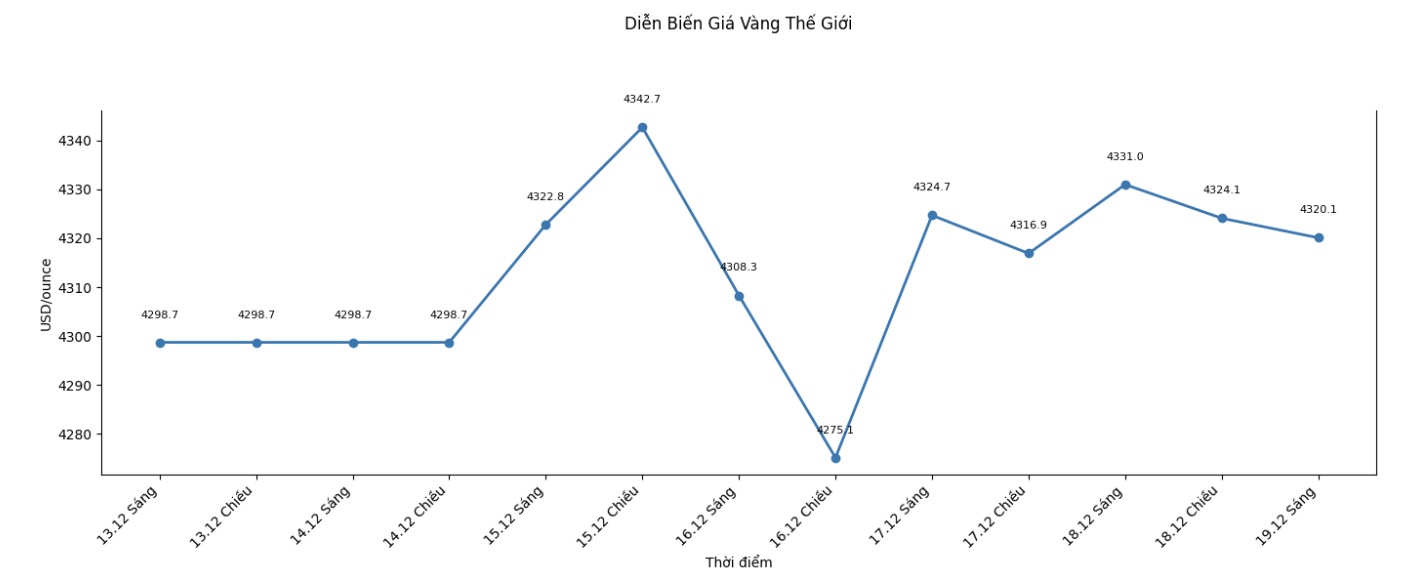
Gold prices turned slightly down in the trading session when gold futures closed down 7.5 USD, equivalent to 0.17%, to 4,364.5 USD/ounce. While it previously set a new record peak for the day at $4,409.5 an ounce.
This modest adjustment comes as the market receives lower-than-expected US inflation data, thereby temporarily weakening safe-haven demand.
The US Department of Labor said the consumer price index (CPI) in November increased 2.7% year-on-year, significantly lower than the forecast of 3.1%, according to a Reuters survey.
This "lowing" inflation data has initially put pressure on gold prices, as investors adjusted their expectations for the monetary policy of the US Federal Reserve (Fed) in the coming time.
After the report, the federal interest rate futures market showed a slight increase in the probability of the Fed cutting interest rates at the January meeting. However, the change is insignificant.
The CME FedWatch tool still shows that the possibility of the Fed keeping interest rates unchanged in January is at 73.4%, almost not much different from before the data was released. This relatively reserved policy has helped limit the decline in gold prices, despite the surprise from inflation data.
According to analysts, gold's decline has been curbed by many existing supporting factors for demand for precious metals. Most notably, escalating diplomatic tensions between the US and Venezuela have increased geopolitical risks in global markets.
Historically, gold has often benefited from international uncertainty as investors seek assets that are considered a place to store value during the period of uncertainty.
The stability of gold prices is clearly shown in the closing price of the trading session. Despite cooling inflation data - a factor that often causes disadvantages for non-yielding assets - gold still recorded the third highest closing price in trading history.
This shows the complex interweaving of factors supporting the precious metals market, including prolonged geopolitical risks, a relatively loose global monetary environment, and structural demand from both institutional and individual investors.
Technical analysts say that gold has maintained a record high, even as economic data has reduced expectations of short-term interest rate cuts, reflecting the market's significant foundational strength.
The slight decrease of 0.17% was mainly the usual profit-taking activity after the new price was tested, not a sign of the change in the uptrend that dominated the gold market throughout 2025.
Looking ahead, investors still expect gold to soon challenge and even surpass the peak of 4,409.50 USD/ounce in the coming sessions.
The combination of geopolitical instability, doubts surrounding the Fed's policy normalization speed, and sustained demand from central banks and investors shows that the main trend of gold is still upward, although there may be short-term accumulation periods.
The interaction between inflationary developments and geopolitical factors is likely to continue to dominate short-term fluctuations in the precious metals market. However, the overall outlook is still considered favorable for gold's next price increase as 2025 gradually closes.
See more news related to gold prices HERE...


