
Although gold prices had a recovery wave at the end of last week, many experts still believe that the market in the short term still contains many risks and is not solid enough to establish a sustainable upward trend.
In the context of investors preparing to welcome a series of important economic data from the US, along with fluctuations from the USD, stock market and geopolitical tensions, some analysts are leaning more towards caution than early optimism.
Mr. Aaron Hill - Market Analysis Director at FP Markets - said that it is still too early to really worry about the inflation shutdown, but such concerns may continue to increase next week as the market receives important manufacturing data.
According to him, concerns about inflation only really overwhelm the risk of inflation simply due to energy when growth figures weaken significantly, such as PMI falling or unemployment rising.
He noted that according to the classic model of the 1970s, this scenario often puts pressure on gold in the short term before the precious metal can regain its prominent role. That also means that at the present time, gold may not immediately enter a period of continuous strong increase.
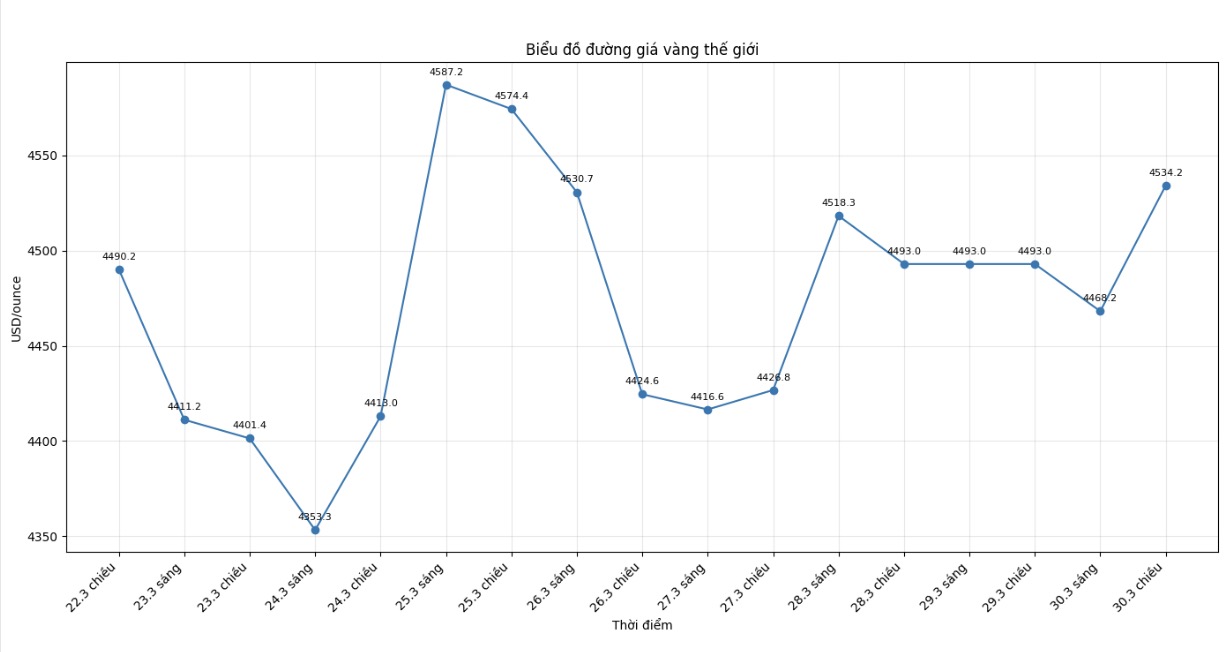
Not only cautious about macroeconomic factors, Aaron Hill also believes that gold still needs to improve technically before it can attract a more sustainable upward momentum.
According to him, the strong upward momentum in the week from below 4,100 USD is more like a liquidity sweep than a bottom-fishing confirmation signal. To form a sustainable price base, the market may need to retest or maintain the 4,200 - 4,300 USD zone with stronger momentum, before it can develop a convincing enough upward momentum towards higher levels.
This view shows that Mr. Hill has not denied the possibility of gold continuing to increase, but he also does not think that just a short recovery is enough to confirm the new trend.
Sharing the same cautious tone, Mr. Marc Chandler - Managing Director at Bannockburn Global Forex, said that spot gold prices held above the 200-day moving average around the 4,982 USD threshold in the first session of the week, but subsequent recovery efforts were blocked when the price only edged up above 4,602 USD in the middle of the week.
According to him, if this milestone is surpassed, the new technical signal becomes more positive and gold may head towards the 4,760 USD zone. Conversely, if the conflict with Iran escalates, the price may completely return to the old bottoms.
He also pointed out a short-term support zone in the range of 4,350 - 4,375 USD, implying that the market is still facing the risk of correction if support conditions are not strong enough.

Notably, Marc Chandler also mentioned the possibility that the market will see capital flows from the financial needs of oil exporting countries in the Middle East. According to him, there is speculation that if these countries need revenue, they may be selling US Treasury bonds and gold.
Although this is just a hypothesis, this assessment partly reflects the vigilance of analysts in the face of unpredictable factors that could cause unfavorable gold price fluctuations in the short term.
Among the experts cited, Mr. Alex Kuptsikevich - senior market analyst at FxPro, expressed a clearer pessimistic view. He believes that gold prices may fall again next week, even though the market ended the week in a positive direction after a strong sell-off at the beginning of the week.
According to him, the downward stock market and rising USD are creating a very unfavorable environment for gold. In such a context, gold's upward momentum is usually not long-lasting and is mainly explained by safe-haven demand. He also warned that when market sentiment worsens, margin call orders will eventually appear and this may continue to put pressure on gold prices.
Alex Kuptsikevich also recalled a typical example in early 2020, when gold once rose sharply after information about the COVID-19 epidemic, before falling at the same pace as stocks. From there, he believes that the view on gold should only shift to a more positive direction when clear signals appear from major central banks showing that they are ready to ease monetary policy. In other words, according to him, the market currently does not have enough macroeconomic foundation to ensure a sustainable and strong increase in gold.


